
Ask most homeowners across the West Midlands what a soffit actually is, and you'll frequently get an uncertain answer. Gutters get attention because they're the visible source of overflow during heavy rain. Fascia boards get attention because they're the component gutter brackets attach to, and their failure is directly linked to gutter detachment. Soffits, positioned beneath the fascia and running horizontally along the underside of the roof overhang, get considerably less attention than either — despite performing a genuinely essential function that, when compromised, creates consequences extending well beyond simple cosmetic deterioration.
This is a dedicated guide to soffit damage specifically — what soffits actually do, why they're consistently overlooked relative to gutters and fascia boards, the specific mechanisms by which they deteriorate, and the early warning signs every West Midlands homeowner should recognise and act on before soffit damage progresses into the roof structure, pest infestation, or ventilation failure that untreated soffit deterioration eventually produces.
📞 WOW Gutters Ltd — Birmingham's fascia and soffit specialists: 07421 433910
Free quote · Before and after photos on every job · Fully insured
Table of Contents
- What Soffits Actually Do and Why They Matter
- Why Soffits Get Less Attention Than Gutters and Fascia
- How Soffit Damage Actually Develops
- The Ventilation Problem Most Homeowners Never Consider
- Pest Entry: The Consequence Nobody Connects to Soffit Damage
- Early Signs of Soffit Damage You Can Check From the Ground
- Signs That Require a Closer Professional Look
- Material Types and How Their Damage Patterns Differ
- What Happens When Soffit Damage Goes Unaddressed
- How Soffit Damage Connects to Gutter and Fascia Condition
- What Proper Soffit Assessment and Maintenance Involves
- FAQ: Soffit Damage in West Midlands Properties
What Soffits Actually Do and Why They Matter
The roofline of a typical West Midlands property consists of several distinct components working together, and it's worth being precise about where the soffit sits within this system and what specific job it performs, because that specificity is exactly what most homeowners lack when trying to understand why soffit condition genuinely matters.
The fascia board runs vertically along the edge of the roof, directly behind the gutter, providing the fixing point for gutter brackets and forming the visible vertical face most people associate with the roofline when looking at a property from the street. The soffit sits beneath the fascia, running horizontally rather than vertically, closing the gap between the top of the external wall and the underside of the roof overhang — essentially forming the underside "ceiling" of the roof eave, visible when looking directly upward at the roof overhang from below rather than from a typical street-level viewing angle.
This horizontal positioning gives the soffit two genuinely distinct and important functions that neither the fascia nor the gutter perform. First, it provides physical protection for the roof structure above it — specifically the rafter ends and the roof timbers that would otherwise be exposed to weather, pest access, and general environmental exposure if the underside of the roof overhang were left open. Second, and less widely understood, soffits typically incorporate ventilation — either through a continuous ventilation strip built into the board, or through discrete circular or slotted vents positioned at intervals along the soffit's length — that allows air to circulate into the roof void from outside, a function that's genuinely critical to preventing condensation and moisture buildup within the loft space, as covered in more detail later in this article.
A soffit performing both of these functions properly is, like most well-functioning building components, essentially invisible in its effect — the roof structure stays protected, the loft ventilates correctly, and nobody has any particular reason to think about the soffit at all. A soffit that has begun to fail at either function creates consequences that frequently show up somewhere else entirely, in ways that don't immediately point back to the soffit as the underlying cause.
Why Soffits Get Less Attention Than Gutters and Fascia
There's a specific, structural reason soffits receive considerably less homeowner attention than the other roofline components, and understanding this reason is useful because it explains exactly why soffit damage tends to progress further before being noticed than equivalent fascia or gutter problems.
Gutters produce an obvious, unmissable symptom when they fail — overflow during heavy rain, visible from ground level without any deliberate effort to look for it. Fascia boards, while less immediately obvious, are at least positioned vertically and facing outward, meaning a homeowner glancing up at their property from a normal street-level vantage point has at least some chance of noticing visible discolouration or paint deterioration without needing to adopt an unusual viewing angle.
Soffits, by contrast, are positioned horizontally and face downward, meaning they're essentially invisible from a standard street-level viewing angle entirely. Seeing a soffit properly requires either standing directly beneath the roof overhang and looking straight upward — an unusual viewing angle that most homeowners simply never adopt during normal daily activity — or viewing the property from an elevated position, such as from an upstairs window of a neighbouring property or from directly across the street at a specific angle that happens to provide a partial view underneath the eave.
This structural invisibility means soffit damage genuinely can and does progress considerably further before being noticed than equivalent damage to a gutter or fascia board would, simply because nobody is naturally positioned to observe it during the course of ordinary daily life. A soffit that has been deteriorating steadily for several years can remain entirely unnoticed by a homeowner who has never had any specific reason to look directly upward at their own roof overhang, right up until the deterioration becomes severe enough to produce a secondary symptom elsewhere — a pest entering the roof void, a patch of damp appearing on an upstairs ceiling, or a piece of soffit board visibly detaching and becoming impossible to ignore.
Read more: Hidden Gutter Damage Is Easier to Spot in Summer · Is Your West Midlands Home Quietly Storing Water Damage Right Now?
How Soffit Damage Actually Develops
Understanding the specific mechanism by which soffit damage develops is genuinely useful for recognising early signs, because the process follows a reasonably consistent and predictable pattern across most West Midlands properties, whether the soffit material involved is timber, uPVC, or a composite board.
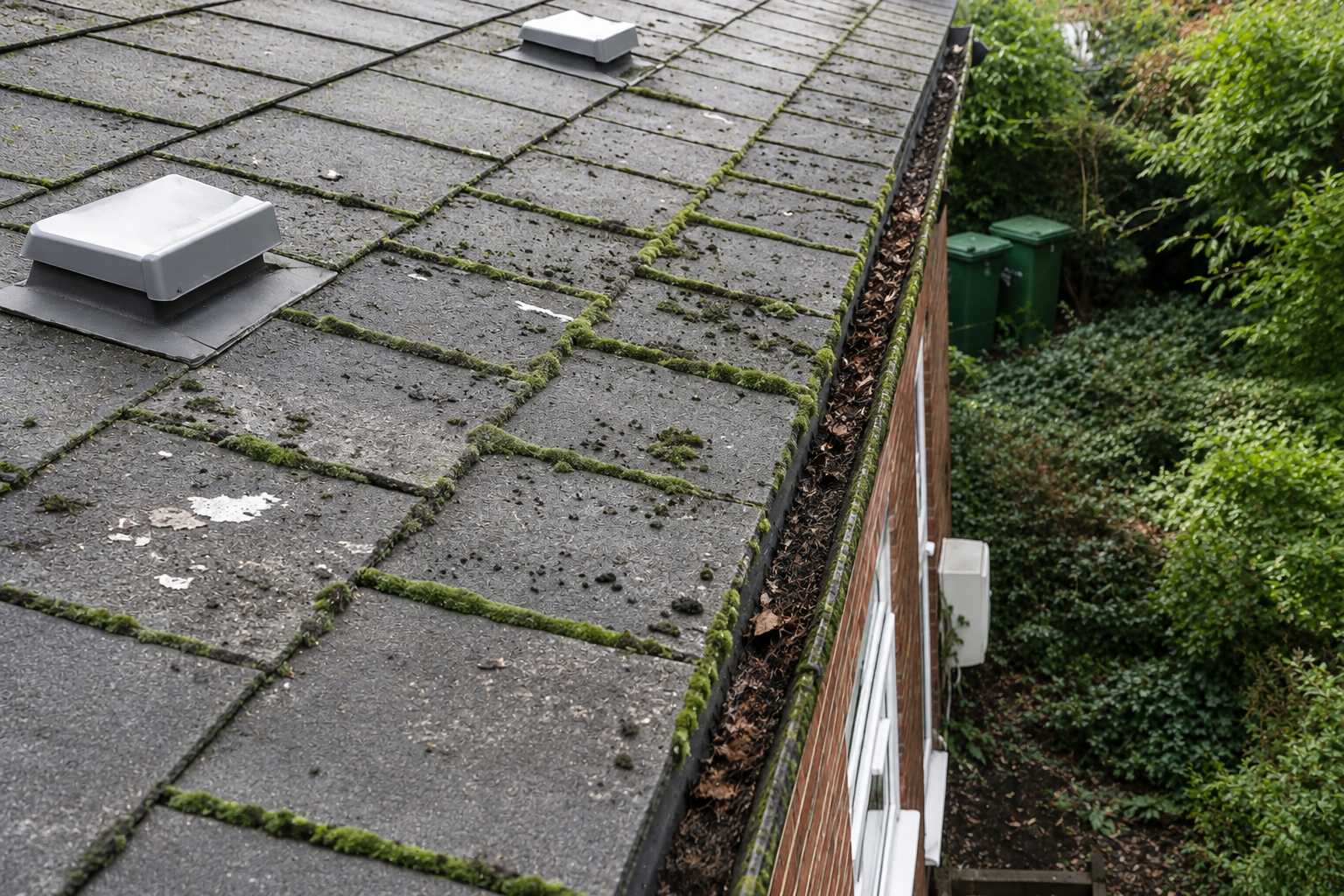
The most common starting point for soffit damage is moisture reaching the board from above, typically originating from a compromised gutter or a failing joint in the guttering system positioned directly above the soffit. Water that overflows a blocked gutter, or that tracks through a failing joint seal, doesn't necessarily run straight down the external wall face in every case — a meaningful proportion tracks backward, behind the fascia board, and reaches the soffit from above rather than from any external, more obviously visible direction. This means soffit moisture exposure frequently originates from precisely the same underlying gutter or fascia problem that a homeowner might already be somewhat aware of, without necessarily connecting that awareness to the possibility that the soffit beneath is also being affected by the same underlying issue.
Once moisture reaches the soffit board, the specific deterioration pattern depends considerably on the material involved. Timber soffits absorb moisture directly into the wood fibre, beginning a rot process that typically starts at the point of moisture contact and progressively spreads outward and inward through the board over successive exposure events, following broadly the same softening and structural weakening process that affects timber fascia boards under equivalent moisture exposure. uPVC soffits don't rot in the same direct sense, being a synthetic, largely moisture-resistant material, but they remain vulnerable to a different category of damage — warping and distortion from sustained moisture trapped behind the board where it cannot properly evaporate, discolouration from prolonged damp exposure, and in more severe cases, the fixing points and joints between soffit panels beginning to fail as the surrounding structure they're fixed to deteriorates.
A second, less commonly recognised damage mechanism affects soffits specifically because of their ventilation function rather than direct external moisture exposure: condensation forming from within the roof void itself, working outward through the soffit's ventilation openings and depositing moisture on the underside of the board from the inside rather than the outside. This internal moisture source is covered in more detail in the following section, because it represents a genuinely distinct risk pathway that most homeowners, and even some less thorough maintenance providers, fail to properly consider when assessing soffit condition.
🔍 Soffit damage doesn't announce itself — it develops invisibly, then surfaces somewhere else entirely.
Our fascia and soffit assessment service uses elevated camera equipment to check the underside of your soffits properly — the viewing position most homeowners never adopt.
📞 07421 433910 · 💬 wa.me/447421433910
The Ventilation Problem Most Homeowners Never Consider
This is arguably the single most overlooked aspect of soffit function and soffit-related risk across West Midlands properties: soffits aren't simply a protective covering for the roof structure — they're an active, functional component of the roof's ventilation system, and when that ventilation function is compromised, the consequences can be genuinely serious, extending well beyond the soffit board itself into the roof structure and insulation above it.
Roof voids, whether occupied as usable loft space or simply left as an unoccupied void above the ceiling insulation, generate a certain amount of moisture from within the living space below through normal daily activities — cooking, bathing, and general occupancy all produce water vapour that rises and, without adequate ventilation, can accumulate within the roof void rather than dispersing harmlessly outside. Proper soffit ventilation allows a continuous flow of outside air into this roof void, carrying accumulated moisture away and preventing the kind of sustained internal condensation that would otherwise develop, particularly during colder months when the temperature differential between the warm, moist internal air and the cold external roof structure is most pronounced.
When soffit ventilation becomes blocked or compromised — whether through physical obstruction from debris, paint applied carelessly over ventilation openings during a redecoration project, insulation material inadvertently pushed too far toward the eave during a loft insulation upgrade and blocking the airflow path, or simply age-related degradation of the ventilation mechanism itself — the roof void loses its designed capacity to disperse internal moisture properly. This trapped moisture condenses on the cold underside of the roof structure, particularly on the roofing felt or the underside of the roof deck itself, creating exactly the kind of sustained dampness that promotes timber rot in the roof structure, encourages mould growth within the loft space, and in more severe, prolonged cases, can compromise roof insulation effectiveness as damp insulation material loses much of its thermal performance.
This ventilation-related consequence is genuinely distinct from the external moisture exposure damage mechanism described in the previous section, and it means that soffit assessment for West Midlands properties needs to consider both directions of potential moisture problem — external moisture reaching the soffit from a compromised gutter or fascia above, and internal moisture affecting the roof void from inadequate soffit ventilation below — rather than assuming that a soffit showing no obvious external staining or discolouration is necessarily functioning correctly in every respect.
Pest Entry: The Consequence Nobody Connects to Soffit Damage
Beyond moisture-related deterioration, soffit damage creates a genuinely distinct and often overlooked secondary consequence: it provides a direct entry point for pests into the roof void, a connection that most homeowners simply don't make when they first notice evidence of pest activity in their loft space.
A soffit board that has deteriorated sufficiently to develop gaps, warping, or areas of structural compromise creates physical openings that birds, squirrels, and various insects can exploit to gain access to the roof void from outside. This is a particularly common issue with ageing timber soffits that have begun to rot at specific points, and with uPVC soffits where panel joints have started to separate due to underlying structural movement or fixing failure, creating gaps that weren't present when the soffit was originally installed correctly.
Once pests gain entry through a compromised soffit, the consequences extend well beyond the immediate nuisance of unwanted wildlife in the roof void. Bird and squirrel activity within a loft space can cause genuine physical damage to insulation, electrical wiring, and roof timbers, while nesting material introduced by birds specifically can itself contribute to the kind of blocked ventilation and moisture-retention problems described in the previous section, compounding the original soffit damage that allowed entry in the first place. Insect activity, while generally less immediately destructive than bird or squirrel access, can indicate and exploit the same underlying moisture and timber softening conditions that soffit damage creates, particularly wood-boring insects attracted to timber that has already begun softening from moisture exposure.
This pest-entry consequence is a genuinely useful diagnostic signal in its own right — a homeowner who notices evidence of bird or squirrel activity in their loft space, or who hears unexplained sounds from the roof void that suggest wildlife presence, should specifically consider soffit condition as a likely entry point, even if the soffit itself hasn't been the primary suspect when the pest activity was first noticed.
Early Signs of Soffit Damage You Can Check From the Ground
Despite the structural invisibility challenge described earlier in this article, several signs of developing soffit damage genuinely are detectable from ground level with a bit of deliberate observation, without requiring specialist equipment or an unusual viewing position.
- Visible sagging or an uneven line along the underside of the roof overhang, noticeable when specifically looking upward at the eave from a position that allows a reasonable view underneath it — a properly functioning soffit should present a straight, consistent horizontal line along its full length, and any visible dip, bow, or unevenness indicates structural compromise at that specific point.
- Paint deterioration on the visible underside surface of the soffit, including peeling, bubbling, or flaking paint that's disproportionate to the general external paintwork condition elsewhere on the property, often indicating moisture reaching the board from either the external overflow source or the internal condensation source described earlier in this article.
- Visible gaps or separation between soffit panels or sections, particularly on uPVC installations where individual panels join together along the soffit run, indicating either fixing failure or underlying structural movement in the fascia or roof structure the soffit connects to.
- Staining or discolouration visible on the soffit's underside, distinct from general weathering and typically presenting as a darker patch or streak pattern that follows the path water has been tracking along or through the board, similar in character to the fascia staining patterns described throughout our broader guidance on hidden gutter and roofline damage.
- Evidence of pest activity around the soffit line specifically, including visible gaps where wildlife appears to be entering, droppings or nesting material visible at the soffit edge, or gnaw marks on timber soffits consistent with squirrel or rodent activity.
Signs That Require a Closer Professional Look
Beyond what's reasonably detectable from ground level, several additional indicators genuinely warrant a closer, more thorough professional assessment, either because they're not reliably visible from a standard viewing position or because they require the kind of internal roof void access that most homeowners aren't positioned to safely carry out themselves.
- Musty odours or visible mould within the loft space, particularly concentrated near the eaves rather than distributed generally throughout the roof void, can indicate the kind of internal condensation problem described earlier in this article, resulting from compromised soffit ventilation rather than any external moisture source.
- Visible daylight or draughts noticeable from within the loft space at the eave line, when standing inside the roof void and looking toward where the soffit meets the roof structure, can indicate gaps or damage that aren't apparent when viewed from outside the property.
- Unexplained sounds from the roof void, including scratching, scurrying, or bird activity noises, particularly if these sounds seem concentrated near the eave rather than distributed throughout the loft space, warrant investigation of soffit condition as a likely pest entry point.
- A noticeable increase in loft temperature fluctuation or humidity, if this is something the homeowner has any means of monitoring, can indicate compromised ventilation affecting the roof void's ability to manage moisture and temperature as designed.
Any of these signs genuinely warrants a proper professional assessment that includes both external soffit observation and, where practical and safe, some consideration of conditions within the roof void itself, given that some of the most significant soffit-related consequences — ventilation failure and pest entry specifically — produce their clearest evidence from inside the loft space rather than from external observation alone.
Material Types and How Their Damage Patterns Differ
West Midlands properties feature several distinct soffit material types, and understanding which material your property has genuinely affects how damage typically presents and what specific signs are most relevant to watch for.
Timber soffits
Common on older Victorian and Edwardian properties across areas including Bournville, Selly Oak, and Handsworth, timber soffits follow a rot-based deterioration pattern broadly similar to timber fascia boards — moisture absorption leading to progressive softening, beginning at points of direct moisture contact and spreading outward over successive exposure events. These soffits typically show paint deterioration and visible discolouration as relatively early, ground-visible warning signs before the underlying structural softening becomes severe enough to produce sagging or visible gaps.
uPVC soffits
Standard on most newer construction and a common replacement choice when original timber soffits are refurbished on older properties, uPVC soffits don't rot directly but remain vulnerable to warping from trapped moisture, discolouration from prolonged damp exposure, and joint or fixing failure where individual panels meet along the soffit run. Damage on uPVC soffits often presents less obviously through direct visual deterioration of the board material itself, and more through visible gaps, panel separation, or sagging at joint points where the underlying fixing has failed.
Composite and modern ventilated soffit systems
Increasingly common on recent construction and renovation projects across the region, composite and modern ventilated soffit board systems incorporate specifically engineered ventilation strips designed to provide controlled, consistent airflow into the roof void. These systems can suffer from blockage of the specific engineered ventilation pathway — through paint, debris, or incorrect installation — even while the board material itself remains in otherwise good physical condition, meaning ventilation function specifically needs separate consideration from general board condition on properties fitted with this type of system.
What Happens When Soffit Damage Goes Unaddressed
The consequences of unaddressed soffit damage escalate in a reasonably predictable pattern, worth understanding in concrete terms rather than as a vague general warning.
In the earliest stage, moisture reaching the soffit from either an external gutter fault or internal condensation begins the deterioration process described earlier — paint lifting, early discolouration, and in timber soffits, the beginning of the rot process at the point of contact. At this stage, addressing the underlying moisture source, whether that means resealing a failing gutter joint or clearing a blocked ventilation pathway, typically allows the soffit itself to stabilise without requiring replacement.
Left unaddressed through this stage, the deterioration progresses to visible structural compromise — sagging, gaps, or in severe timber cases, sections of board that have softened enough to be genuinely fragile to the touch. At this stage, the soffit typically requires at minimum a targeted repair to the affected section, and depending on the extent of deterioration, potentially a more comprehensive replacement of the affected run rather than a simple point repair.
Beyond this stage, the consequences extend meaningfully beyond the soffit board itself. Structural compromise creates the pest entry pathway described earlier, with the associated wildlife damage risk to insulation, wiring, and roof timbers that follows. Continued ventilation failure, if the underlying cause was blocked airflow rather than external moisture, allows internal condensation to progressively affect the roof structure and insulation above, potentially requiring remediation extending well beyond the soffit itself into genuine roof timber treatment and insulation replacement in the most severe, prolonged cases.
At every stage of this progression, the cost and scope of remediation required increases considerably compared with addressing the same underlying issue at an earlier point, which is precisely the argument for the kind of early sign recognition covered throughout this article rather than waiting for soffit problems to become visually undeniable from ground level.
Read more: How Professional Gutter Cleaning Extends the Life of Your Roofline
How Soffit Damage Connects to Gutter and Fascia Condition
Soffit condition doesn't exist independently of the rest of the roofline system — it's genuinely and directly connected to gutter and fascia condition in ways worth understanding as a complete picture rather than three entirely separate concerns.
As explained throughout this article, a significant proportion of soffit moisture damage originates from the same underlying cause affecting fascia boards — a failing gutter joint or overflow condition tracking water backward behind the fascia and downward to the soffit beneath. This means a proper roofline assessment genuinely needs to consider gutters, fascia, and soffits together as a connected system, rather than treating soffit condition as an entirely separate concern requiring its own independent investigation disconnected from gutter and fascia maintenance.
This connection also means that regular, thorough gutter maintenance — the kind that includes genuine structural assessment of joint condition and fascia observation, rather than simple debris removal — provides meaningful indirect protection for soffit condition as well, by addressing the moisture sources that most commonly cause soffit deterioration in the first place before that moisture has the opportunity to reach the soffit at all.
See also: What Happens During a Professional Gutter Clean? · Fascia and Soffit Cleaning · Can Blocked Gutters Cause Damp?
What Proper Soffit Assessment and Maintenance Involves
Given everything described throughout this article, proper soffit assessment for West Midlands properties should include several distinct elements, ideally carried out as part of a comprehensive roofline maintenance visit rather than as an isolated, separately scheduled task.
- Visual inspection of the soffit's underside for sagging, discolouration, gaps, or evidence of pest activity, ideally carried out using elevated camera equipment that provides genuine visibility of the underside surface rather than relying solely on the limited partial views achievable from ground level.
- Assessment of ventilation function specifically, checking that any ventilation strips or discrete vents are genuinely clear and unobstructed, rather than assuming their presence alone indicates they're functioning correctly.
- Connection to the underlying gutter and fascia condition assessment, recognising that soffit moisture problems frequently trace back to a gutter or fascia issue that needs addressing at the source rather than treating soffit symptoms in isolation.
- Where practical and safe, some consideration of conditions within the roof void itself, particularly checking for evidence of internal condensation, mould, or pest entry that provides the clearest evidence of ventilation failure or structural compromise that external observation alone might miss.
Our fascia and soffit cleaning and assessment service covers exactly this comprehensive scope, recognising soffit condition as a genuine, connected element of overall roofline health rather than an isolated concern.