
Summer in Birmingham has a way of making everything feel fine.
The sun is out. The garden looks decent. The house looks well. And the gutters — well, nobody thinks about the gutters in July. They sit up there, quietly, doing whatever it is gutters do, and most homeowners give them exactly zero attention until October when the leaves start falling and the problems suddenly become impossible to ignore.
Here's the thing. By October, you're already behind. The issues that make autumn so damaging for Birmingham gutters — the moss that's been building since spring, the joint that started weeping in April, the downpipe partially blocked by a bird nest in May, the summer storm debris that compacted into a plug in August — none of those things happened in October. They happened over the months before it. October is just when the rain arrives heavy enough to make them visible.
Summer is the window. It's when everything is dry enough to inspect properly, when debris can be extracted cleanly, when any structural repairs can be done without working in driving rain, and — critically — when there's still time to fix problems before autumn turns them into emergencies.
This is why every Birmingham home needs a gutter health check this summer. Not a quick glance from the ground. A proper, thorough professional inspection of every section of your gutter system, while conditions are as good as they're going to get all year.
WOW Gutters Ltd — Birmingham's gutter specialists
07421 433910What a Gutter Health Check Actually Involves
The phrase "gutter clean" undersells what a thorough professional inspection actually covers. A clean removes debris. A health check does that — and then assesses the structural condition of everything it finds underneath.
A proper gutter health check for a Birmingham property covers:
- Full debris extraction from every gutter channel — leaves, moss fragments, seed casings, silt, and compacted organic matter
- Joint inspection — every joint along every run, checked for seal failure, cracking, or water tracking
- Bracket and fixing assessment — looking for brackets that have pulled from the fascia, are visibly corroded, or are no longer supporting the gutter at the correct fall angle
- Gutter fall verification — gutters should run at a slight angle toward the downpipe outlet; a sagging section, even a subtle one, creates a low point where water pools and debris accumulates permanently
- Downpipe flow testing — water run through every downpipe to confirm unobstructed flow from gutter channel to ground drain
- Fascia board condition — the boards behind the gutter brackets; any softening, discolouration, or rot is flagged
- Roof edge and flashing observation — identifying any visible issues at the point where the roof meets the gutter, where water ingress most commonly begins
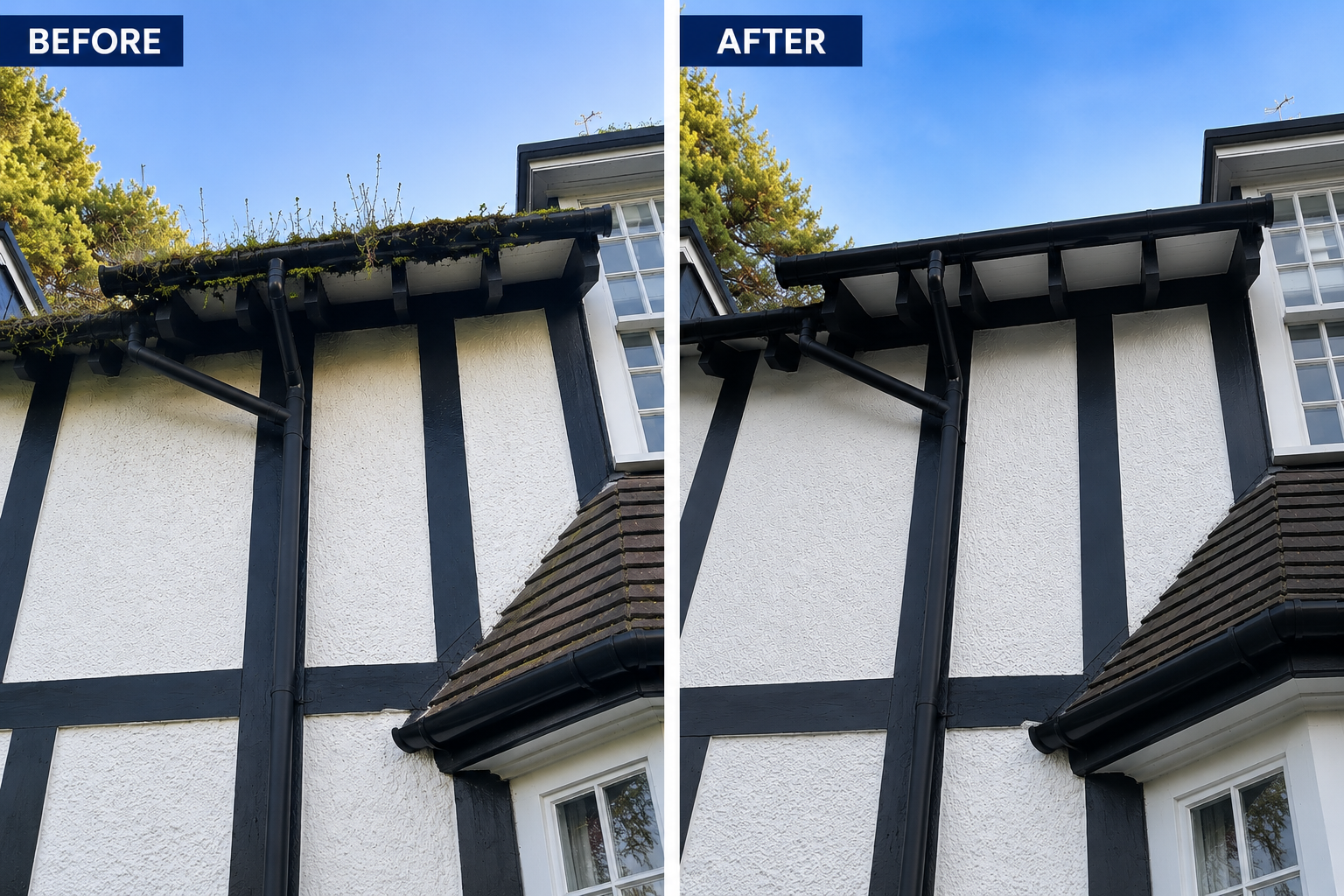
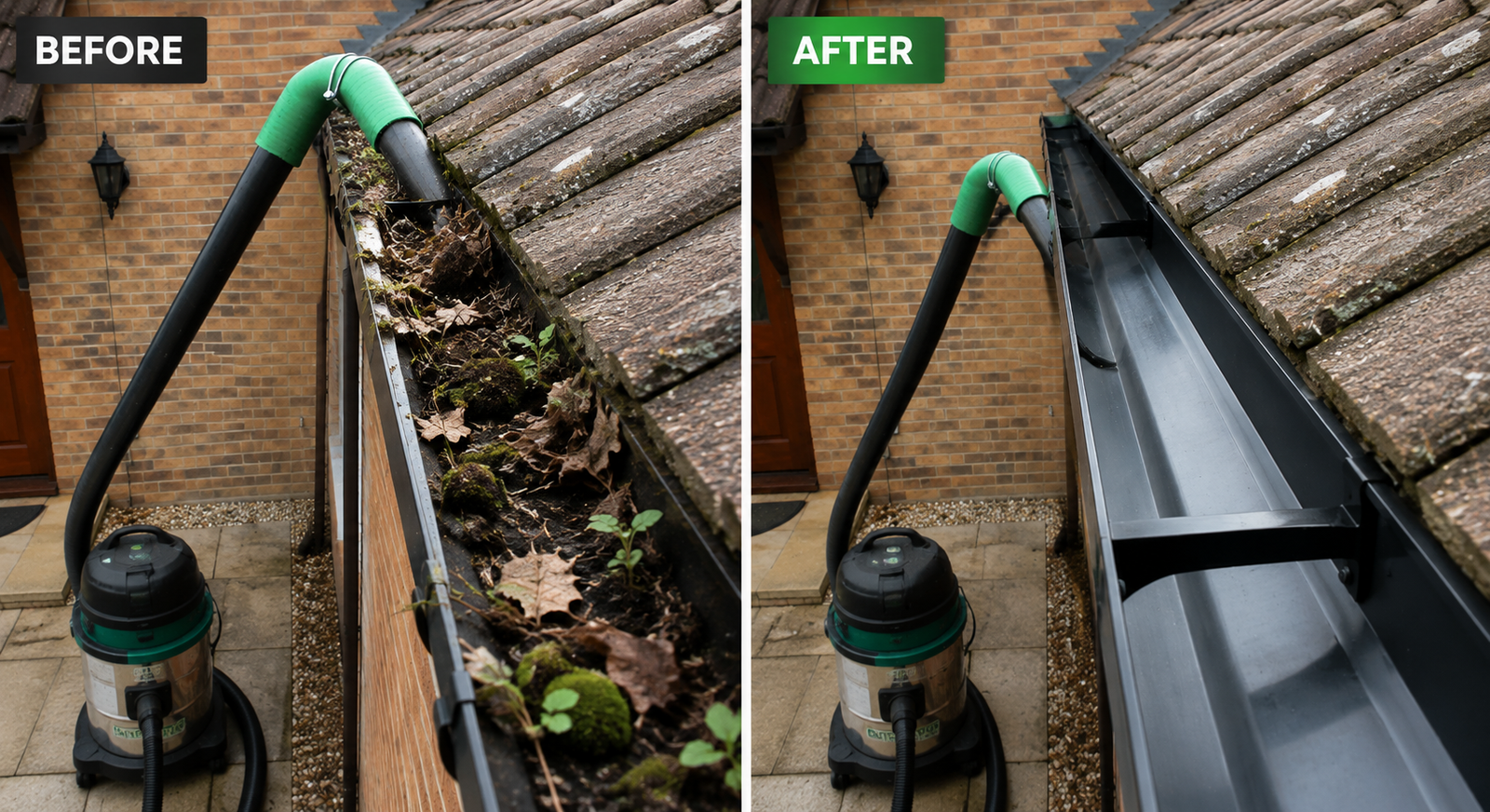
- Before and after photographic documentation — every section recorded so you have a complete visual record of what was found and what was done
That's what a gutter health check is. Not a quick sweep. A complete assessment of the drainage system that protects your home from water damage — carried out while conditions are dry enough to do it properly.
Why Summer Is the Right Time — Not Autumn
The instinct to deal with gutters in autumn is understandable. Leaves fall, gutters block, the connection is obvious. But acting in autumn means you're responding to a problem that's already developed — often one that's been building for months.
Summer offers something autumn doesn't: time and conditions.
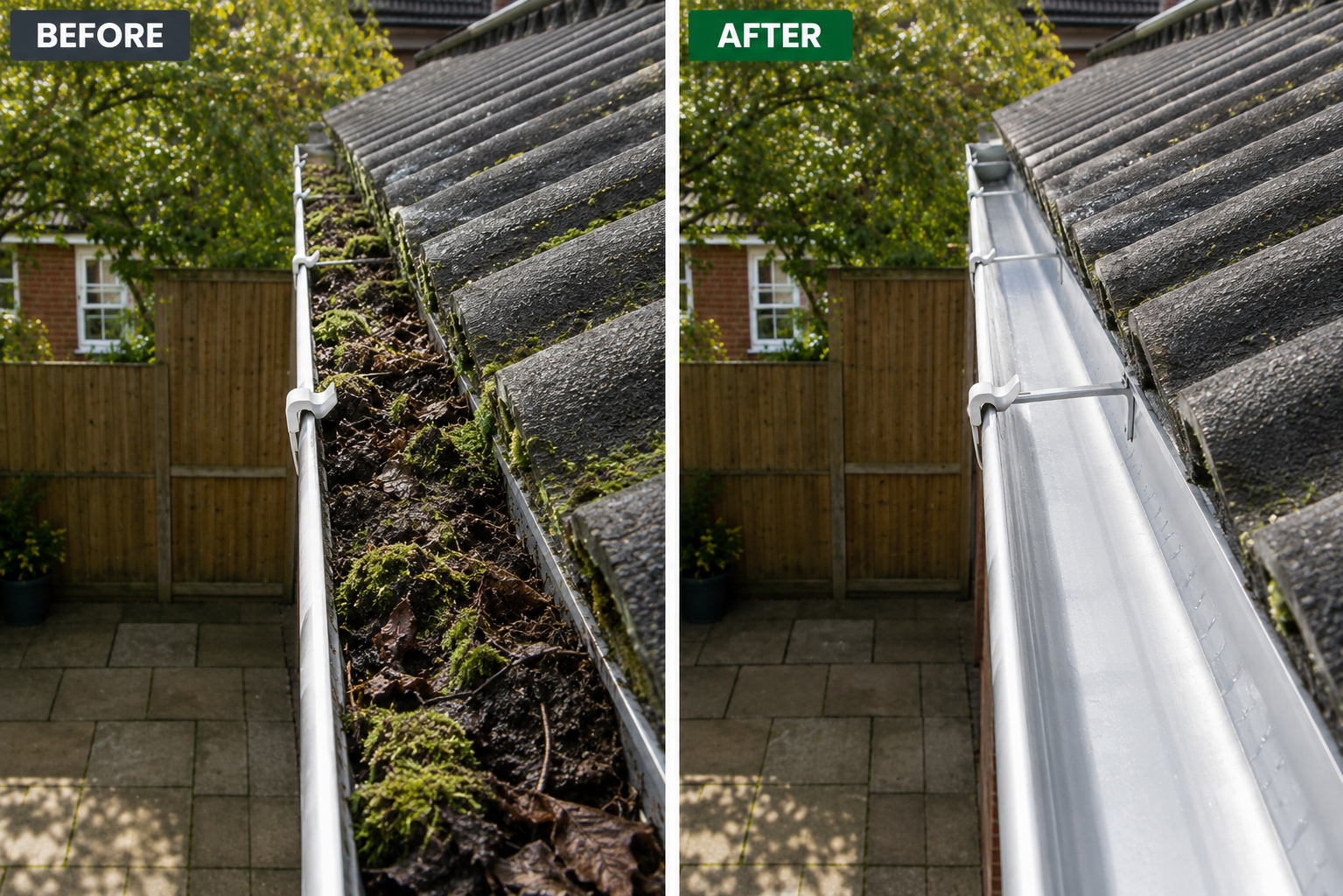
Dry conditions mean better inspection. A gutter cleared in dry summer conditions reveals its actual structural state clearly. A joint that's failed shows staining and residue that's visible and dry. A bracket that's pulling from the fascia is obvious when you can see the fascia board clearly. In November, everything is wet, dirty, and partially obscured by debris. You clear the leaves and you can see roughly what's there — but not with the same clarity as a dry July inspection.
Repairs are practical in summer. If a health check identifies a joint that needs resealing, a bracket that needs replacing, or a downpipe that needs refitting — all of these are straightforward in summer. In November, working on wet fascia boards and cold, wet gutter sections is slow, difficult, and less effective. Sealants don't bond as reliably in cold wet conditions. It's simply better work done in better conditions.
Summer buys you lead time. A health check in June or July that identifies a failing section gives you weeks — possibly months — to address it before the first serious autumn rainfall. A health check in October that finds the same issue leaves you scrambling to fix it during the worst possible weather window.
Summer storm damage needs checking. Birmingham does receive significant summer storms — sudden, intense downpours that can shift debris, dislodge loose brackets, and overwhelm any existing partial blockage. After a heavy summer storm, gutters that appeared to be fine beforehand can be in noticeably worse condition. A summer health check catches this.
The autumn gutter industry is built around reactive maintenance. Summer maintenance is proactive — and it's always cheaper than reactive.
What Happens to Birmingham Gutters Between January and July
Most homeowners assume their gutters are roughly the same condition in July as they were when they were last cleaned. That assumption is usually wrong.
Here's what actually accumulates in a Birmingham gutter between January and the summer months.
January–February: Winter residue. Even a well-cleaned autumn gutter collects winter residue — silt washed from the roof surface, decomposed leaf fragments that survived the autumn clear, and airborne organic matter deposited during winter rain. Frost cycles open minor cracks in sealant and gutter material that admit moisture; when this moisture freezes, it expands the crack further. By February, even a recently maintained gutter has collected several weeks of winter debris.
March–April: Moss active growth season begins. Spring is when roof moss enters its active growth phase. Moss that was dormant through winter — potentially looking relatively flat and dry — begins to expand and thicken as temperatures rise and spring rain arrives. Fragments break off continuously and wash into gutters. If your roof had visible moss coverage in autumn, it has more now.
April–May: Bird nesting season. House sparrows, starlings, and pigeons all nest in and around roof structures. Nesting material — twigs, grass, feathers, and droppings — regularly falls into gutter channels and accumulates at downpipe inlets. Starlings in particular are prolific nesters in the Birmingham area, with dense urban populations across Handsworth, Aston, Lozells, and Erdington. A single nest above a downpipe inlet can significantly restrict flow.
May–June: Sycamore and other seed cases. Birmingham's sycamore trees begin releasing their seed cases (the familiar helicopter seeds) from late spring. These light, winged seeds travel considerable distances in wind and are a primary cause of early-summer gutter blockage. They accumulate quickly, compact under moisture, and are often the hidden base layer beneath later leaf fall that makes autumn blockages so severe.
June–July: Summer storm debris. Any significant summer rainfall flushes accumulated material from the roof surface into the gutter channel, potentially compacting a season's worth of light debris into a consolidated blockage at the downpipe outlet. A gutter that appeared to be coping before a summer storm may be significantly restricted afterward.
That's seven months of continuous accumulation. By the time you get to July, your gutters are not the same as they were after last autumn's clean. A summer health check starts from an honest baseline.
Seven Things a Summer Inspection Will Catch That You Won't See From the Ground
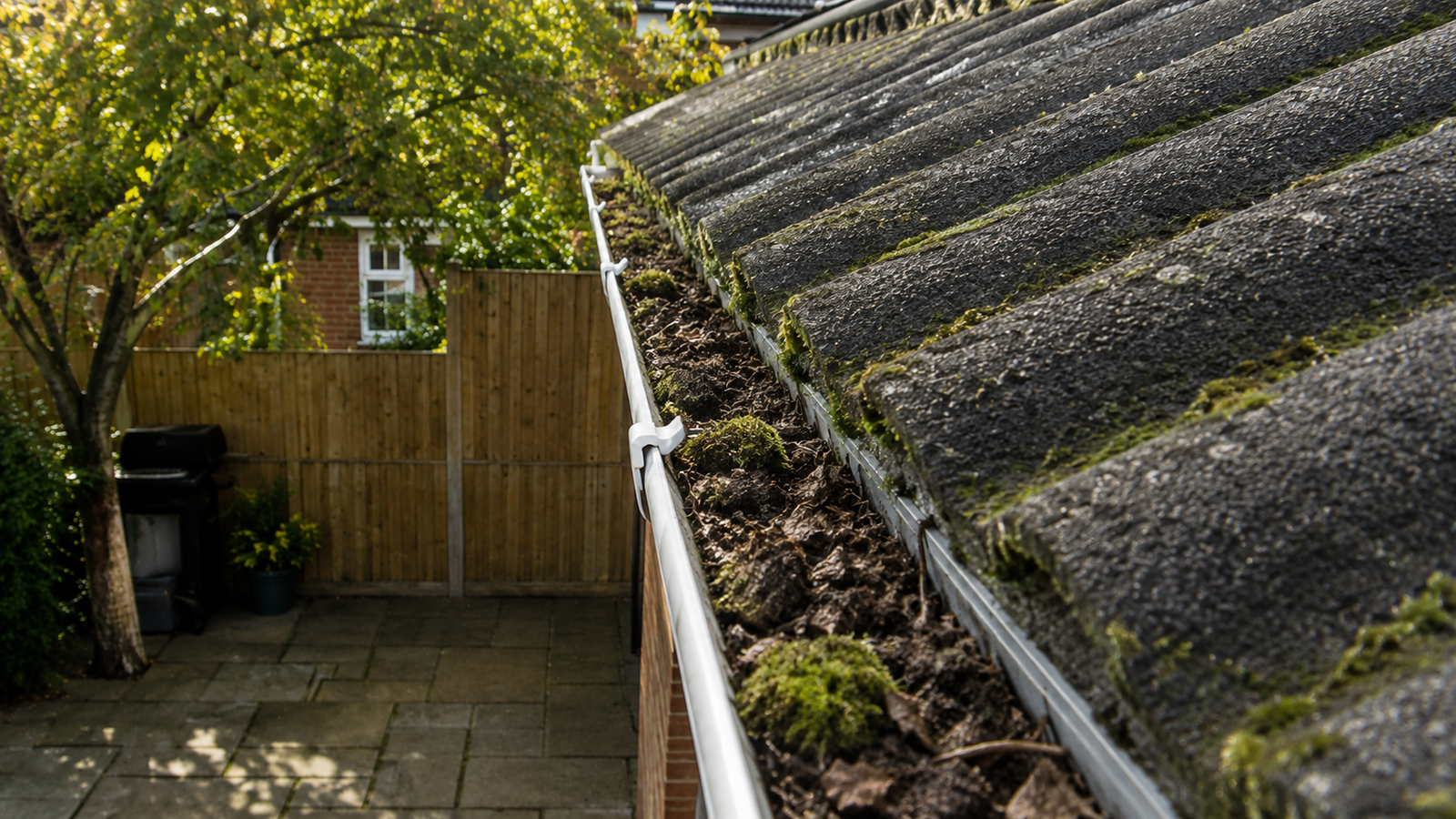
You can learn something from a ground-level inspection — visible sagging, overflow staining on walls, obvious plant growth at the gutter line. But there are seven specific problems that only become visible when you can actually see into the gutter channel, and all of them are things that a summer health check will catch while there's still time to address them.
1. Silt build-up at the gutter base
Fine silt — washed from roof surfaces over months of rain — settles at the base of the gutter channel and hardens. This silt layer is invisible from the ground and doesn't block the gutter in the way that leaves do — it simply reduces the gutter's capacity, leaving less headroom for the heavy rain and debris of autumn. Over several seasons without clearing, silt can account for a significant proportion of the gutter's total cross-section.
2. Partial downpipe blockage
A downpipe that's partially blocked continues to drain — slowly. From the ground, it appears to be functioning because water does eventually leave the gutter. But under heavy rainfall, a partially blocked downpipe cannot keep pace with the flow, and the gutter overflows at the outlet end. This is a common cause of localised overflow that homeowners misdiagnose as a gutter capacity problem when the real issue is a restricted downpipe.
3. Joint sealant failure
Gutter joint sealant has a finite lifespan — typically five to ten years depending on material and conditions. In Birmingham's climate, with its cycle of wet winters and occasional summer heat, sealant can fail invisibly. A joint that looks intact from the ground may be weeping water along its back edge — running down the fascia board, behind the gutter bracket, and soaking the wood over months before any visible external staining appears. A proper inspection from above the gutter line catches this.
4. Bracket corrosion
Cast iron brackets on older Birmingham properties corrode from the inside surface — the part that contacts the gutter and the fascia. This corrosion isn't visible from the ground. A corroded bracket that appears solid may be structurally compromised — one season of heavy leaf load away from pulling out of the fascia entirely.
5. Incorrect fall angle
A gutter must run at a slight downward angle toward the downpipe outlet — typically around 1 in 350 (roughly 3mm per metre). A bracket that has dropped slightly, or was never installed at quite the right angle, creates a low point in the run where water pools permanently. Standing water in a gutter encourages moss and algae growth, accelerates corrosion in metal gutters, and attracts insects. This is only detectable by checking the actual gutter line from above — not from a ground-level inspection.
6. Fascia board deterioration
The fascia board is what the gutter brackets are fixed to. Fascia boards that have been subjected to repeated moisture — from long-term overflow, joint failure, or inadequate roof overhang — soften and begin to rot from the front surface inward. The outside can look presentable while the wood behind it is compromised. A professional checking the bracket fixings will immediately feel whether the fascia is solid or soft. Soft fascia needs addressing urgently — a bracket in rotting wood provides no meaningful support for a loaded autumn gutter.
7. Moss and algae on the gutter interior
Moss and algae that establish inside the gutter channel — on the gutter floor and walls rather than just on the roof above — indicate persistent moisture and restricted drainage. This internal growth contributes to blockage formation and can physically grip debris in the channel, making subsequent cleaning more difficult. It's not visible from the ground and is only found during a proper internal inspection.
Any one of these issues, left unaddressed through summer, becomes significantly harder and more expensive to deal with once autumn rain is falling.
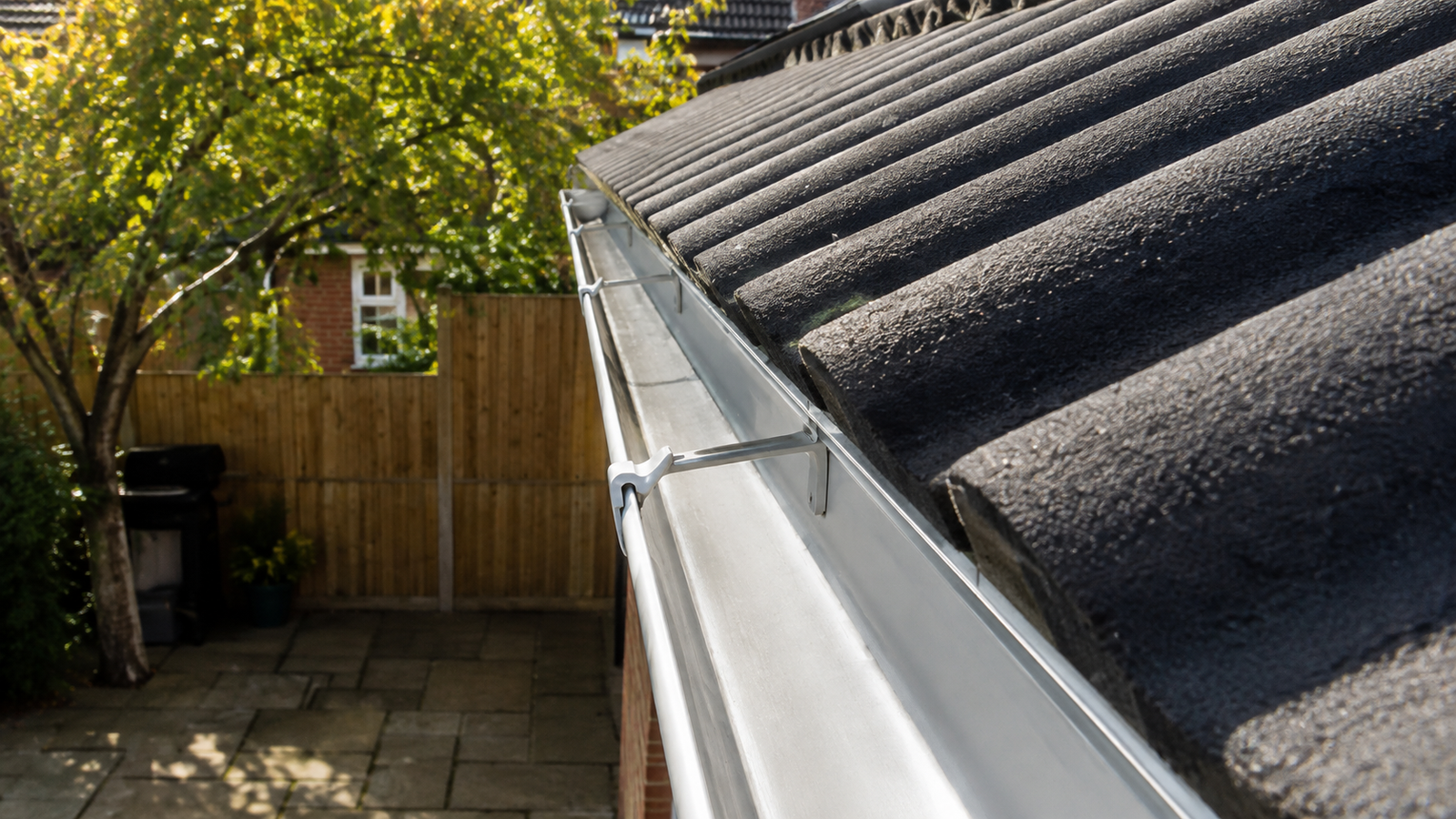
The Properties Most at Risk in Birmingham
While every Birmingham property benefits from a summer gutter health check, some are more exposed than others. If your home falls into any of the following categories, a summer check isn't just advisable — it's urgent.
Victorian and Edwardian terraces. Large swathes of Birmingham — Bournville, Selly Oak, Sparkhill, Handsworth, Aston, Perry Barr, Kings Heath — are characterised by original or early-replacement cast iron or UPVC gutter systems on terraced properties. These homes typically have long, continuous gutter runs shared across several properties, where a blockage in one section affects the entire terrace's drainage. Cast iron gutters on Victorian terraces are also more susceptible to joint failure and bracket corrosion than modern systems.
Properties adjacent to mature trees. The leafy residential streets of Edgbaston, Harborne, Moseley, Sutton Coldfield, and Four Oaks are beautiful precisely because of the mature tree canopy — and that canopy deposits debris into gutters year-round. Sycamore, ash, oak, and lime trees lining these streets mean gutters accumulate faster than in open environments.
Semi-detached properties with shared gutter runs. Semi-detached homes — the dominant property type across Birmingham's suburban areas — often share a central gutter run above the party wall. This central section is frequently the most difficult to access and the most likely to be neglected. Debris accumulates where two roof slopes meet, and a blockage here affects both properties.
Homes with north-facing roof slopes. North-facing roof surfaces receive less direct sunlight, remain damp longer after rainfall, and support moss growth more actively than south-facing slopes. Properties across Sutton Coldfield, Erdington, and Great Barr with significant north-facing roof area typically carry heavier moss loads and shed more moss fragments into gutters year-round.
Rental properties and HMOs. Landlords across Birmingham — particularly in the student rental areas around Selly Oak and Harborne, and the HMO-heavy areas of Moseley, Balsall Heath, and Sparkbrook — are legally responsible for maintaining their properties in good repair. Gutters are a maintenance item. A summer health check provides documented evidence of condition — useful for both compliance and for defending against tenant damp claims that may or may not be gutter-related.
Summer Gutter Health Check vs Emergency Winter Callout
Let's put this in plain terms.
A summer gutter health check from WOW Gutters Ltd is a planned, convenient, unhurried piece of work. It's carried out in good weather. Our operative can see clearly, work thoroughly, and document everything properly. If any issues are found, you have months to address them at your convenience.
An emergency winter callout is the opposite of all of those things. It's reactive, urgent, happening in poor conditions, and usually triggered by damage that's already occurred — water inside the property, a section of gutter detached from the fascia, a downpipe that's burst under ice pressure. The cost is higher. The conditions are worse. And you're fixing problems rather than preventing them.
Between those two options, one is significantly better — and it's the one most Birmingham homeowners don't choose until they've experienced the other one at least once.
Book the summer health check. It's the smarter call every time.
BOOK YOUR SUMMER GUTTER HEALTH CHECK
Free quote — no hidden charges. Before and after photos on every job across Birmingham and the West Midlands.
What WOW Gutters Ltd Checks on Every Visit
When you book a gutter health check with WOW Gutters Ltd, here's exactly what you get.
Our industrial-grade SkyVac gutter vacuum system operates entirely from the ground. No ladders are placed against your property at any point. Our carbon-fibre reach poles extend to four storeys, and the camera inspection head gives our operative a real-time view of every section of your gutter channel — something a ladder-based clean simply cannot provide.
Every health check includes:
- Complete debris extraction using industrial vacuum — leaves, moss, silt, seed cases, nesting material, all removed
- Real-time camera inspection of gutter channel condition throughout the clean
- Downpipe flow test on every outlet — water run through to confirm clear passage to ground drain
- Joint and bracket condition check — any concerns noted and reported
- Fascia board observation — any signs of softening, staining, or deterioration flagged
- Before and after photographs of every gutter run — provided to you after every job without exception
- Written summary of any condition concerns found — so you know exactly what state your gutters are in
We cover all Birmingham postcodes and the wider West Midlands — including Solihull, Sutton Coldfield, Edgbaston, Harborne, Kings Heath, Moseley, Bournville, Erdington, Wolverhampton, Walsall, Dudley, West Bromwich, Coventry, Redditch, Bromsgrove, Worcester, and Kidderminster.
You don't need to be home. Most customers book and get on with their day. We send the before and after photographs directly to you on completion.
FAQ: Summer Gutter Health Checks in Birmingham
Book Your Summer Gutter Health Check Today
Don't wait until the leaves are falling and the rain is hammering down to find out your gutters weren't ready for it.
WOW Gutters Ltd is Birmingham's trusted professional gutter cleaning and inspection service — serving homeowners, landlords, and commercial property owners across the city and the wider West Midlands. Fully insured. Ground-based vacuum system. No ladders. Before and after photographs on every single job.
Summer is short. The window to get ahead of autumn is open right now.
BOOK YOUR SUMMER GUTTER HEALTH CHECK
Free quote — no hidden charges. Before and after photos on every job across Birmingham and the West Midlands.
Call: 07421 433910
Email: support@wowgutters.co.uk
Web: wowgutters.co.uk
Serving Birmingham, Solihull, Sutton Coldfield, Edgbaston, Harborne, Kings Heath, Moseley, Bournville, Erdington, Wolverhampton, Dudley, Walsall, West Bromwich, Coventry, Redditch, Bromsgrove, Worcester, Kidderminster and all West Midlands areas.