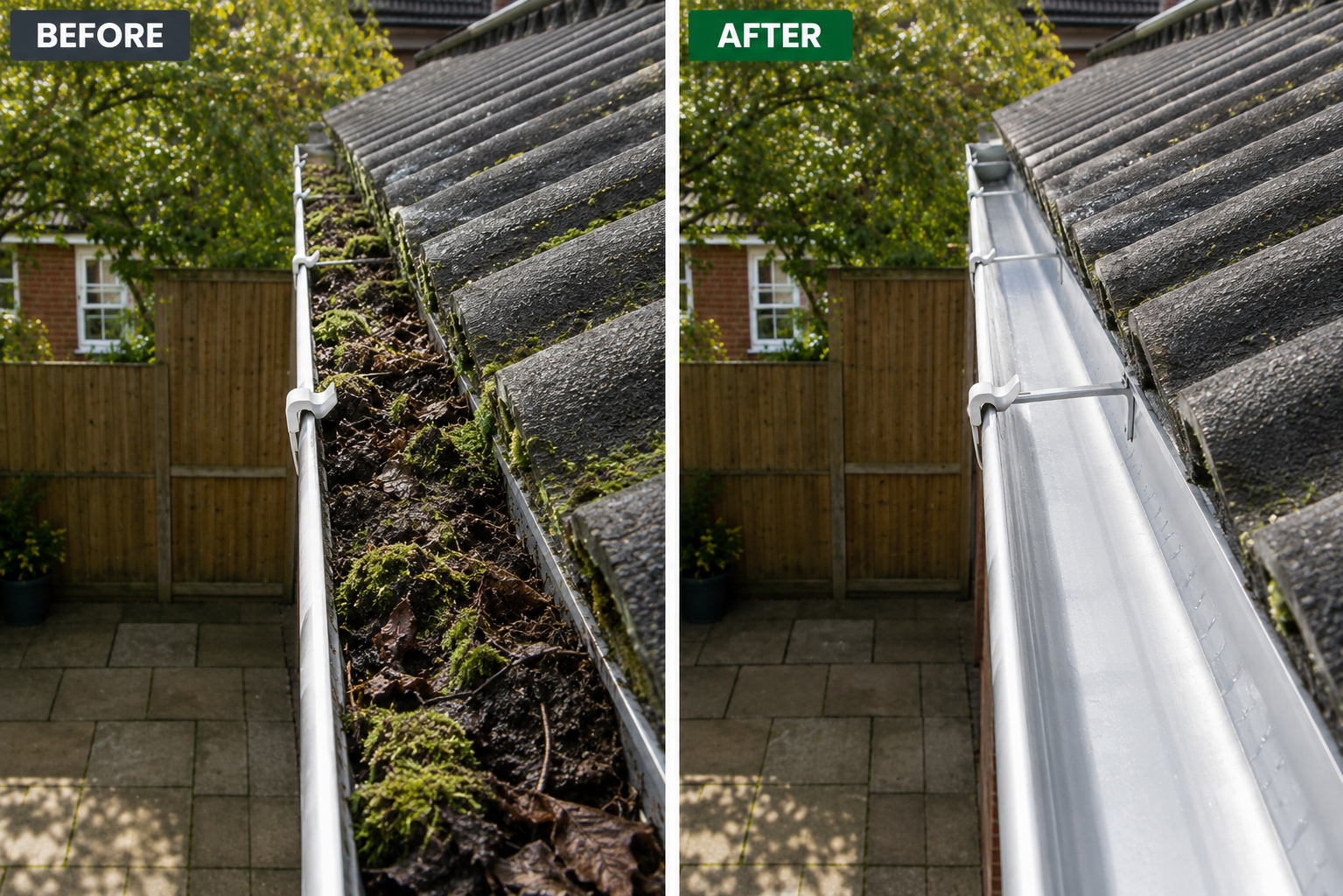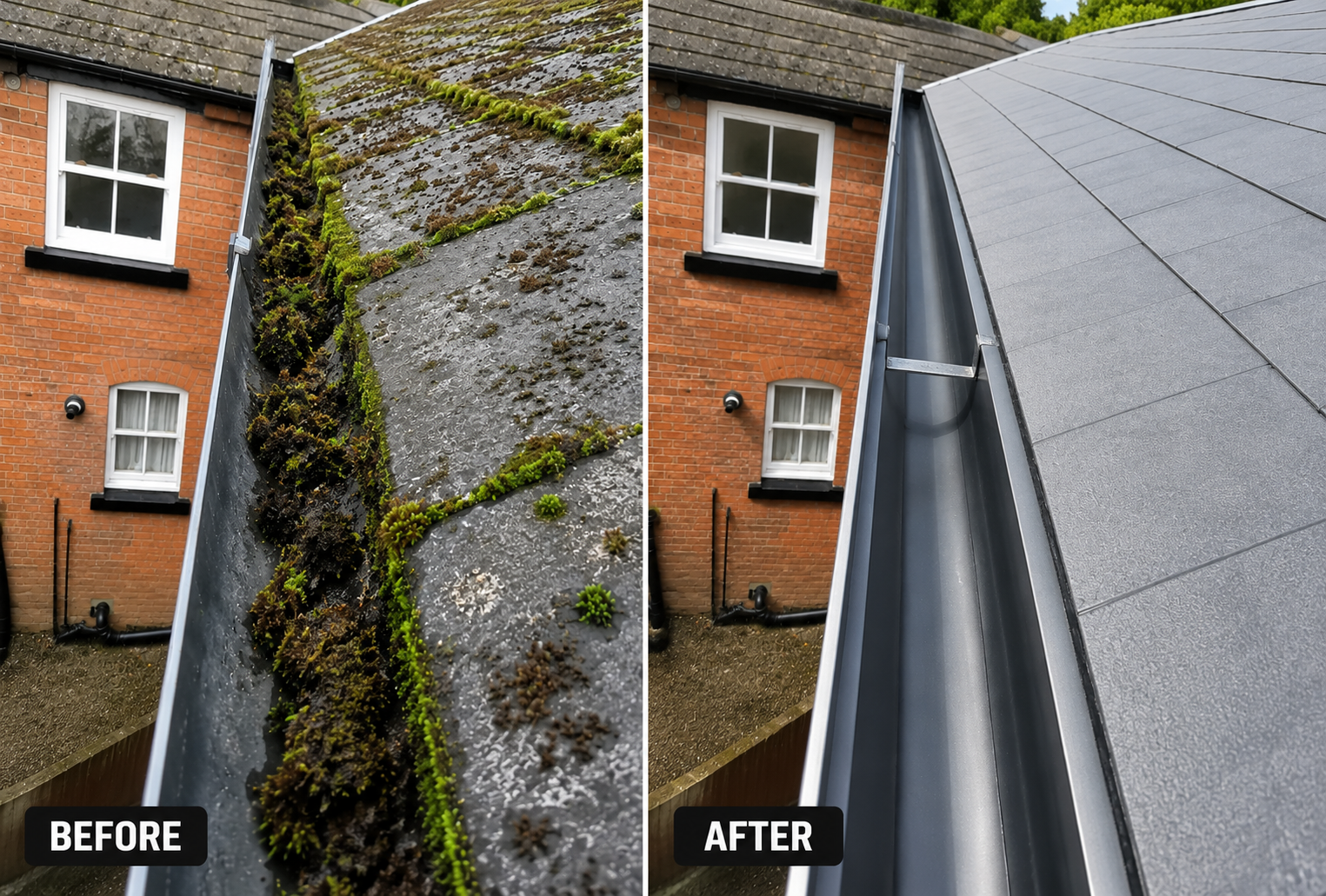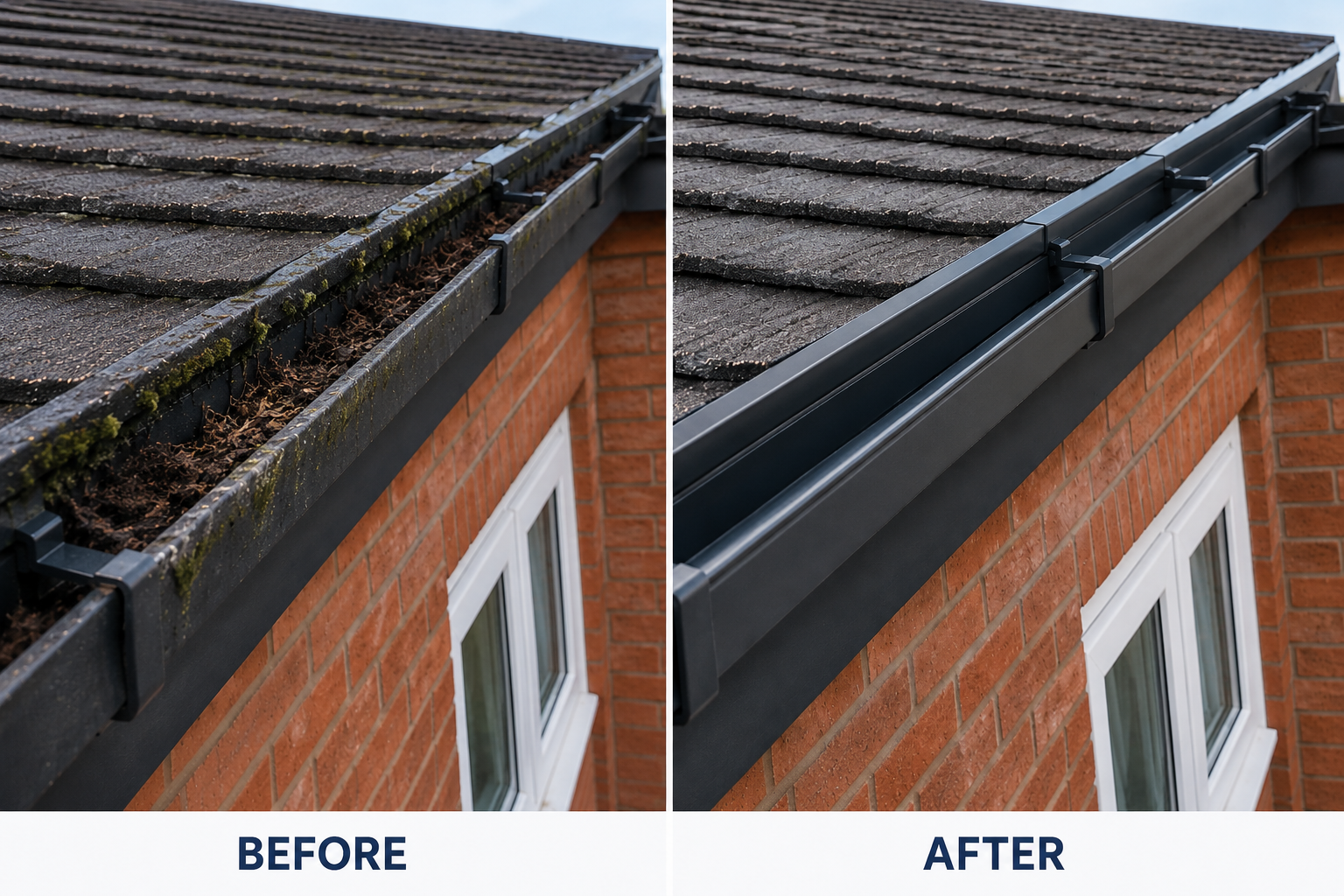

Search for gutter maintenance advice online and almost every article you find assumes the same thing: a pitched roof, a gutter running along the eave, water draining downward under gravity toward a downpipe. This assumption runs through nearly all generic guidance, including a significant proportion of our own content on this website — and for good reason, because it describes the majority of residential roofs across Birmingham.
But it doesn't describe all of them. Extensions, garages, dormer roofs, bay window canopies, and a considerable number of commercial and converted properties across Birmingham and the wider West Midlands have flat roofs, and flat roofs drain water in a fundamentally different way. The maintenance risks are different. The failure points are different. And because almost every gutter guide out there is written with a pitched roof in mind, flat roof drainage tends to get either ignored entirely or lumped in as an afterthought, despite facing genuinely distinct problems that deserve their own dedicated explanation.
This is that explanation. If your property has a flat roof section anywhere — a rear extension, a garage, a dormer, a porch canopy, or an entire commercial flat roof — this article covers exactly what's different about how it drains, what typically goes wrong, and what proper maintenance actually looks like.
WOW Gutters Ltd — Birmingham's flat roof and gutter specialists
07421 433910Why Flat Roof Drainage Is a Completely Different System
The core assumption behind almost all standard gutter guidance is that water reaches the roof edge under gravity, along a sloped surface, and is collected by a gutter running the length of that edge before travelling to a downpipe. This is how a pitched roof works, and it's the model that shapes nearly every piece of advice about seasonal cleaning, leaf clearance, and downpipe testing you'll find online.
A flat roof — which is never actually perfectly flat, but built with a very slight fall of typically 1 in 40 to 1 in 80, barely perceptible to the eye — works on an entirely different principle. Rather than water reaching a single collection point along an eave line, it needs to travel across a much larger, wider surface area toward one or more specific drainage points positioned somewhere within that surface, whether at the edge, in a corner, or in some cases at a central point on the roof itself.
This difference matters enormously for maintenance, because the entire risk profile shifts. On a pitched roof, water that isn't managed correctly overflows a gutter and runs down an external wall — a problem, but a relatively contained and visible one. On a flat roof, water that isn't managed correctly simply sits on the roof surface itself, sometimes for extended periods, creating a completely different category of risk that has nothing to do with gutters overflowing and everything to do with sustained standing water sitting directly on top of the waterproofing membrane that's the only thing keeping that water out of the building below.
This is precisely the gap that most generic gutter guidance leaves unaddressed. A pitched-roof-focused article about seasonal leaf clearance genuinely doesn't apply to a flat roof drainage outlet in any meaningful sense, and a homeowner following that advice on a flat roof section of their property is likely missing the actual risks entirely.
The Types of Flat Roof Drainage Found on Birmingham Properties
Flat roof drainage isn't a single system — it takes several distinct forms across Birmingham properties, and understanding which type your property has is the first step to maintaining it correctly.
Rainwater outlets set into the roof surface itself. This is the most common arrangement on residential flat roof extensions, garages, and dormer roofs across Birmingham. A circular or square outlet, typically fitted with a domed or flat grille to prevent large debris entering, sits at the lowest point of the roof's slight fall and connects directly to a downpipe running down the external wall. Water travels across the roof surface toward this single collection point rather than along a linear gutter.
Parapet gutters, common on commercial and some larger residential properties. Where a flat roof is bordered by a raised wall — a parapet — rather than an open edge, a gutter channel runs along the base of that parapet wall, collecting water that would otherwise pool against it. These are structurally similar in concept to the box gutters found on larger commercial buildings, but scaled for a residential or smaller commercial context.
Box gutters at the junction between a flat roof and an adjoining pitched roof. This is an extremely common arrangement on Birmingham extensions, where a flat-roofed rear addition meets the original pitched roof of the main house. A box gutter runs along this junction, collecting water from both the flat roof section below it and the pitched roof section above, making it one of the highest-risk drainage points on the entire property given the combined water volume it needs to handle.
Internal or siphonic drainage systems, found on some larger commercial flat roofs across the region. Outlets are positioned away from the roof edge entirely and water is carried through pipework running inside the building structure rather than down an external wall. These systems are less common on residential properties but do appear on some larger commercial and industrial sites we've worked on.
Each of these systems has its own specific failure points, but they share one characteristic that sets flat roof drainage apart from standard pitched roof gutters: because water is travelling across a surface rather than falling directly into a linear channel, any obstruction anywhere on that surface — not just at the drainage point itself — can redirect water flow and create localised ponding in places that wouldn't be a problem on a pitched roof.
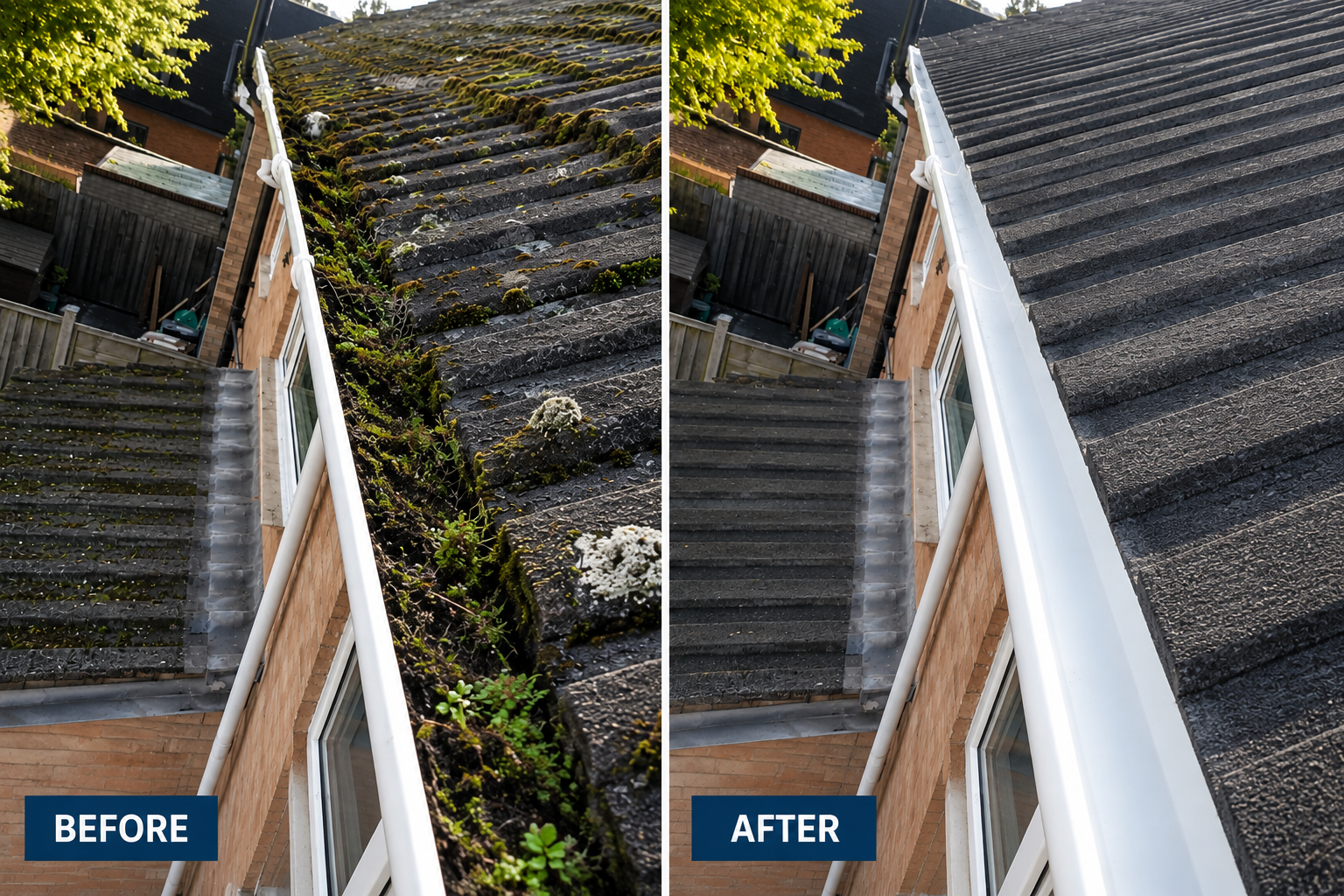
Why Ponding Is the Central Problem on Every Flat Roof
If there's one concept that every flat roof owner across Birmingham needs to understand, and that almost no generic gutter guide ever properly explains, it's ponding.
Ponding is the term for water that remains on a flat roof surface for an extended period after rainfall — typically defined as standing water still present more than 48 hours after the last rain event. Because a flat roof's fall is so slight, even minor obstructions, slight deflections in the membrane surface, or a partially blocked outlet can be enough to create areas where water simply doesn't drain away in a reasonable timeframe, instead sitting on the roof surface as a shallow pool.
The reason this matters so much more than the equivalent situation on a pitched roof comes down to what that standing water is actually resting against. A flat roof's waterproofing — whether felt, EPDM rubber membrane, GRP fibreglass, or a liquid-applied system — is designed to shed water that's moving across it reasonably quickly. It is not typically designed to remain submerged under standing water for extended periods without consequence. Sustained ponding accelerates UV degradation at the specific points where water sits, increases the risk of membrane blistering as trapped moisture beneath a compromised seal expands and contracts with temperature changes, and adds significant additional structural load to the roof deck if the ponding is extensive or the property experiences a period of sustained heavy rainfall on top of an already-standing pool.
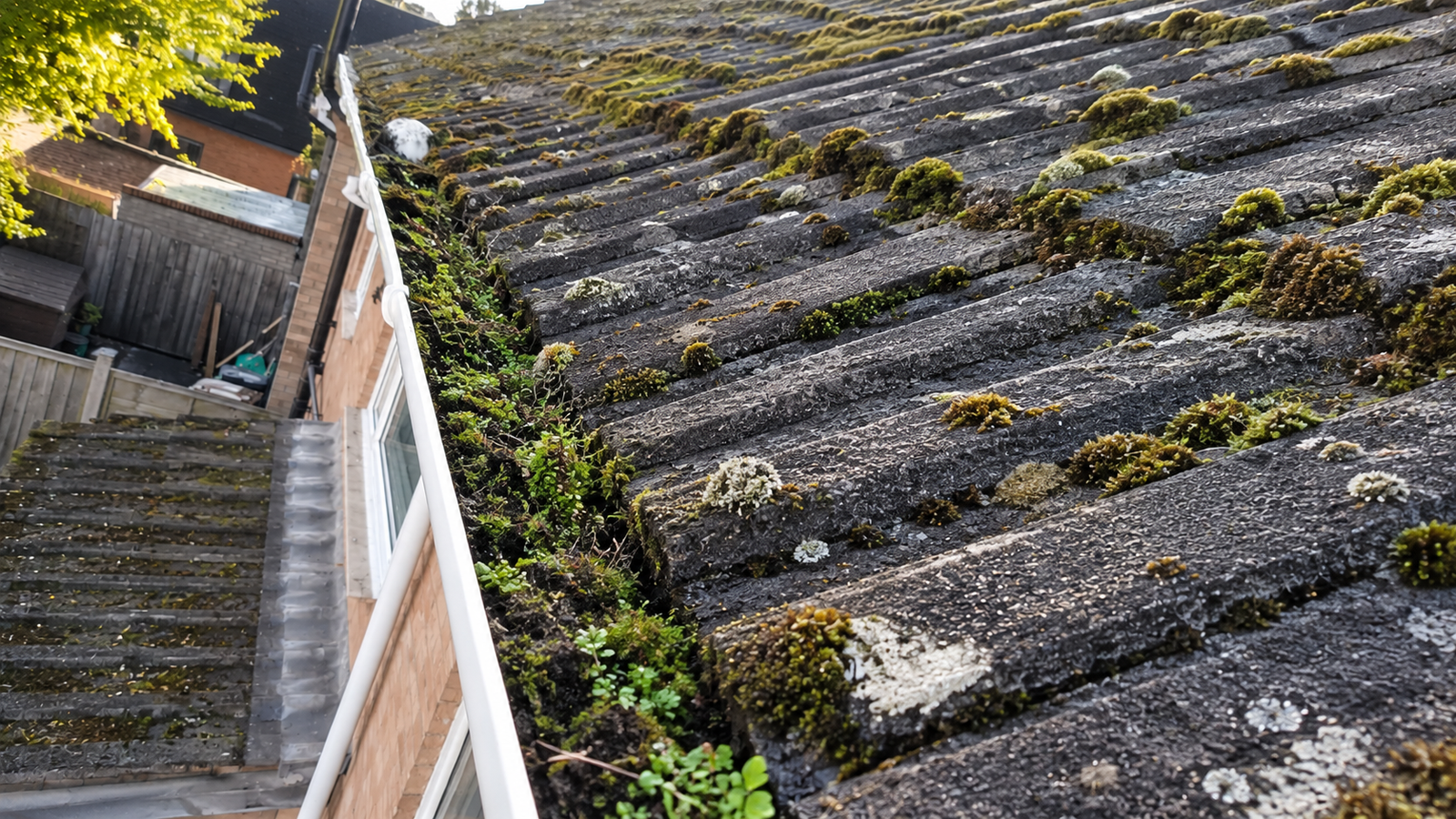
Ponding also creates a specific and often overlooked secondary problem: it becomes a breeding environment for algae and moss growth directly on the roof membrane itself, in a way that's considerably more aggressive than the moss growth found on pitched roof tiles. This growth further impedes drainage by creating additional surface texture that traps debris and slows water movement even further, creating a compounding cycle where poor drainage encourages growth, and that growth makes the drainage progressively worse.
None of this is covered in standard pitched-roof gutter advice, because ponding simply isn't a concept that applies to a system where water is meant to fall away under gravity along a sloped surface rather than travel across a broad, nearly level one.
WOW Gutters Ltd — Birmingham's flat roof and gutter specialists
07421 433910Where Flat Roof Drainage Actually Fails
The specific failure points on flat roof drainage systems are genuinely different from the joint failures, bracket corrosion, and downpipe blockages that dominate pitched-roof gutter maintenance, though there's some overlap at the point where water finally leaves the roof via a downpipe.
Outlet blockages from debris that pitched roofs never accumulate in the same way. Because a flat roof surface collects debris across its entire area rather than concentrating it along a linear gutter, leaves, moss fragments, and windblown material spread across the whole roof and gradually migrate toward the outlet as water moves them during rainfall. Over time, this can create a build-up directly around and inside the outlet itself, particularly on flat roofs positioned beneath or near trees, common on rear extensions across Birmingham's tree-lined suburban streets.
Membrane damage from foot traffic or falling debris. Small tears, punctures, or areas of compromised waterproofing that wouldn't be immediately obvious but allow water ingress precisely at the points where ponding is most likely to occur. This is a failure mode entirely absent from pitched roof gutter maintenance, where the roof surface itself and the drainage system are physically separate.
Outlet grille displacement or damage. The grille fitted over a rainwater outlet, designed to prevent large debris from entering and blocking the downpipe below, can become dislodged, cracked, or covered by accumulated debris sitting on top of it — effectively sealing the outlet even though the grille itself remains in place.
Falls that have degraded over time. Flat roofs are built with their slight drainage fall incorporated into the deck construction or the insulation layer beneath the membrane. Over years of thermal movement, structural settlement, or simply the passage of time, this fall can degrade in specific areas, creating new low points that didn't exist when the roof was originally installed — meaning a flat roof that drained adequately when new can develop ponding issues years later purely from structural movement, entirely separate from any debris accumulation.
Parapet gutter and box gutter joint failures. These share more similarity with the failure points described in our standard pitched roof gutter guidance — joint sealant degradation, debris accumulation at the channel base — but occur within a system that's typically harder to access and inspect than an open eave gutter, given the raised parapet walls or the awkward junction position where a box gutter sits between two roof sections.
Why Flat Roofs Are Common on Extensions and What That Means for Maintenance
A significant proportion of the flat roofs across Birmingham properties exist specifically because of rear extensions, side returns, and single-storey additions built onto originally pitched-roof Victorian, Edwardian, and interwar properties across areas like Selly Oak, Kings Heath, Moseley, and Bournville. Flat roof construction is often the practical and cost-effective choice for single-storey extensions, and as a result, a considerable number of Birmingham homes now have a mixed roofline — pitched roof over the main structure, flat roof over the extension — each requiring genuinely different maintenance approaches.
This mixed arrangement creates a specific practical problem that's worth being aware of directly: it's entirely possible, and in our experience quite common, for a homeowner to have their pitched roof gutters cleaned regularly while the flat roof drainage on their extension goes completely unchecked, simply because the two systems don't naturally get thought of together, and a standard gutter clean focused on the main house's eave-level gutters may not extend to checking the extension's separate outlet or the box gutter junction where the two roofs meet.
The junction point between a flat-roofed extension and the original pitched roof above it deserves particular attention precisely because of this common oversight. As described earlier, this junction is frequently a box gutter carrying water from both roof sections, making it one of the highest-risk drainage points on the whole property, and yet it's also one of the least visible from ground level and therefore one of the most likely to be overlooked during a routine maintenance visit that doesn't specifically account for it.
Commercial and Larger-Scale Flat Roof Drainage
Beyond residential extensions, flat roof drainage is the standard arrangement on the majority of commercial, industrial, and warehouse properties across Birmingham and the wider West Midlands — the kind of large-footprint distribution and industrial buildings covered in our commercial gutter clearing case studies, where box gutters and internal drainage outlets handle water across roof areas many times larger than any residential property.
At commercial scale, the consequences of neglected flat roof drainage escalate considerably. Ponding across a large commercial flat roof represents a genuinely significant structural load if it accumulates during a period of sustained rainfall, and the potential for water ingress affecting stock, equipment, or racking below makes commercial flat roof drainage maintenance a genuinely business-critical consideration rather than simply a property upkeep concern. Our own experience clearing commercial box gutters — including cases where years of unaddressed silt accumulation had progressed to the point of supporting actively rooted vegetation — illustrates just how severe this neglect can become when a large flat or near-flat commercial roof drainage system goes unmaintained for an extended period.
The Membrane Risk That Pitched Roof Guides Never Mention
This is perhaps the single biggest gap in how flat roof drainage gets discussed, if it gets discussed at all, in generic gutter maintenance content: the waterproofing membrane itself is a maintenance consideration entirely separate from, but closely connected to, the drainage system's condition.
A pitched roof's tiles or slates are a genuinely robust, long-lasting waterproofing solution largely unaffected by moderate standing water, because water simply doesn't stand on a sloped surface for any meaningful length of time. A flat roof's membrane — whether felt, EPDM rubber, GRP, or a liquid-applied coating — is a fundamentally different kind of waterproofing, more sensitive to sustained water contact, UV exposure, and physical damage, and directly dependent on the drainage system working correctly to avoid the kind of prolonged ponding that accelerates its degradation.
This means flat roof drainage maintenance genuinely cannot be separated from an awareness of the membrane's condition in the way that gutter maintenance on a pitched roof can be treated as largely independent of the tiles themselves. A blocked outlet on a flat roof isn't just a drainage problem waiting to cause an overflow — it's actively degrading the roof's primary waterproofing layer for as long as the resulting ponding persists, in a way that a blocked gutter on a pitched roof simply doesn't do to the tiles above it.
What Proper Flat Roof Drainage Maintenance Actually Involves
Given everything described above, proper flat roof drainage maintenance needs to address a genuinely different set of tasks from standard pitched roof gutter cleaning, even though some overlap exists at the downpipe stage.
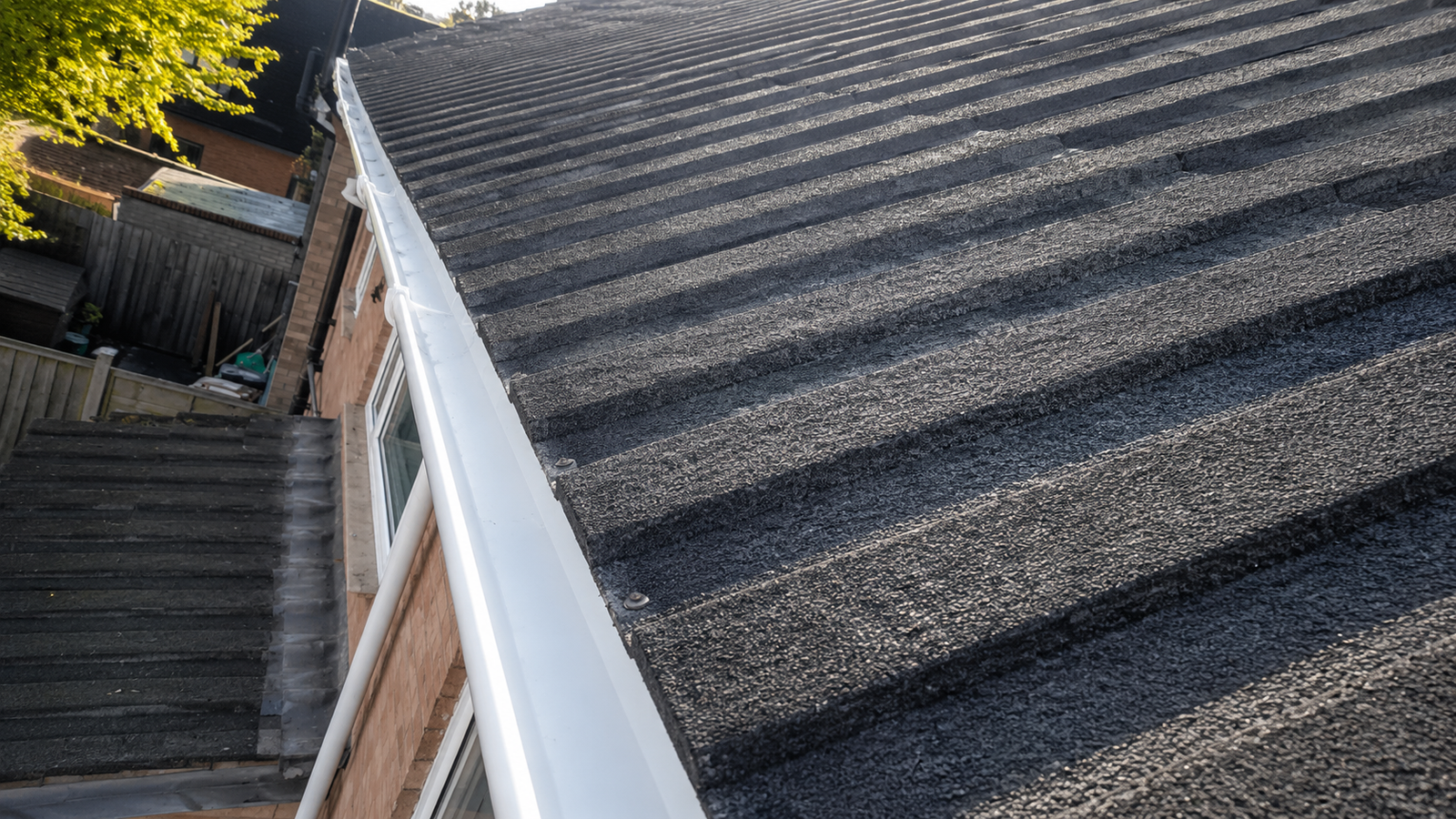
Full outlet clearance. Removing debris from directly around and inside every rainwater outlet on the roof, not just checking that the grille is visible. Debris trapped beneath a grille that looks clear from a casual glance can still be restricting flow considerably.
A visual sweep of the entire roof surface, not just the drainage points. Debris anywhere on a flat roof can redirect water flow and create localised ponding away from the outlet itself. This is a meaningfully different task from clearing a linear gutter, where debris outside the channel simply doesn't affect drainage in the same way.
Ponding assessment. Checking for areas of standing water more than 48 hours after recent rainfall, which indicates either a blocked outlet, degraded fall, or both, and which warrants further investigation into the underlying cause rather than simply clearing visible debris and assuming the problem is resolved.
Box gutter and parapet gutter clearance at the specific junction points described earlier, given how commonly these are overlooked during routine maintenance that focuses primarily on the main pitched roof gutters.
Downpipe flow testing, exactly as with pitched roof gutters. Confirming that water reaching the outlet actually clears the roof and reaches ground-level drainage rather than simply moving from the roof surface into a downpipe that's itself partially blocked.
A general visual check of the membrane surface for obvious signs of damage, blistering, or areas where standing water appears to be a recurring pattern rather than a one-off event — not a substitute for a proper roofing inspection where genuine concerns are identified, but a useful early-warning observation that can prompt further investigation before a minor issue becomes a significant one.
How Often Flat Roof Drainage Needs Attention
Flat roof drainage generally benefits from at least the same twice-yearly maintenance schedule recommended for pitched roof gutters, but the specific timing considerations differ somewhat given the different risk profile involved.
Properties with flat roof sections near mature trees — common on rear extensions across Birmingham's tree-lined suburban streets in areas like Edgbaston, Harborne, and Moseley — face an elevated risk of outlet blockage from leaf and seed debris settling directly on the roof surface, making seasonal clearance genuinely important rather than optional. Commercial and larger-scale flat roofs, given the structural load implications of ponding at scale, generally warrant more frequent inspection, particularly ahead of the autumn and winter period when Birmingham's rainfall is at its heaviest and any existing drainage weakness is most likely to be tested and exposed.
A summer inspection carried out in dry conditions offers the same diagnostic advantages for flat roof drainage as it does for pitched roof gutters — outlet condition, membrane surface state, and any signs of degraded fall are all considerably easier to assess accurately when the roof surface is dry rather than during or immediately after rainfall.
Signs Your Flat Roof Drainage Is Already Failing
Several signs, some visible from ground level and some requiring a proper roof-level inspection, indicate that a flat roof drainage system may already be struggling.
Visible standing water on the roof surface. Viewable from an upstairs window overlooking the flat roof section, persisting well beyond a reasonable drying period after rainfall, this is the most direct indicator of a ponding problem, whether from outlet blockage or degraded fall.
Staining or discolouration on the ceiling directly beneath a flat roof section. Particularly appearing after periods of sustained rainfall, this indicates that water has found its way through a compromised or overwhelmed membrane into the structure below.
Visible moss or algae growth on the roof surface itself. Viewable from an elevated vantage point or a neighbouring window, this indicates sustained moisture retention consistent with recurring ponding rather than water that's draining away promptly after each rainfall event.
A downpipe from the flat roof section that runs noticeably longer than expected after rain has stopped, or that shows a weak or intermittent flow during rainfall itself, indicating a restriction somewhere in the drainage path.
Any visible sagging or deflection in the roof surface itself. Viewable from a distance or from an upstairs window, this can indicate either an existing area of sustained ponding adding structural load, or a degraded fall that's beginning to create a genuine dip in the roof deck.
GET YOUR FLAT ROOF DRAINAGE PROPERLY ASSESSED
Professional drainage maintenance for both pitched roof gutters and flat roof systems across Birmingham and the West Midlands — rainwater outlets, box gutters, and parapet gutters on residential extensions and commercial flat roofs of any scale. Free quote · Before and after photos · Fully insured.
FAQ: Flat Roof Gutters and Drainage in Birmingham
Get Your Flat Roof Drainage Properly Assessed
If your Birmingham property has a flat roof section — a rear extension, a garage, a dormer, or a larger commercial roof — and it's never had drainage maintenance separate from your main pitched roof gutters, this is genuinely one of the most overlooked maintenance gaps we encounter across the region.
WOW Gutters Ltd provides professional drainage maintenance for both pitched roof gutters and flat roof systems across Birmingham and the West Midlands, including rainwater outlets, box gutters, and parapet gutters on residential extensions and commercial flat roofs of any scale. Ground-based access equipment where appropriate. Before and after photographs on every job. Fully insured professional team.
GET YOUR FLAT ROOF DRAINAGE PROPERLY ASSESSED
Professional drainage maintenance for both pitched roof gutters and flat roof systems across Birmingham and the West Midlands — rainwater outlets, box gutters, and parapet gutters on residential extensions and commercial flat roofs of any scale. Free quote · Before and after photos · Fully insured.
Call: 07421 433910
Email: support@wowgutters.co.uk
Web: wowgutters.co.uk
Serving Birmingham, Solihull, Sutton Coldfield, Edgbaston, Harborne, Kings Heath, Moseley, Bournville, Erdington, Wolverhampton, Dudley, Walsall, West Bromwich, Coventry, Redditch, Bromsgrove, Worcester, Kidderminster and all West Midlands areas.
Related Guides
- What Happens During a Professional Gutter Clean? A Birmingham Homeowner's Walkthrough
- Hidden Gutter Damage Is Easier to Spot in Summer
- Is Your West Midlands Home Quietly Storing Water Damage Right Now?
- Can Blocked Gutters Cause Damp?
- Commercial Gutter Cleaning
- Commercial Warehouse Gutter Clearing Birmingham
- Warehouse Gutter Clearing Box Gutter Case Study
- Downpipe Unblocking
- Gutter Clearing
- How Professional Gutter Cleaning Extends the Life of Your Roofline
- Why Every Birmingham Home Needs a Gutter Health Check This Summer
- Areas We Cover