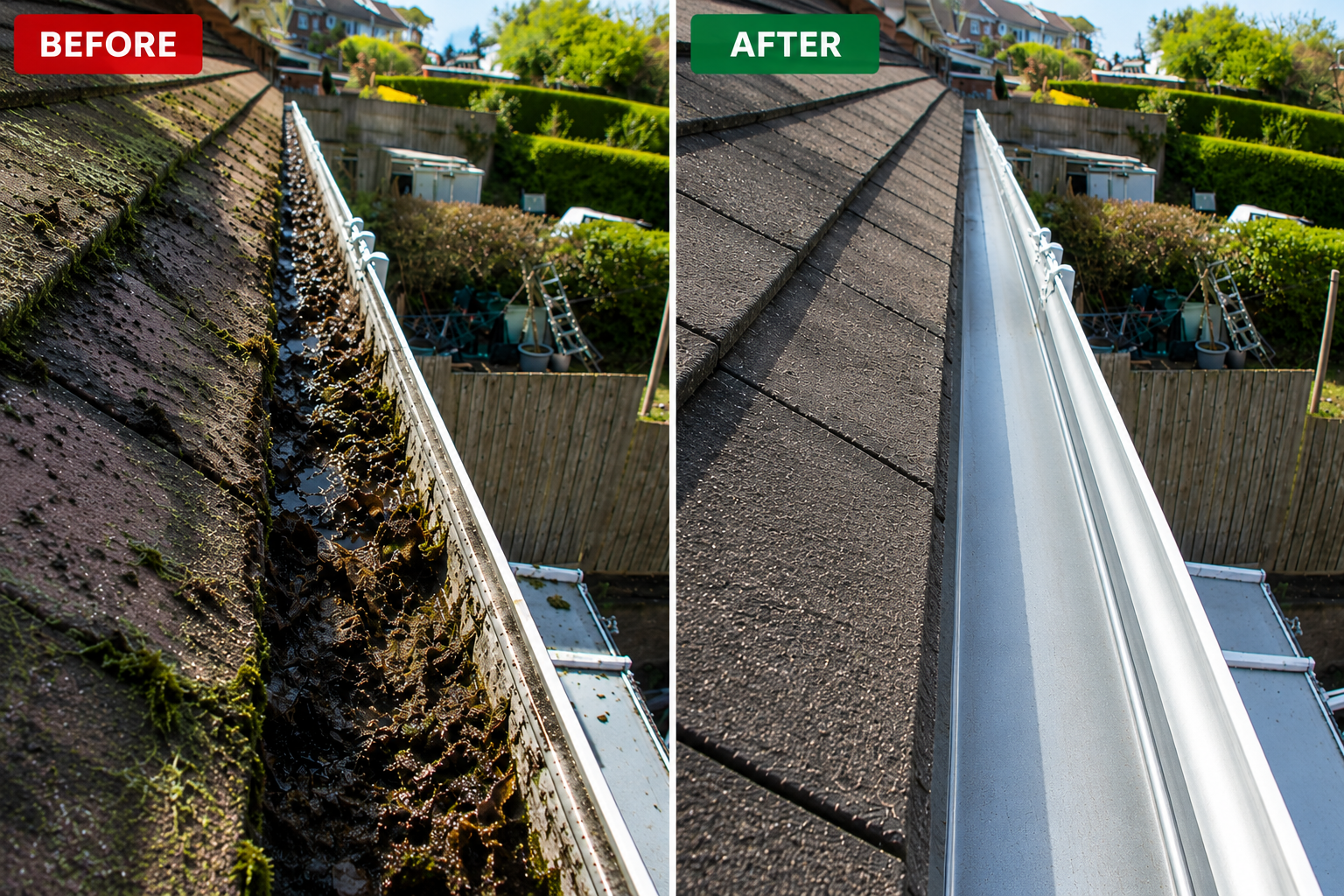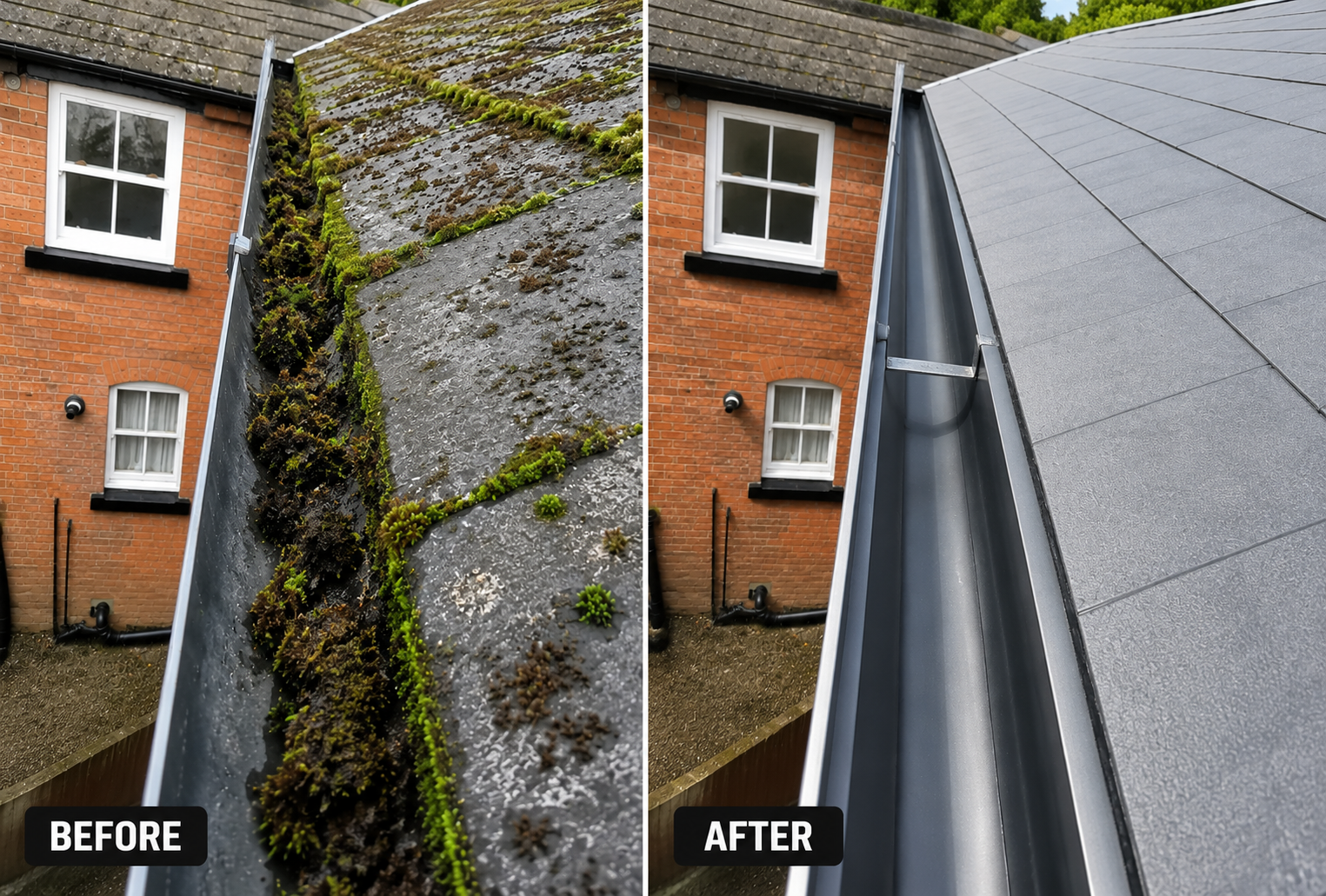

Two gutter runs on the exact same property — the front elevation and the rear, or the left side facing one direction and the right side facing another — can accumulate debris at genuinely, measurably different rates, even when both are fed by identical tree coverage overhead and identical roof pitch and construction. The variable most homeowners across Birmingham never think to consider is wind direction, and it has a considerably more direct, physical effect on which specific sections of your gutters fill fastest than most generic maintenance guidance ever addresses or acknowledges.
This article explains exactly how prevailing wind patterns across Birmingham and the wider West Midlands shape debris deposition on your roof surface and within your gutters specifically, why certain elevations of your property genuinely warrant more frequent attention than others regardless of what a generic twice-yearly schedule might suggest, and how understanding this pattern properly helps target maintenance where it actually delivers the most value rather than applying identical attention uniformly across a property that, in reality, faces genuinely uneven debris risk from one side to the other.
WOW Gutters Ltd — Birmingham's gutter cleaning specialists
07421 433910Birmingham's Prevailing Wind and What It Physically Means for Your Roof
The United Kingdom's prevailing wind direction is broadly southwesterly for the majority of the year, a well-established meteorological pattern resulting from the general position of Atlantic weather systems relative to the British Isles. Birmingham and the wider West Midlands follow this general national pattern for the substantial majority of the calendar year, with wind more frequently arriving from the south and west than from the north or east, though genuine exceptions and variations do occur, particularly during specific winter weather systems, as covered in more detail later in this article.
This isn't a minor meteorological curiosity with no practical relevance to property maintenance. It has a direct, physical, and genuinely predictable effect on which parts of your specific property receive the heaviest debris deposition over the course of a typical year. Leaves, sycamore seed cases, moss fragments, and other windblown debris material don't simply fall straight downward from a source tree in perfectly still air, landing directly beneath the tree's canopy in a neat, predictable circle. They're actively carried by whatever wind happens to be blowing at the moment they detach and become airborne, and given that the prevailing wind for most of the year blows from the southwest, debris originating from a tree positioned to the southwest of your property is considerably more likely, statistically and physically, to be carried onto your roof and deposited into your gutters than an equivalent volume of debris from an equally sized, equally mature tree positioned instead to the northeast of the same property.
This basic physical principle, while genuinely simple once explained, has meaningful practical consequences for how debris actually distributes across a real property over the course of a year, consequences that most homeowners have never had explained to them and that most generic gutter maintenance guidance simply doesn't address at all, treating a property's entire gutter system as a single undifferentiated unit facing uniform risk from every direction and every elevation simultaneously.
Why This Matters More Than Generic Guidance Ever Acknowledges
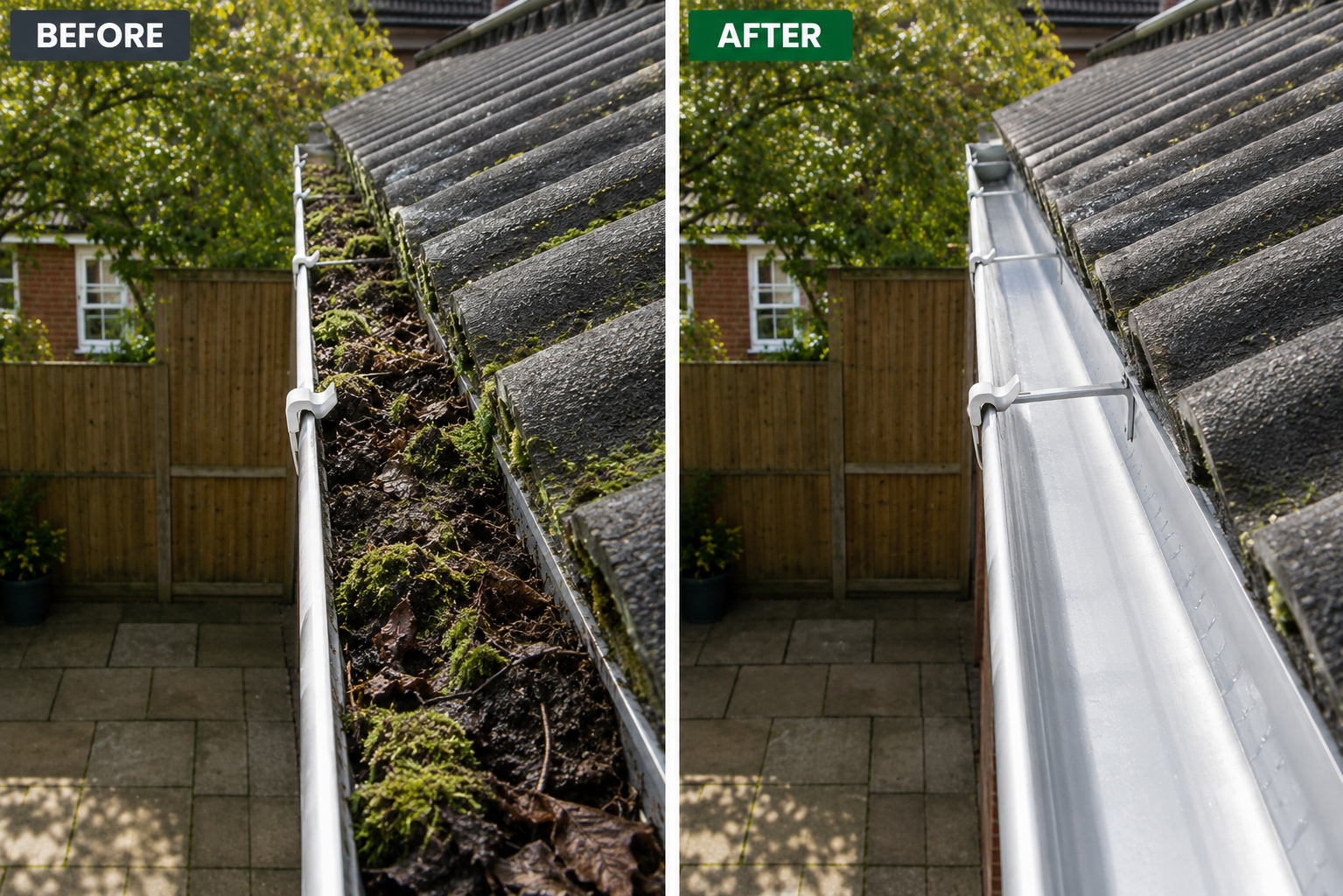
Tree species genuinely changes the debris pattern your gutters face, as covered extensively in our detailed guidance on how tree cover changes your gutter cleaning schedule across Birmingham. Wind direction adds a genuinely important second layer to this already useful picture — it's not simply a question of which tree species happen to be positioned near your property, but specifically which direction the prevailing wind typically carries that species' shed debris that ultimately determines where accumulation concentrates most heavily on your particular property.
Consider two otherwise identical properties, each with a single mature sycamore tree of equivalent size and age positioned near the boundary. On the first property, that sycamore sits to the southwest of the house, directly upwind of the prevailing wind direction relative to the roof. On the second, an otherwise entirely identical sycamore sits to the northeast, downwind of the prevailing pattern. Despite the tree species, size, and seasonal shedding timing being genuinely identical between these two scenarios, the first property will experience considerably heavier debris deposition on the corresponding roof sections and gutters than the second, purely as a consequence of the tree's position relative to the prevailing wind rather than anything about the tree itself.
Generic gutter maintenance advice, which almost universally treats a property's gutters as a single, undifferentiated system requiring identical attention across every elevation, genuinely misses this important variation entirely. A homeowner following purely generic advice has no reason to suspect that one side of their property might require meaningfully more frequent attention than another, and consequently allocates their maintenance attention — whether through DIY checking or professional visit frequency — evenly across a property that, in physical reality, faces genuinely uneven debris risk depending on elevation and orientation relative to both nearby vegetation and prevailing wind.
The Leeward Accumulation Effect Explained
Wind doesn't simply carry debris toward a property in a straightforward, direct line from source to destination — it also significantly affects how that carried debris actually settles once it arrives in the vicinity of the roof, and this settling behaviour produces a genuinely counterintuitive pattern that surprises most homeowners when it's first explained to them.
Airborne debris carried on prevailing wind tends to accumulate considerably more heavily on the leeward side of a roof structure — meaning the side sheltered from the direct force of the wind, positioned on the opposite side of the building from where the wind is actually blowing from — rather than on the windward side that faces directly into the prevailing wind. This occurs because wind speed and airflow naturally slow as air passes around and over a building structure, particularly on the sheltered side where the building itself creates a wind shadow, and this reduction in airflow speed causes carried debris to lose the momentum keeping it airborne, settling onto the roof surface and subsequently into the gutter below at a considerably higher rate than occurs on the windward side, where continued stronger airflow can actually keep some lighter debris material moving past the property entirely rather than settling onto it.
The practical consequence of this leeward accumulation effect is that the elevation of a typical Birmingham property facing away from the prevailing southwesterly wind — which for most properties means the northeast-facing elevation, though this varies depending on the specific orientation of any given building relative to true compass directions — frequently accumulates debris considerably more heavily than the southwest-facing elevation that sits directly exposed to and facing into the prevailing wind. This represents a genuinely counterintuitive pattern that most homeowners never anticipate without having it specifically explained, given that the "exposed" side of the property, facing directly toward the wind and often facing toward any nearby trees that happen to be positioned upwind, intuitively feels like it should logically accumulate the most debris, when the physical reality of how airflow and settling actually behaves frequently produces the opposite pattern.
WOW Gutters Ltd — Birmingham's gutter cleaning specialists
07421 433910Why Corners and Valleys Concentrate Debris Far More Than Straight Runs
Beyond the general leeward accumulation pattern affecting entire elevations, wind creates specific, more concentrated deposition points at roof corners and roof valleys — the internal angles where two separate roof sections meet at an angle, common on properties with more complex rooflines involving multiple pitches, dormers, or extensions — and this corner and valley concentration effect is considerably more pronounced than the general effect observed along straight, open gutter runs positioned along a simple single-pitch eave.
Wind turbulence around building corners and within roof valleys creates localised eddies and areas of reduced, chaotic airflow that deposit carried debris considerably more heavily than the more even, predictable airflow pattern found along a straight, open gutter run without any nearby structural features to disrupt the wind. As detailed extensively in our guide to hidden gutter damage that's easier to spot in summer, these localised concentration points frequently develop the kind of compacted silt and debris buildup that produces recurring, seemingly inexplicable blockages at one specific section of a gutter run while the remainder of the same run stays comparatively clear, a pattern that genuinely confuses homeowners who cannot understand why one particular section of their gutters consistently requires more frequent attention than the rest.
This corner and valley concentration effect connects directly to the recurring downpipe blockage problem covered extensively in our dedicated guide on why downpipes keep blocking again despite repeated clearing attempts. A downpipe positioned near a roof corner or valley junction, where wind turbulence naturally concentrates debris deposition considerably more heavily than elsewhere on the property, frequently proves to be the specific recurring blockage point that keeps reasserting itself even after apparently thorough clearing work elsewhere on the same property, simply because the underlying debris deposition rate at that specific location genuinely exceeds what occurs along the rest of the gutter system, requiring more frequent attention at that particular point regardless of the overall property's general maintenance schedule.
Storm Winds: The Exception That Catches Homeowners Out
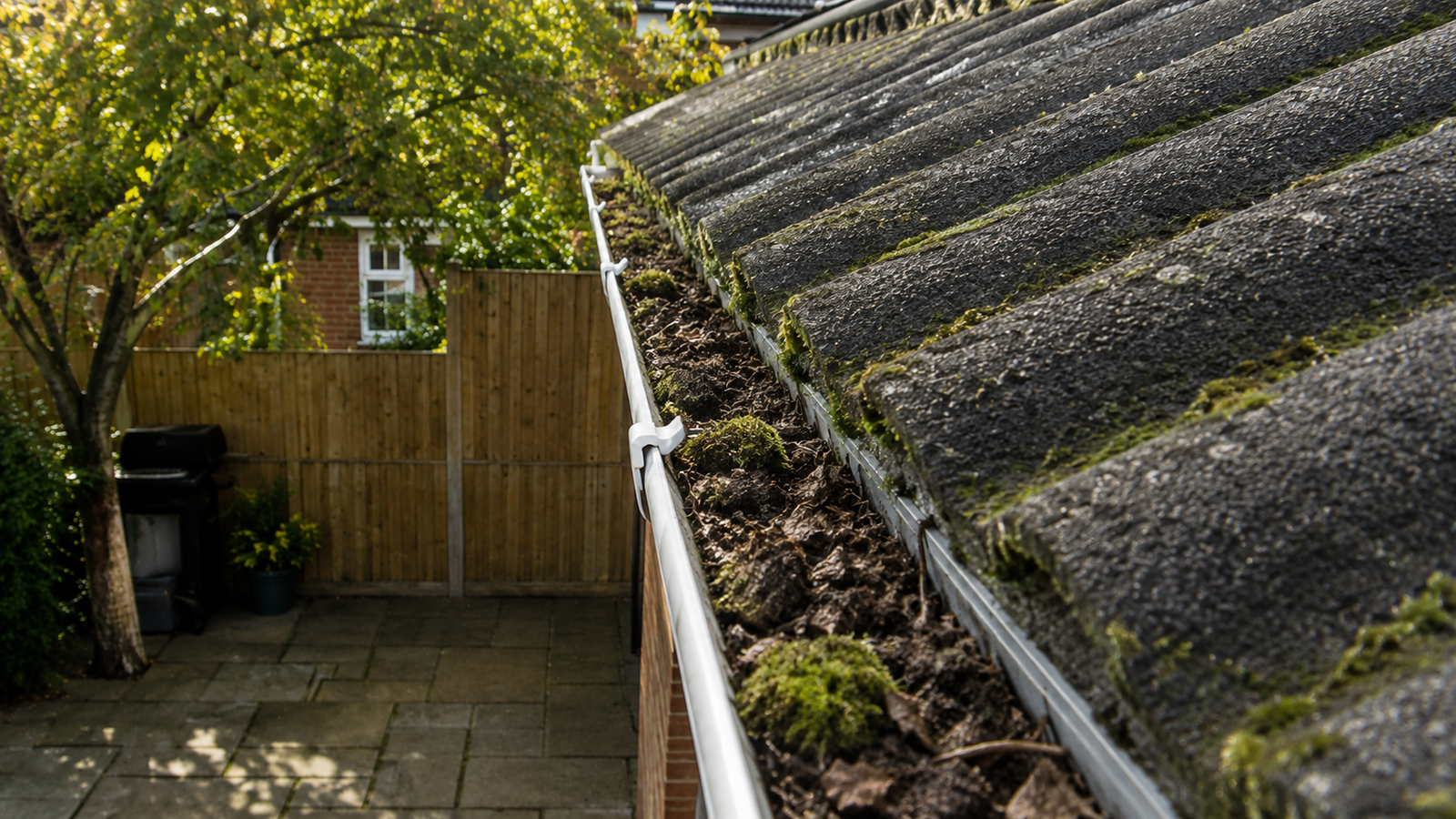
While the southwesterly prevailing wind pattern genuinely dominates for the substantial majority of the calendar year across Birmingham and the wider West Midlands, the region does experience distinct storm events and weather systems that arrive from meaningfully different directions — northerly and easterly winds occurring during certain specific winter weather patterns, for instance, when different atmospheric conditions temporarily override the usual prevailing southwesterly pattern entirely.
These exceptional weather events, while genuinely less frequent than the standard prevailing pattern, can deposit meaningful volumes of debris onto elevations of a property that rarely accumulate significant material during typical, more common wind conditions. A homeowner who has only ever assessed their own gutter maintenance needs based on the general prevailing wind pattern — quite reasonably prioritising attention toward the leeward, typically northeast-facing elevation that usually accumulates the most debris — can genuinely be caught out by unexpected, meaningful accumulation on a normally low-debris elevation following an atypical storm event that temporarily reversed the usual wind pattern and deposited debris onto a side of the property that hadn't previously required particular attention.
This scenario is precisely the kind of finding that a thorough professional gutter maintenance visit, as detailed comprehensively throughout our guide to what actually happens during a professional gutter clean, genuinely catches through systematic real-time camera inspection of every elevation and every gutter run on the property, rather than assuming the typically low-accumulation side of a property can be safely skipped or given meaningfully reduced attention purely on the basis of the general prevailing wind pattern that, while genuinely useful as a general planning guide, doesn't account for the exceptional events that occasionally, though genuinely less commonly, override the typical pattern.
How Building Height and Surrounding Structures Change the Pattern
Beyond the general prevailing wind and leeward accumulation principles described above, the specific height and surrounding context of an individual property genuinely modifies how these general patterns actually play out in practice, meaning two properties with theoretically identical orientation relative to the prevailing wind can still experience meaningfully different debris accumulation patterns depending on their specific local context.
Taller properties, or properties positioned on genuinely elevated ground relative to their immediate surroundings, tend to experience more consistent, less turbulent wind exposure across their full roof surface, meaning the leeward accumulation and corner concentration effects described throughout this article tend to apply somewhat more predictably and consistently than on lower, more sheltered properties. Properties positioned in close proximity to taller neighbouring buildings, mature trees positioned close enough to create their own localised wind shadow effect, or other significant structures can experience genuinely more complex, less predictable wind patterns around their own roof surface, where the theoretical general prevailing wind principle gets meaningfully modified by these immediate local obstructions in ways that are genuinely harder to predict from general principles alone without direct observation of the specific property.
This means the general principles described throughout this article are genuinely useful as a starting framework for understanding likely debris patterns, but a proper professional assessment of an individual property's specific local context — its immediate surroundings, nearby structures, and observed accumulation patterns over time — provides considerably more accurate, property-specific guidance than the general prevailing wind principle applied in isolation without any consideration of these local modifying factors.
WOW Gutters Ltd — Birmingham's gutter cleaning specialists
07421 433910Combining Wind Direction With Tree Species for a Genuinely Accurate Picture
The genuinely most useful, practically actionable understanding of a specific property's debris risk comes from combining the wind direction principles covered throughout this article with the tree species timing and characteristics covered extensively in our companion guide on how tree cover changes your gutter cleaning schedule across Birmingham, rather than treating either factor in isolation from the other.
A property with mature sycamore positioned to the southwest, directly upwind of the prevailing wind pattern, faces a genuinely compounded risk profile combining both the elevated overall debris volume that sycamore's two-wave shedding pattern produces, as detailed in our tree species guidance, with the elevated deposition rate that upwind positioning relative to prevailing wind creates on the corresponding leeward elevation of the property. This same property, if the sycamore were instead positioned downwind to the northeast, would face a meaningfully lower overall debris risk from that same tree, despite the tree itself, its species, size, and seasonal shedding pattern remaining entirely unchanged — illustrating clearly why position relative to prevailing wind genuinely matters as much as tree species and proximity alone in determining actual debris risk for any specific property.
Properties facing debris from multiple different tree species positioned at different points around their boundary, which describes the majority of established Birmingham properties on typical residential streets with mixed vegetation, benefit from considering each contributing tree's specific position relative to the prevailing wind individually, rather than simply totalling up all nearby tree coverage as a single undifferentiated risk factor without regard to directional positioning.
What This Means for Your Actual Maintenance Approach
Understanding your specific property's wind exposure and orientation allows for a genuinely more targeted, effective maintenance approach than the alternative of treating every gutter run on a property identically regardless of its specific position and exposure.
Begin by identifying which elevation of your property faces away from the prevailing southwesterly wind pattern — this leeward side, for most standard Birmingham property orientations, likely warrants closer, more frequent attention than a generic uniform schedule applied evenly across the whole property would suggest, given the leeward accumulation effect described in detail earlier in this article. Pay particular attention to any roof corners and valley junctions present on your specific property, given the meaningfully more pronounced concentration effect these features create compared with straight, open gutter runs, rather than assuming debris distributes evenly along the full length of any given gutter section.
Recognise, too, that combining this genuine wind-direction awareness with the tree-species timing considerations covered throughout our tree cover guidance produces a considerably more accurate, genuinely property-specific maintenance picture than either factor considered entirely in isolation from the other. And finally, remain aware that exceptional storm events occasionally override the typical prevailing pattern, meaning even the normally lower-risk elevation of a property genuinely benefits from periodic proper inspection rather than being assumed permanently safe from meaningful accumulation purely on the basis of the general prevailing wind principle.
Assessing Your Own Property's Wind Exposure
While a proper professional assessment genuinely provides the most accurate, reliable picture of your specific property's debris risk pattern, there are some practical steps any homeowner can take to develop a reasonable general understanding of their own property's likely exposure before booking a professional visit.
Consider your property's actual compass orientation, ideally using a genuine compass or a smartphone compass application rather than assuming based on rough visual impression alone, since the difference between a property oriented directly southwest-to-northeast versus one oriented at a meaningful angle to this axis genuinely affects which specific elevation experiences the strongest leeward accumulation effect. Identify the position of any significant trees, hedgerows, or other vegetation near your property boundary relative to this established orientation, noting specifically whether each is positioned upwind or downwind of the prevailing pattern relative to your roof.
Observe, where practical, any patterns you've noticed over previous seasons regarding which sections of your gutters have historically required more frequent attention or produced more visible overflow during heavy rain — this kind of accumulated practical observation, even if informal and not systematically recorded, often confirms or usefully refines the general theoretical pattern described throughout this article for your specific property's actual real-world behaviour.
Why This Matters More in Certain Birmingham Areas
While the general wind direction principles described throughout this article apply to any property regardless of specific location, certain characteristics of particular Birmingham areas make understanding and applying this wind-direction awareness particularly valuable rather than simply a nice-to-have theoretical refinement.
Properties across areas with substantial mature tree canopy, including Edgbaston, Harborne, Moseley, Bournville, and Sutton Coldfield, genuinely benefit most from combining wind-direction awareness with the tree-species considerations covered in our detailed tree cover guidance, given the greater overall volume and variety of debris sources present in these more heavily vegetated residential areas compared with more open, less densely planted parts of the wider West Midlands region. Properties with more complex rooflines involving multiple pitches, extensions, or dormers — common across a considerable proportion of both older converted properties and more architecturally varied newer developments across the region — face a correspondingly greater number of corners and valley junctions where the concentration effect described earlier in this article applies, making systematic assessment of every such junction genuinely more valuable than it would be on a simpler, single-pitch roof structure with fewer such features present.
GET EVERY ELEVATION OF YOUR PROPERTY PROPERLY ASSESSED
Professional gutter cleaning across Birmingham and the West Midlands — systematic real-time camera inspection of every elevation and every gutter run on your property during every visit, rather than assuming any section can be given reduced attention based on general assumptions alone. Ground-based vacuum system. No ladders. Before and after photographs on every job. Free quote · Fully insured.