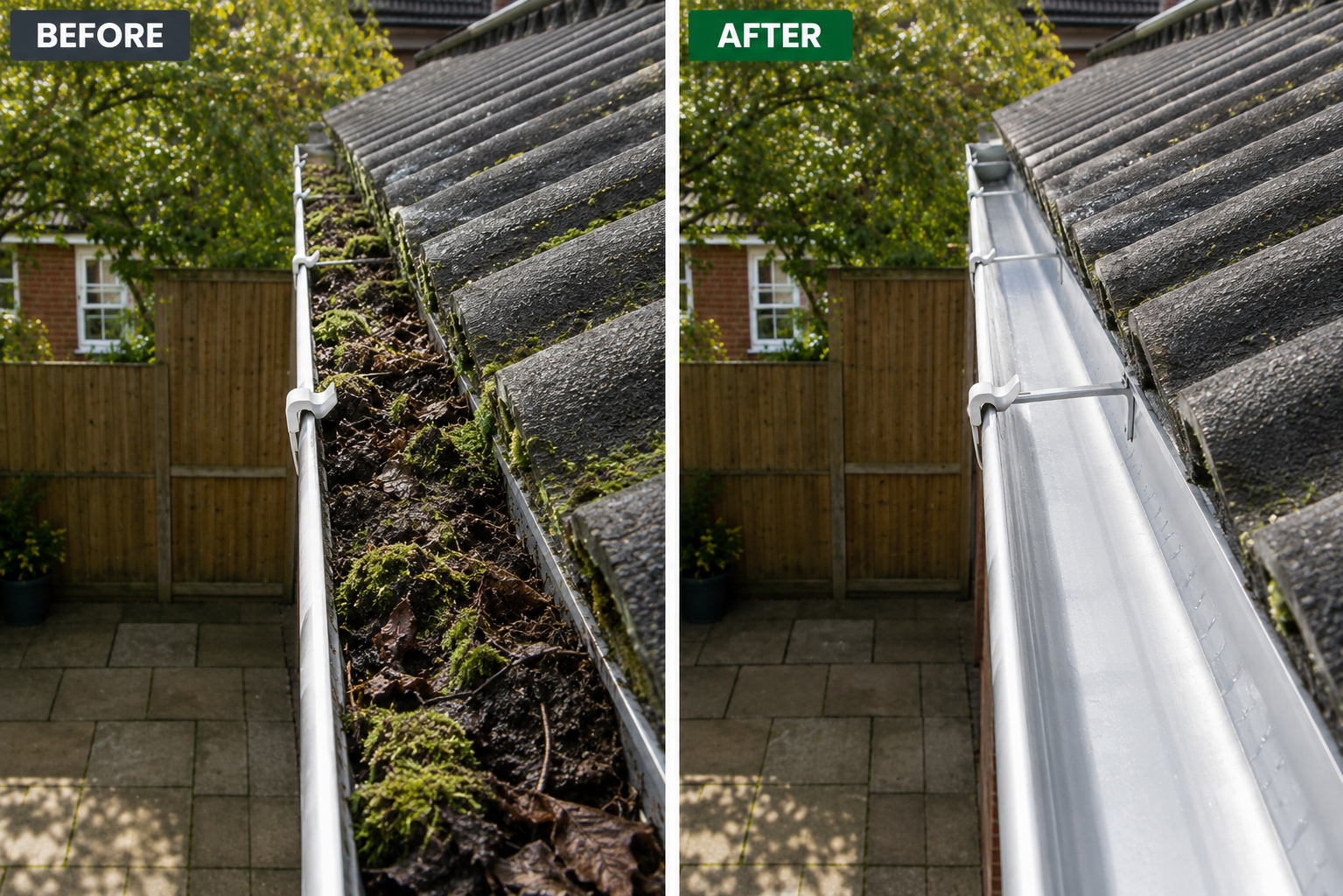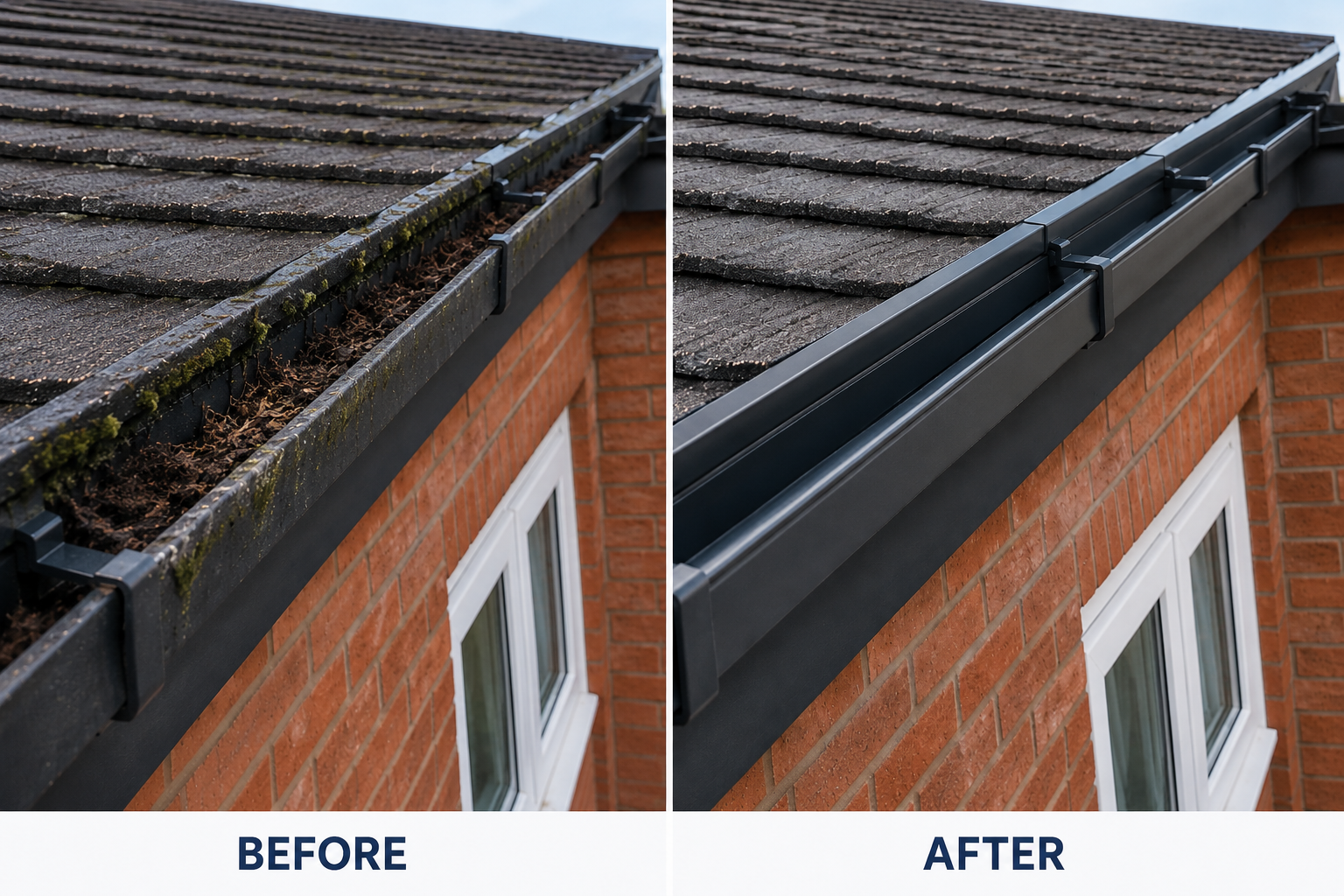

Two houses on the same Birmingham street, built in the same year, with identical gutter systems installed by the same builder, can genuinely need completely different maintenance schedules — and the only meaningful variable that explains the difference is what happens to be growing above each of them.
A property beneath a mature oak faces an entirely different debris pattern from one standing beside a sycamore. A property near a lime tree deals with a completely different maintenance challenge from one surrounded by conifers. Generic gutter cleaning advice — the kind that recommends a simple twice-yearly clean regardless of context, which admittedly forms the sensible baseline covered in our own seasonal guidance — genuinely doesn't account for this variation, and it's one of the most significant reasons why so many Birmingham properties end up under-maintained relative to what their specific tree coverage actually demands, or in some cases over-maintained when a simpler schedule would have served perfectly well.
This article provides the tree-by-tree breakdown that most generic guides skip entirely. If you know what species are growing near your property — in your own garden, a neighbour's, or as street trees along your road — you can build a genuinely accurate maintenance schedule tailored to your actual situation, rather than following generic seasonal advice that may not match what's really happening above your roofline at all.
WOW Gutters Ltd — Birmingham's gutter cleaning specialists
07421 433910Why "Twice a Year" Is a Starting Point, Not a Universal Rule
The standard recommendation found throughout most gutter maintenance guidance, including a good portion of our own — clean in autumn after leaf fall, clean again in spring to clear winter accumulation — is a genuinely sensible baseline for a property with minimal overhead vegetation. A house with no significant trees nearby, in an open or newly developed part of the region, will typically do perfectly well on this schedule, because the debris load it accumulates between visits stays within a manageable range regardless of exactly when those two visits happen to fall.
The moment meaningful tree coverage enters the picture, this baseline becomes considerably less reliable, in either direction. Some tree species produce debris loads and timing patterns that genuinely require more than two visits per year to manage properly, leaving a twice-yearly schedule exposed for significant stretches of the calendar. Other species produce continuous, low-volume debris that doesn't concentrate into the kind of seasonal spike a twice-yearly schedule is designed around, meaning the standard timing might actually be less effective than a different pattern of more frequent, lighter visits would be.
The gap between what a generic schedule recommends and what a specific property actually needs is often the exact mechanism behind the kind of hidden gutter damage that only becomes visible once it has already caused genuine harm — a property owner following sensible-sounding generic advice, entirely unaware that their specific tree coverage requires a meaningfully different approach, ends up with gutters that are technically "maintained" on paper while still accumulating problematic debris loads during the gaps the generic schedule doesn't account for.
Sycamore: The Species That Breaks the Standard Schedule Completely
If there's one tree species responsible for more mismatched gutter maintenance schedules across Birmingham than any other, it's sycamore — abundant across residential streets in Edgbaston, Harborne, Moseley, Bournville, and Sutton Coldfield, where mature specimens frequently overhang multiple neighbouring properties simultaneously.
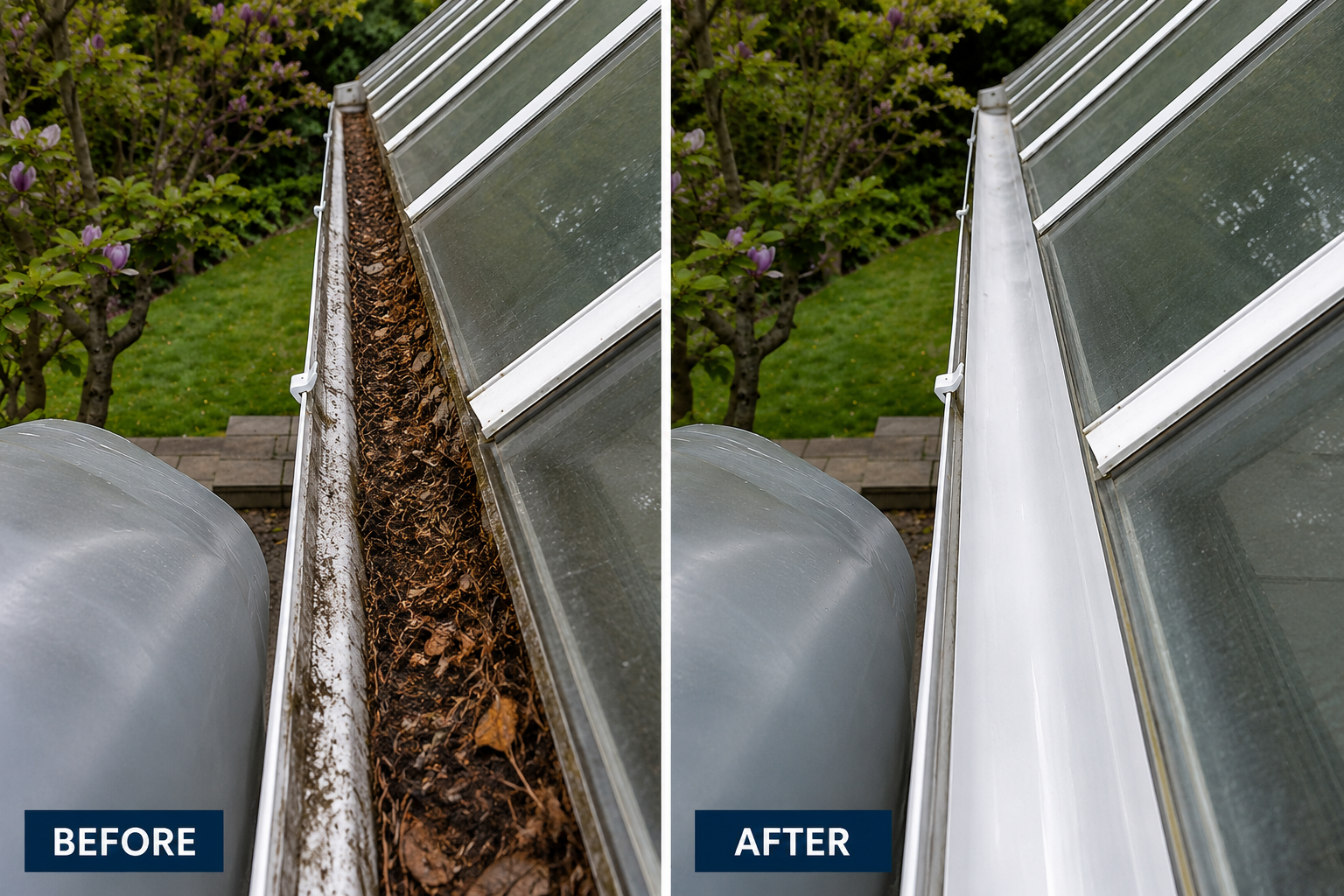
Sycamore sheds in two entirely separate waves that most homeowners don't fully appreciate until they've had the pattern explained to them directly. The first wave arrives in the form of winged seed cases — the familiar helicopter seeds — falling from late spring through early summer, well before anyone is naturally thinking about gutter maintenance at all. These seeds travel considerable distances on the wind, meaning even a property without a sycamore in its own garden can receive a meaningful deposit from a mature specimen several doors away or on a neighbouring street. The seed cases compact under summer rainfall into a dense layer that, left unaddressed, becomes the base layer on which the second wave — the actual leaves, falling in the more conventional October and November window — subsequently accumulates.
The practical consequence is that a property beneath or near mature sycamore genuinely needs three separate visits across the year to be properly managed: an early-summer clear specifically targeting the seed case accumulation before it compacts, a late-summer clear removing anything further that's built up alongside general seasonal debris, and a proper autumn clean for the main leaf fall itself. A standard twice-yearly schedule applied to a sycamore-adjacent property leaves it genuinely exposed for a considerable stretch of the year — typically the entire summer period between a spring clean and an autumn one — during which the seed case accumulation has been building entirely unaddressed.
Oak: The Late Finisher That Catches Everyone Out
Oak trees, common across the more mature and established streets of Sutton Coldfield and parts of Solihull where larger, older properties with substantial garden trees are more prevalent, hold their leaves considerably longer into the year than most other deciduous species found across Birmingham. Some mature oaks don't complete their leaf fall entirely until December, well beyond the point at which most homeowners consider the autumn gutter maintenance season to have concluded.
This creates a specific and genuinely common scheduling trap. A homeowner books what they believe to be their complete autumn gutter clean for October, following entirely reasonable general guidance about autumn maintenance timing, and considers the season handled once that visit is complete. What they haven't accounted for is a second, later wave of oak leaf fall arriving through November and into December — debris that their already-completed October visit never addressed, because it simply hadn't fallen yet at the time of the clean.
Properties genuinely near mature oak need their final autumn visit pushed meaningfully later than the standard schedule suggests — sometimes as late as early December — to properly capture this delayed leaf fall. Where a property sits beneath a mixture of earlier and later species, as is common across many Birmingham streets, this often means the two-visit autumn approach described in our broader seasonal guidance needs adjusting specifically to accommodate the oak's delayed timing on top of whatever earlier clearance addresses the faster-dropping species nearby.
Ash: Fast Decomposition, Fast Downpipe Blockage
Ash trees drop their leaves relatively late in the season, following a broadly similar timing pattern to oak rather than the earlier sycamore and cherry pattern, but with one significant additional characteristic that makes ash-adjacent properties face a genuinely distinct maintenance risk: ash leaves break down considerably faster in wet conditions than most other common species, forming a dense, dark, slurry-like material rather than remaining as recognisable, largely intact whole leaves for an extended period.
This decomposed slurry behaves very differently from intact leaf debris when it comes to gutter and downpipe function. Whole leaves, even in significant volume, tend to create a physical mat that restricts flow but often still allows some water passage around and through it. The wet slurry that ash leaves rapidly decompose into is considerably more effective at forming a complete seal at a downpipe inlet, converting what might otherwise be a partial restriction into a genuinely complete blockage far more readily than intact leaf matter from slower-decomposing species would.
Properties with significant ash coverage nearby therefore benefit from particular attention to downpipe flow testing as a specific priority, rather than treating gutter channel clearance alone as sufficient. A visual check confirming the gutter channel itself looks reasonably clear can be misleading on an ash-adjacent property if the downpipe beneath it has already been sealed by decomposed slurry that isn't necessarily visible from a casual glance at the channel above.
WOW Gutters Ltd — Birmingham's gutter cleaning specialists
07421 433910Lime: Sticky, Voluminous, and Consistently Underestimated
Lime trees are a genuine fixture of Birmingham's Victorian and Edwardian residential streets, planted in considerable numbers across areas including Bournville, Selly Oak, and Kings Norton as part of the original street tree planting schemes that characterise much of the city's older residential development. Lime trees drop leaves in high volume — often noticeably more than comparable deciduous species of similar size — and produce a sticky honeydew secretion throughout the summer months that coats surfaces beneath the canopy, including the debris that subsequently falls into nearby gutters.
This honeydew coating changes the physical behaviour of the debris considerably compared to drier leaf matter from other species. Rather than sitting relatively loosely in a gutter channel where a moderate vacuum extraction pass removes it readily, honeydew-coated lime debris tends to adhere more tenaciously to the channel surface and to itself, requiring more thorough extraction to remove completely rather than a quick surface sweep.
Properties near mature lime trees frequently need extraction methods closer to the more comprehensive approach described throughout our detailed guidance on professional gutter cleaning generally, prioritising thorough vacuum extraction over a rapid clearance visit, given how firmly this specific type of debris bonds to the gutter channel compared with drier leaf matter from species without the honeydew characteristic.
Cherry: Early, Small, and Easily Missed
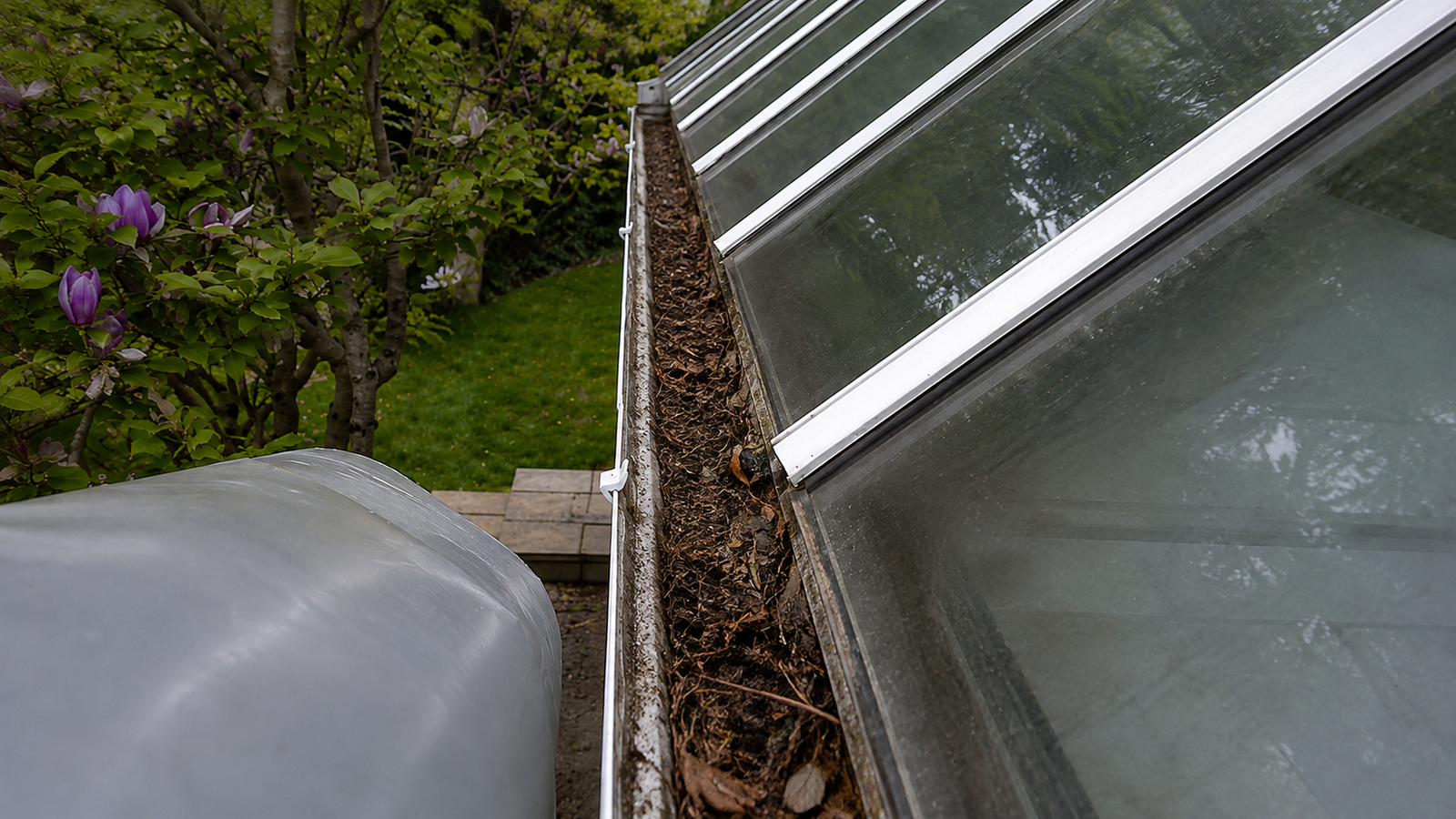
Ornamental and wild cherry trees, increasingly common across Birmingham's newer residential developments and popular as garden and street tree choices in more recently built areas, drop their leaves earlier in the season than most of the species discussed above, often beginning as early as September rather than following the more typical October onset most homeowners associate with the start of autumn leaf fall.
Cherry leaves are also physically smaller than leaves from species like sycamore or lime, and this size difference has a specific practical consequence for properties that have had gutter guards installed. Standard gutter guard mesh, designed primarily to exclude larger leaf debris, frequently allows smaller cherry leaves to pass through relatively easily, meaning a property with gutter guards installed specifically to reduce maintenance frequency can still accumulate meaningful debris from nearby cherry trees despite the guards being in place and functioning as intended for larger debris.
This combination of early timing and guard-penetrating leaf size means cherry-adjacent properties genuinely benefit from an earlier seasonal check than the standard autumn timing would suggest, and shouldn't necessarily assume that installed gutter guards have eliminated the maintenance need entirely.
Conifers: The Species Nobody Associates With Gutter Problems
Unlike every deciduous species discussed above, conifers don't produce an obvious, concentrated autumn leaf-drop event that naturally prompts a homeowner to think about gutter maintenance timing. This absence of an obvious seasonal trigger is precisely why properties near mature conifers — common in some of the more established, larger gardens across Sutton Coldfield and Four Oaks in particular — often get overlooked entirely when homeowners are considering their gutter maintenance needs, despite genuinely accumulating meaningful debris over the course of a year.
Conifers shed needles continuously throughout the year in relatively small quantities rather than concentrating their debris drop into one obvious seasonal event. Individually, each needle is a genuinely minor contribution to gutter debris, but the continuous, year-round nature of this shedding means the cumulative volume over twelve months can be considerable, particularly from a large, mature specimen positioned close to the property. Needle litter also compacts into a dense mat over time that's genuinely difficult to distinguish from moss growth at a casual glance — both present as a greenish-brown, textured layer within the gutter channel, meaning a homeowner glancing up at their gutters might reasonably assume they're seeing moss accumulation when the actual cause is compacted conifer needle litter, a distinction that matters for correctly diagnosing and addressing the underlying source.
Properties near mature conifers genuinely benefit from a different maintenance pattern than the concentrated seasonal visits that suit deciduous tree coverage — more frequent, lighter-touch clearance spread across the year, rather than one or two intensive visits timed around a leaf-drop event that simply doesn't exist for this category of tree.
Birch: Fine Debris That Fills Silt Layers Fast
Birch trees, present across various Birmingham residential streets though generally less dominant than sycamore, oak, or lime in terms of sheer numbers, produce fine catkins alongside relatively small leaves that break down considerably faster than the debris from most other common species discussed in this article.
This rapid breakdown characteristic means birch-adjacent properties contribute disproportionately to the silt layer accumulation that forms at the base of a gutter channel over successive seasons — the compacted mineral and organic layer that reduces effective gutter capacity without producing any visible overflow symptom until the reduced capacity is finally tested by genuinely heavy rainfall, at which point a gutter that "always seemed fine" begins overflowing seemingly without explanation. Properties near mature birch trees may accumulate this hidden base-layer silt more rapidly than the debris volume would suggest from a casual visual assessment, given how quickly the fine leaf and catkin material breaks down into contributing silt rather than remaining as visible, easily identified debris.
WOW Gutters Ltd — Birmingham's gutter cleaning specialists
07421 433910What Happens on Streets With Mixed Species
The reality across most Birmingham streets is genuinely mixed tree coverage rather than a single dominant species — a property might have a sycamore in its own garden, a neighbour's oak overhanging one boundary, and a lime tree as a street tree along the pavement, each contributing debris on entirely different timing patterns simultaneously.
This mixed coverage scenario, which describes the majority of established residential streets across areas like Edgbaston, Moseley, Harborne, and Kings Heath, genuinely requires combining the relevant elements from each species' individual pattern into a single, tailored schedule rather than defaulting to whichever single species happens to be most visually prominent. A property with both sycamore and oak nearby, for instance, needs both the early-summer seed case clearance that sycamore demands and the delayed late-autumn visit that oak requires — a schedule that looks considerably more involved than either species would demand in isolation, but that genuinely reflects what the property is actually accumulating across the full year.
This is precisely the kind of property-specific assessment that a generic, one-size-fits-all schedule simply cannot provide, and it's why a proper professional assessment of your specific surrounding vegetation, rather than a blanket seasonal recommendation, produces a genuinely more accurate and effective maintenance plan.
GET A SCHEDULE BUILT AROUND YOUR ACTUAL TREES
Professional gutter cleaning across Birmingham and the West Midlands — assessing your property's specific tree coverage and surrounding vegetation to recommend a genuinely tailored maintenance schedule rather than a generic one-size-fits-all approach. Free quote · Before and after photos · Fully insured.
Building Your Actual Schedule: A Practical Framework
Bringing everything above together into a usable framework, here is how to think about your own property's specific schedule based on what's actually growing nearby.
- No significant tree coverage overhead: the standard twice-yearly schedule — autumn and spring — covered throughout our general seasonal guidance is genuinely sufficient, and additional visits beyond this baseline are unlikely to provide meaningful additional protection.
- Sycamore or cherry present nearby: add an early-summer visit specifically targeting seed cases and early leaf drop, ideally timed for the dry-condition inspection advantages that early summer provides, before the standard autumn clean addresses the main leaf fall later in the year.
- Oak or ash present nearby: push your final autumn visit meaningfully later than the standard October timing, into November or even early December, rather than booking a single early-autumn clean and assuming the season has been fully addressed.
- Lime present nearby: prioritise thorough, comprehensive vacuum extraction over a rapid clearance visit at every scheduled clean, given how firmly honeydew-coated debris bonds to the gutter channel compared with drier leaf matter.
- Conifers present nearby: move away from concentrated seasonal visits entirely and toward a lighter-touch, more frequent clearance pattern spread across the year, reflecting the continuous rather than seasonal nature of conifer needle shedding.
- Birch present nearby: pay particular attention to base-layer silt assessment during any professional visit, given how quickly fine birch debris contributes to this often-overlooked accumulation layer.
- Mixed species, which describes most established Birmingham streets: combine the relevant elements above into a genuinely tailored schedule reflecting your property's actual specific surroundings, ideally developed in consultation with a professional gutter cleaning service that assesses your particular situation rather than applying a blanket recommendation.
Why This Matters More for Certain Birmingham Areas
While the species-specific guidance above applies to any Birmingham property with the relevant tree coverage, certain areas of the city carry a particularly high concentration of mature, established trees that make this kind of tailored scheduling especially valuable rather than simply a nice-to-have refinement.
Areas including Edgbaston, Harborne, Moseley, Bournville, and Sutton Coldfield in particular carry substantial mature tree canopy across residential streets, reflecting both the age of the housing stock in these areas and the deliberate street tree planting schemes established when much of this development originally took place. Properties across these areas are statistically far more likely to face the kind of multi-species, extended-season debris accumulation described throughout this article than properties in more recently developed or more open parts of the wider West Midlands region, making the tailored scheduling approach considerably more relevant and valuable for homeowners in these specific locations.
GET A SCHEDULE BUILT AROUND YOUR ACTUAL TREES
Professional gutter cleaning across Birmingham and the West Midlands — assessing your property's specific tree coverage and surrounding vegetation to recommend a genuinely tailored maintenance schedule rather than a generic one-size-fits-all approach. Free quote · Before and after photos · Fully insured.
FAQ: Tree Species and Gutter Maintenance Timing
Get a Schedule Built Around Your Actual Trees, Not a Generic Calendar
A twice-yearly gutter clean is a sensible starting point for a property with minimal overhead vegetation. It is genuinely insufficient for a considerable number of Birmingham properties given the specific tree coverage many of them face, and understanding exactly what's growing near your property is the first step to building a maintenance schedule that actually matches what your gutters are dealing with across the full year.
WOW Gutters Ltd provides professional gutter cleaning across Birmingham and the West Midlands, assessing your property's specific tree coverage and surrounding vegetation to recommend a genuinely tailored maintenance schedule rather than a generic one-size-fits-all approach. Ground-based vacuum system. No ladders. Before and after photographs on every job without exception. Fully insured professional team.
GET A SCHEDULE BUILT AROUND YOUR ACTUAL TREES
Professional gutter cleaning across Birmingham and the West Midlands — assessing your property's specific tree coverage and surrounding vegetation to recommend a genuinely tailored maintenance schedule rather than a generic one-size-fits-all approach. Free quote · Before and after photos · Fully insured.
Call: 07421 433910
Email: support@wowgutters.co.uk
Web: wowgutters.co.uk
Free quote: wowgutters.co.uk/quote
Serving Birmingham, Solihull, Sutton Coldfield, Edgbaston, Harborne, Kings Heath, Moseley, Bournville, Erdington, Wolverhampton, Dudley, Walsall, West Bromwich, Coventry, Redditch, Bromsgrove, Worcester, Kidderminster and all West Midlands areas.
Related Guides
- Get Your Gutters Ready Before Birmingham's Autumn Leaves Arrive
- Late Summer Gutter Maintenance: Prepare Your Home for Autumn
- Hidden Gutter Damage Is Easier to Spot in Summer
- Birmingham Gutter Maintenance Calendar
- Why Every Birmingham Home Needs a Gutter Health Check This Summer
- Preparing Your Gutters During Summer for the Seasons Ahead
- How Professional Gutter Cleaning Extends the Life of Your Roofline
- What Your Gutters Are Trying to Tell You This Summer
- Is Your West Midlands Home Quietly Storing Water Damage Right Now?
- Downpipe Unblocking
- Roof Cleaning and Moss Removal
- Beat the Autumn Rush