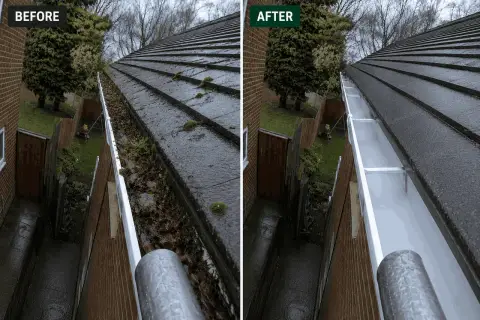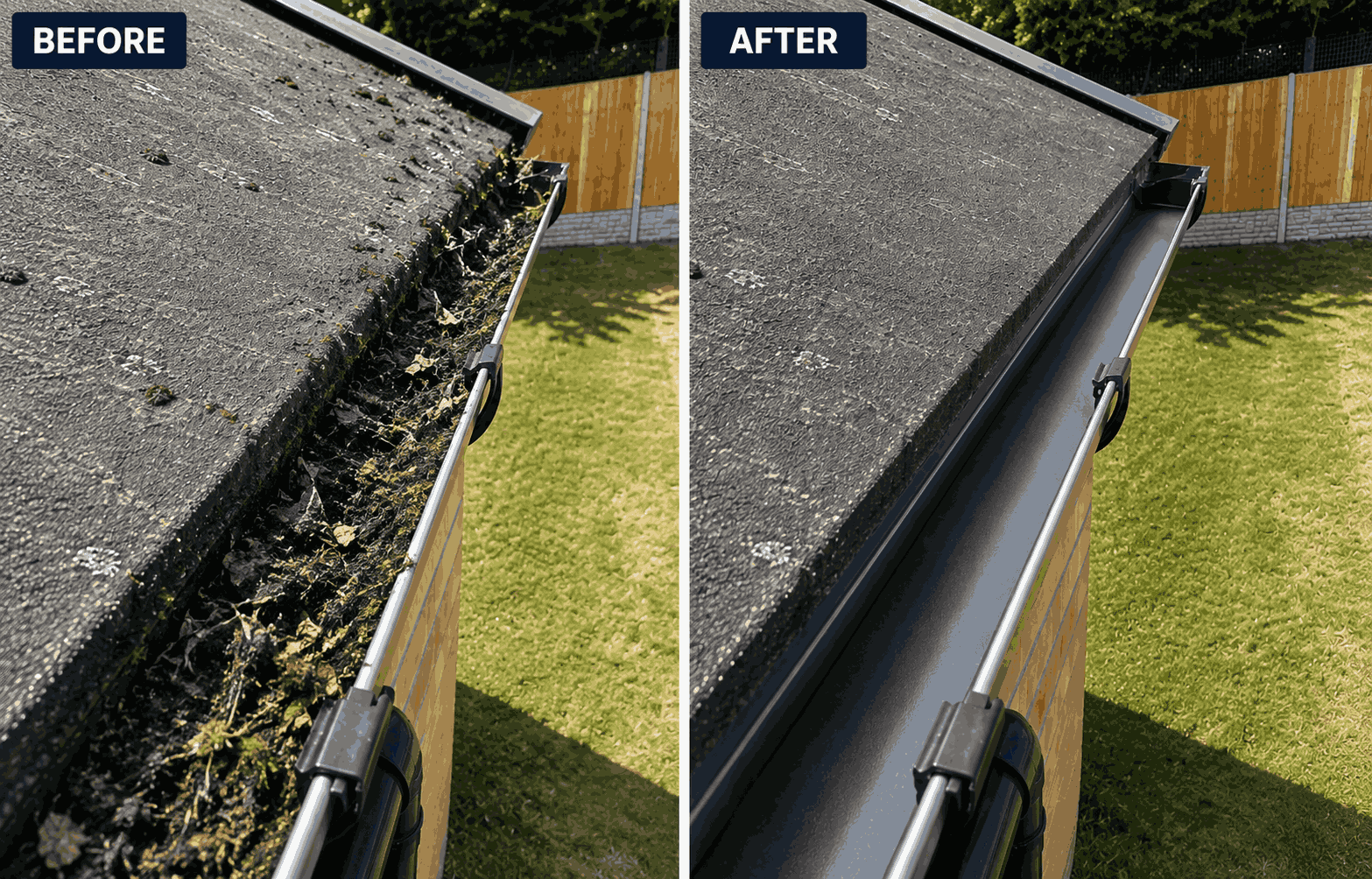

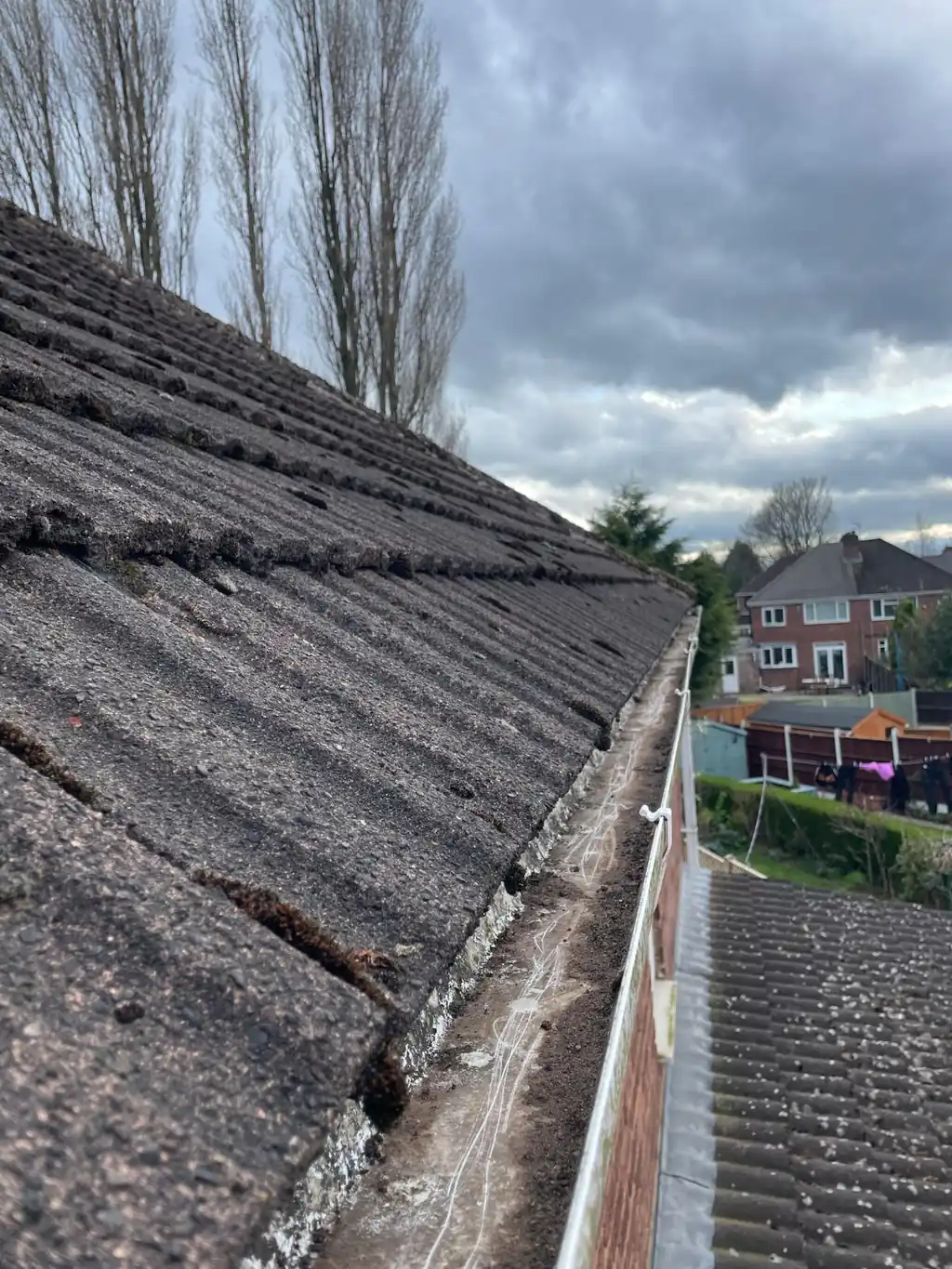
Gutter guards — also called leaf guards, gutter filters, gutter mesh or gutter protection — are a popular product for Birmingham homeowners who are tired of booking a clean every year. The pitch is appealing: fit a guard once and forget about gutters. The reality is more nuanced. This guide explains what the five main types actually do, what none of them can fully prevent, and when they are genuinely worth the investment for a home in Birmingham. It is general guidance, not a recommendation for a specific product.
📞 WOW Gutters Ltd: 07421 433910 | 📋 Request a free quote
Quick verdict: Gutter guards work — but not as advertised. They reduce blockage frequency, not eliminate it. The best case is extending your cleaning interval from 12 months to 18–24 months. The worst case (wrong product for your tree type) is a guard that holds debris on top of the gutter while blocking access below. For heavy-canopy Birmingham gardens, they are a useful tool, not a solution.
Why Birmingham Gardens Make This Question Important
Birmingham has one of the highest urban tree canopy rates of any UK city. Mature oak, sycamore, lime, horse chestnut and silver birch overhang residential gutters across Moseley, Harborne, Sutton Coldfield, Kings Heath, Acocks Green, Edgbaston and beyond. A house under a large sycamore can have its gutters completely blocked within six weeks of leaf fall. That is the problem gutter guards are designed to address.
But the debris in Birmingham gutters is not just leaves. It is also:
- Moss spores washing from roof tiles
- Sycamore seed pods (helicopters) — small enough to pass through most mesh
- Grit and mineral debris from ageing roof tiles
- Bird droppings and nesting material
- Algae growth inside the channel itself
No guard filters all of these. Understanding what your specific problem is — heavy leaf fall, moss, seed pods, all of the above — determines whether a guard helps and which type to choose.
The Five Main Types of Gutter Guard
1. Mesh / Micro-Mesh Guards
How they work: A fine or medium mesh screen sits across the top of the gutter channel. Large debris (leaves, twigs) rests on top and is blown or washed off. Water flows through the mesh into the channel.
✔Works well for: Large-leaf trees (oak, chestnut, sycamore leaves), properties with moderate debris load, standard half-round and square-profile gutters.
✗Limitations: Fine debris (grit, seed pods, moss spores) passes through or accumulates on the mesh surface. The mesh itself can become a surface for moss growth. Heavy leaf fall can sit on the mesh and prevent water flowing through — causing the gutter to overflow even though it is technically clean below.
💡Birmingham verdict: Best all-round option for most Birmingham homes. Micro-mesh (finer aperture) outperforms standard mesh for sycamore seed pods but costs more and needs cleaning more frequently. Plan to brush or rinse the mesh surface every 12 months even if the channel itself is clear.
2. Foam Inserts
How they work: A porous foam block sits inside the gutter channel. Water flows through the foam; leaves and debris rest on top and (in theory) blow away.
✔Works well for: Very low debris environments — a property with no overhanging trees and minimal moss.
✗Limitations: In Birmingham's wet, shaded gutters, foam inserts become saturated with moss within 12–18 months. Roots from moss and weeds grow through the foam. Fine debris compacts into the foam surface and cannot be removed without replacing the insert entirely. Once mossy, the foam holds more water than it channels.
⚠Birmingham verdict: Not recommended for most Birmingham properties. The wet climate and tree cover create conditions where foam inserts frequently make the problem worse. We regularly find foam inserts that have become solid blocks of compacted moss and seed material.
3. Brush Inserts
How they work: A cylindrical bristle brush (similar to a large bottle brush) sits inside the gutter. The idea is that leaves rest on the bristles while water flows between them.
✔Works well for: Light debris loads, autumn leaf management on properties with one or two trees.
✗Limitations: Bristles trap seed pods, fine grit and moss rhizomes between them. Clearing a brush insert covered in compacted debris is significantly more time-consuming than clearing a bare gutter. Brushes also move in heavy rainfall, leaving gaps.
💡Birmingham verdict: Adequate for lightly-treed properties; problematic for heavy canopy. If you have sycamore or lime nearby, brush inserts are likely to trap seed pods at a rate that creates blockages faster than a bare gutter would.
4. Reverse-Curve / Surface-Tension Guards
How they work: Water clings to a curved surface and follows it into the gutter; leaves and large debris fall over the edge due to their weight and momentum.
✔Works well for: High-volume water scenarios (steep roofs, heavy rain) where the physics of surface tension are most effective.
✗Limitations: In heavy downpours — which Birmingham sees frequently — water overshoots the curve and misses the gutter entirely, defeating the purpose. Fine debris still follows the water path into the channel. These guards are also significantly more expensive to install.
💡Birmingham verdict: Generally not cost-effective for UK residential properties. The heavy-rain overshoot problem is a known issue in climates with intense rainfall events, which Birmingham increasingly experiences.
5. Solid-Cover / Helmet Guards
How they work: A solid cover spans the gutter opening with a small slot at the front edge. Water runs over the cover, curves around the front edge and drops into the gutter through the slot.
✔Works well for: Heavy leaf-fall properties where the primary goal is keeping leaves out of the channel.
✗Limitations: The slot at the front edge still admits fine debris. The slot can become clogged with compacted grit or moss, completely blocking water entry. Access for inspection and cleaning requires removing the cover, adding cost and complexity to every maintenance visit.
💡Birmingham verdict: Reduces leaf intrusion effectively but does not eliminate maintenance. Confirm before purchase how the cover is removed for access — some designs require professional tools to remove without damage.
What No Gutter Guard Can Prevent
What passes through or around every type of guard
⚠Moss spores — microscopic, pass through any mesh and grow on wet surfaces inside the channel. This is the main reason guarded gutters still need occasional cleaning.
⚠Roof grit and mineral dust — fine particles from ageing or mossy tiles wash through any mesh aperture above approximately 1mm.
⚠Algae growth — gutters that hold any moisture grow algae regardless of what is covering them.
⚠Sycamore and ash seed pods (samaras) — the small "helicopter" seeds are typically 8–15mm in length and pass easily through standard mesh. Only micro-mesh (aperture under 2mm) blocks them, and even then pods accumulate on the mesh surface.
⚠Bird debris and nesting material — birds often push debris into or through guards.
The practical implication: a guarded gutter will need professional cleaning every 18–24 months on average (versus every 12 months for most Birmingham unguarded gutters), not never. If a salesperson tells you a guard eliminates the need for cleaning entirely, that is not accurate for UK climates.
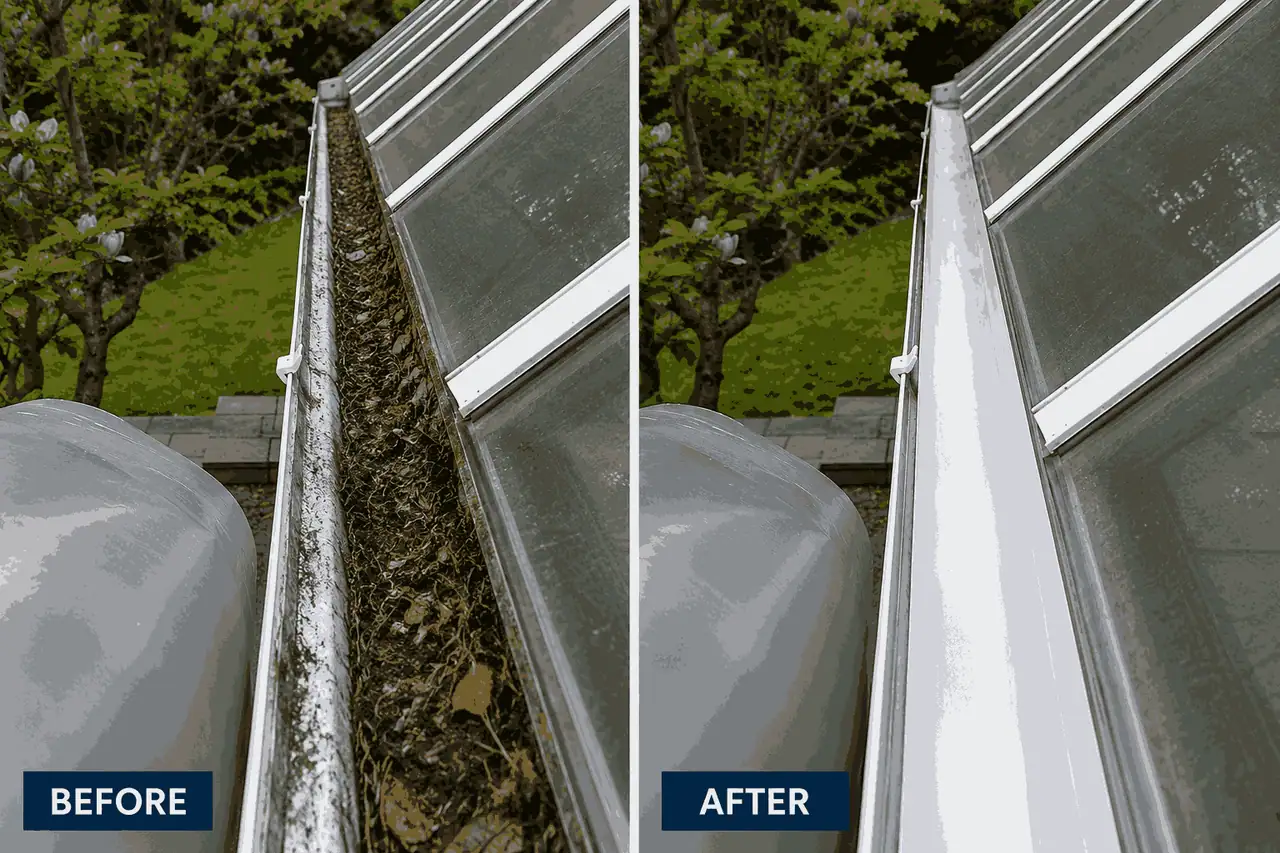
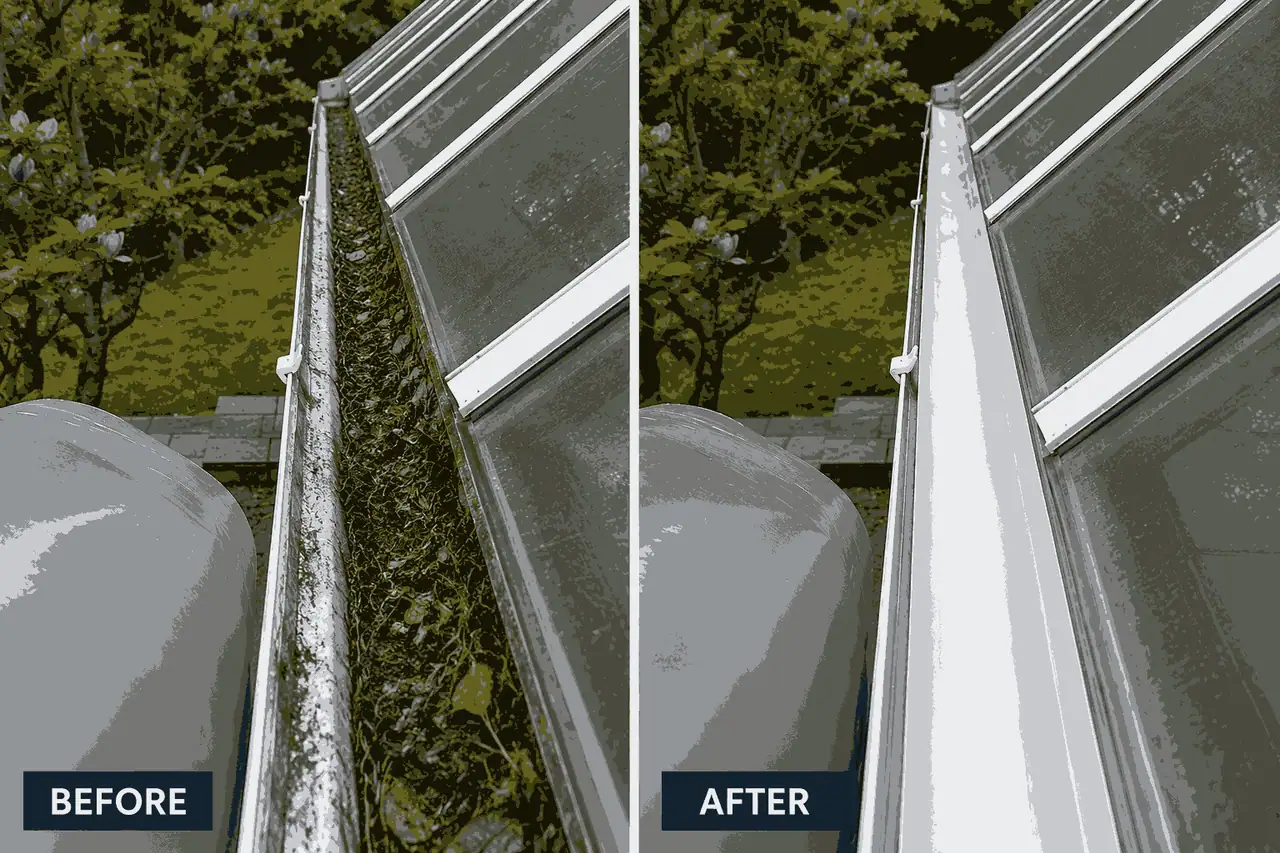
Before and After: What Tree Cover Does to Gutters


The before and after above is from a Birmingham property with a large sycamore overhanging the rear gutter — a classic heavy-debris scenario. Even with a standard mesh guard fitted, this gutter would accumulate seed pods on the mesh surface and grit inside the channel, requiring a clean every 18 months or so. Without a guard, annual cleaning is typically needed.
When Gutter Guards Are Worth It for a Birmingham Home
Situations where guards genuinely help
✔Three-storey or high-access properties — where scaffolding or specialist equipment is needed for each clean. Reducing cleaning frequency from annual to every 2 years has a significant cost impact.
✔Elderly or mobility-restricted homeowners who want fewer contractor visits and less disruption.
✔Rental properties where a landlord wants to reduce maintenance frequency between tenancies. Fewer cleans means fewer contractor coordination calls.
✔Heavy-leaf properties (oak, chestnut) where gutters currently block 2–3 times per year — a guard with annual cleaning is likely cheaper over 5 years than 2–3 cleans per year with no guard.
✔Properties where downpipe blockages are the main problem — a mesh guard reduces leaf entry and therefore the debris reaching downpipe heads, which is where most blockages form.
Situations where guards are less worthwhile
✗Properties with no significant tree cover — if moss and grit are the main debris source, a guard does little. The moss problem is on the roof, not in the trees.
✗Standard annual-clean properties — if your gutters are cleaned once a year and the cost is straightforward, a guard's upfront installation cost takes many years to recoup in cleaning savings.
✗Older uPVC or cast iron guttering in poor condition — fixing or replacing the guttering is a better investment than fitting a guard to a system that already has joint or bracket problems.
✗Heavy sycamore or lime cover — seed pods and sticky honeydew residue challenge every type of guard. The cleaning interval reduction may be less than expected.
What to Check Before Buying
Six questions to ask any supplier
1.What is the mesh aperture size? For sycamore seed pods, you need under 3mm. For standard leaf cover, 5–8mm is adequate.
2.How is it cleaned? Can moss and debris be brushed off the top without removing the guard? Or does the guard need to come off for every clean?
3.Does it fit your gutter profile? Half-round, square-line, ogee and cast iron profiles all need different fittings. A guard fitted to the wrong profile either falls off or doesn't seal.
4.What is the warranty and what does it cover? Some guards carry product warranties but no installation warranty. If the mesh corrodes or the fixings fail, what is covered?
5.Does fitting a guard void any existing gutter warranty? Some uPVC gutter systems have manufacturer warranties that specify no modifications.
6.What is the realistic cleaning interval after fitting? Ask for this in writing. If the answer is "you'll never need to clean again," that is not credible for a Birmingham property.
The Alternative: Increase Cleaning Frequency Instead
For some Birmingham properties — particularly those with sycamore or lime over the rear gutters — the most cost-effective approach is not a guard but a second annual clean in October, before the main leaf fall peaks. Two targeted cleans a year (October and November/December) often costs less over five years than fitting a guard and still needing annual cleaning.
See our guide to timing: How Tree Type Changes Your Autumn Gutter Schedule | Gutter Cleaning 2027: Birmingham Homeowner's Complete Annual Plan
Frequently Asked Questions
Do gutter guards actually work in the UK?
Yes, with realistic expectations. Mesh guards in particular reduce blockage frequency meaningfully on leaf-heavy properties. The UK climate — consistent rainfall, damp conditions, significant tree cover — means no guard eliminates the need for occasional cleaning. The honest benefit is extending the cleaning interval from 12 months to 18–24 months on most properties.
What is the best gutter guard for a sycamore tree?
Micro-mesh with an aperture of 2–3mm is the most effective for sycamore seed pods. Standard mesh (5–8mm aperture) allows the smaller pods through. Even micro-mesh will accumulate a mat of pods on the surface during heavy seed fall — this needs to be brushed off annually. No guard fully solves the sycamore problem; it only reduces it.
How much do gutter guards cost to fit in Birmingham?
Cost varies significantly by guard type, gutter profile and linear metres. Foam and brush inserts are cheapest (DIY-possible). Mesh systems fitted by a contractor to a standard semi-detached are typically mid-range; solid cover or micro-mesh systems on larger properties cost more. Get at least two written quotes and ask each supplier to specify the product, aperture size and fitting method.
Can I fit gutter guards myself?
Foam and brush inserts can be fitted from a ladder without specialist tools. Mesh systems require cutting to length and clipping or screwing to the gutter edge — feasible DIY but working at height is a risk. Solid cover and micro-mesh systems fitted along a full roofline are best left to a contractor with appropriate access equipment. Never work from an unsupported ladder on a first or second-floor gutter — use a ladder with a stabiliser or book a professional. See our safety note: December Gutter Safety: Why Not to Climb.
Should I clean gutters before fitting a guard?
Always. Fitting a guard over debris traps it in place and makes it harder to clear later. Book a professional clean first, confirm the gutter channels, brackets and downpipes are all in good condition, and then fit the guard. This also gives you a baseline — the contractor can tell you whether the guttering is worth protecting or whether replacement is a better investment.
Gutter Repair or Replace: How to Decide | What a Professional Gutter Clean Includes
Does WOW Gutters Ltd fit gutter guards?
We focus on cleaning, unblocking and repair across Birmingham and the West Midlands. If you are considering a guard, we can advise on whether your current guttering is in a suitable condition to protect, and what debris type is causing your blockages — which helps you choose the right guard product. Call 07421 433910 or request a quote.
Summary: Honest Verdict on Gutter Guards for Birmingham
The honest summary
✔Mesh guards are genuinely useful for heavy-leaf properties — they extend the cleaning interval and reduce emergency blockages during heavy rain.
✔Micro-mesh is worth the extra cost if sycamore seed pods are your main problem — but plan to brush the surface annually.
✗Foam inserts are not recommended for Birmingham's climate — they become a moss trap in damp, shaded conditions.
✗No guard eliminates cleaning — moss, grit and fine debris require periodic attention regardless of product.
💡Always clean before fitting and ensure the existing guttering is structurally sound — a guard on a rotting fascia or cracked channel just delays the inevitable repair.
📞 WOW Gutters Ltd: 07421 433910 | 📋 Request a free no-obligation quote — Birmingham and the wider West Midlands.
Related reading: What Happens If You Never Clean Your Gutters | 9 Clogged Gutter Symptoms to Check From the Ground | Gutter Cleaning Cost Guide Birmingham