
The assumption most Birmingham homeowners carry about gutter work is that it belongs in autumn.
Leaves fall. Gutters block. The connection is obvious, the timing feels logical, and the urgency that drives bookings arrives naturally when the first October downpour produces that familiar cascade of water over the gutter edge. So people call in October. They get their gutters cleared. The job is done.
What they do not realise is that a significant proportion of what should have been found during that visit — joint sealant failure, a bracket that has dropped and created a pooling low point, a fascia board that has been softening since spring, a crack in a UPVC channel section — was either invisible in wet conditions, obscured by running water, ambiguous on a damp surface, or simply too late to repair before the wet season tested it to failure.
None of this is the fault of the contractor. It is the fault of the season.
Dry summer weather does not just make gutter work more comfortable. It makes it measurably more accurate, more complete, and more revealing. Faults that hide in November are visible in July. Surfaces that are ambiguous when wet are unambiguous when dry. Repairs that are uncertain in cold damp conditions are reliable in warm dry ones. And everything found in summer has months of lead time before the demands of autumn and winter arrive to test it.
This article explains specifically what dry conditions reveal, why it matters for Birmingham properties in particular, and what a professional summer gutter inspection from WOW Gutters Ltd delivers that an autumn visit simply cannot match.
WOW Gutters Ltd — Birmingham's gutter specialists
07421 433910Why Conditions Matter So Much to Gutter Inspection Accuracy
A gutter inspection is only as good as what it can see. And what it can see is directly determined by the conditions in which it is carried out.
This is a principle well understood in other maintenance disciplines. A damp survey carried out after sustained rainfall produces different results than one carried out after a dry period — because moisture levels affect what the instruments detect. A roof inspection carried out in overcast conditions misses detail that clear daylight reveals. A structural survey carried out on freshly painted surfaces cannot assess what the paint is covering.
Gutter inspection is subject to the same principle. The conditions in which the inspection happens determine what can be accurately identified, what is ambiguous, and what is effectively invisible.
Autumn and winter inspections in Birmingham are carried out in the conditions that make gutter inspection least accurate. Rain is frequent. Surfaces are consistently wet. Temperatures are low. Debris in the gutters is waterlogged and compacted. Running water obscures surfaces that would otherwise tell a clear diagnostic story. And anything found needs to be repaired in conditions where repair materials perform below their optimal specification.
Summer inspections are carried out in the opposite conditions. Surfaces are dry. Debris is loose and extractable. Running water is absent, meaning every surface shows its actual condition rather than being obscured by rainfall. And anything found has weeks or months of good weather in which to be properly addressed.
The difference in diagnostic accuracy between a summer inspection and an autumn one is not marginal. It is substantial. And for Birmingham homeowners whose older housing stock carries less tolerance for missed defects than modern builds, that difference has real financial consequences.
Eight Things Dry Summer Weather Reveals That Wet Autumn Conditions Hide
1. Joint Sealant Failure — Precisely Located
A gutter joint that has failed — sealant cracked, rubber seal deteriorated, or the joint simply opened through repeated temperature cycling — leaves a distinct and localised story in dry conditions. The residue of water that has been tracking through that joint during past rainfall events dries on the fascia board behind it as a specific stain, often with a rust streak on cast iron systems, always at the exact location of the failure.
In dry summer conditions, that stain is unambiguous. It tells you precisely which joint has failed and exactly where on the fascia board water has been tracking. There is no other explanation for a localised stain of that specific character in that specific location. The diagnosis is certain.
In wet autumn conditions, water runs down every surface during rainfall. The entire fascia board is wet. The specific weep from a failing joint is entirely indistinguishable from the general surface moisture covering everything. Finding the exact source of a joint failure during an October inspection in the rain requires the kind of close-up investigation that is difficult and slow in poor conditions — and is still less certain than the clear dry-weather evidence that makes the same failure obvious in July.
The practical consequence: failing joints found in summer are resealed in good conditions before they have damaged the fascia behind them. Failing joints missed in wet autumn conditions run water down the fascia all winter, softening timber that may eventually require replacement rather than a simple reseal.
2. Gutter Fall Angle Problems — Visible From Biological Evidence
A gutter run must slope slightly downward toward the downpipe outlet — typically around 3mm of fall per metre of run. A bracket that has dropped, or was never fixed at quite the correct angle, creates a low point in the run where water pools permanently rather than draining away.
In dry summer conditions, a low point in a gutter run announces itself through the biological growth that accumulates at that specific location and nowhere else — algae, moss, a darker staining at the base of the channel floor at that precise point. Water has been sitting there. The evidence is clear, specific, and permanent.
In wet conditions, the same low point holds pooled water that looks identical to the rainwater sitting in every other section of gutter after a shower. There is nothing to distinguish the structural low point from normal post-rainfall water in adjacent sections. Identifying it requires more investigation and more inference than the dry-season evidence requires.
A dropped bracket identified in summer is a straightforward resetting job. Left unidentified through autumn, the low point fills with debris that sits in permanent standing water, accelerating corrosion in metal gutters, encouraging persistent biological growth, and adding weight to a bracket that has already failed.
3. Fascia Board Condition — Soft vs Sound, Unmistakably
The fascia board behind the gutter is what holds the gutter brackets in place. A fascia board that has been subjected to repeated moisture — through sustained overflow or joint failure — begins to soften from the surface inward. The difference between a sound fascia board and one that has started to deteriorate is immediately apparent to touch and observation in dry conditions.
A dry sound fascia board is firm, consistent in colour, with paint adhered cleanly to the surface. A dry deteriorating fascia board shows paint beginning to lift, slight surface discolouration, and yields slightly to pressure in a way that sound timber does not.
In wet conditions, every timber surface is damp. Every fascia board feels slightly soft when it has been rained on. The specific softness of deterioration is genuinely hard to distinguish from the general surface dampness of a board that is actually sound but simply wet. Experienced operatives can make this assessment in wet conditions — but not with the same certainty or speed as in dry ones.
Identifying a deteriorating fascia board in summer means addressing it before an autumn gutter loaded with wet leaves adds the weight and stress that pulls the bracket from compromised timber. Missing it in autumn means the gutter load of winter is borne by a bracket in rotting wood.
4. Silt Layer Depth and Distribution — Visible and Measurable
Fine silt — mineral particles washed from the roof surface over months of rainfall — settles at the base of the gutter channel and hardens over time. This layer does not produce obvious blockage symptoms. It simply reduces the effective depth of the channel, leaving less headroom for the heavy rainfall and debris of autumn and winter.
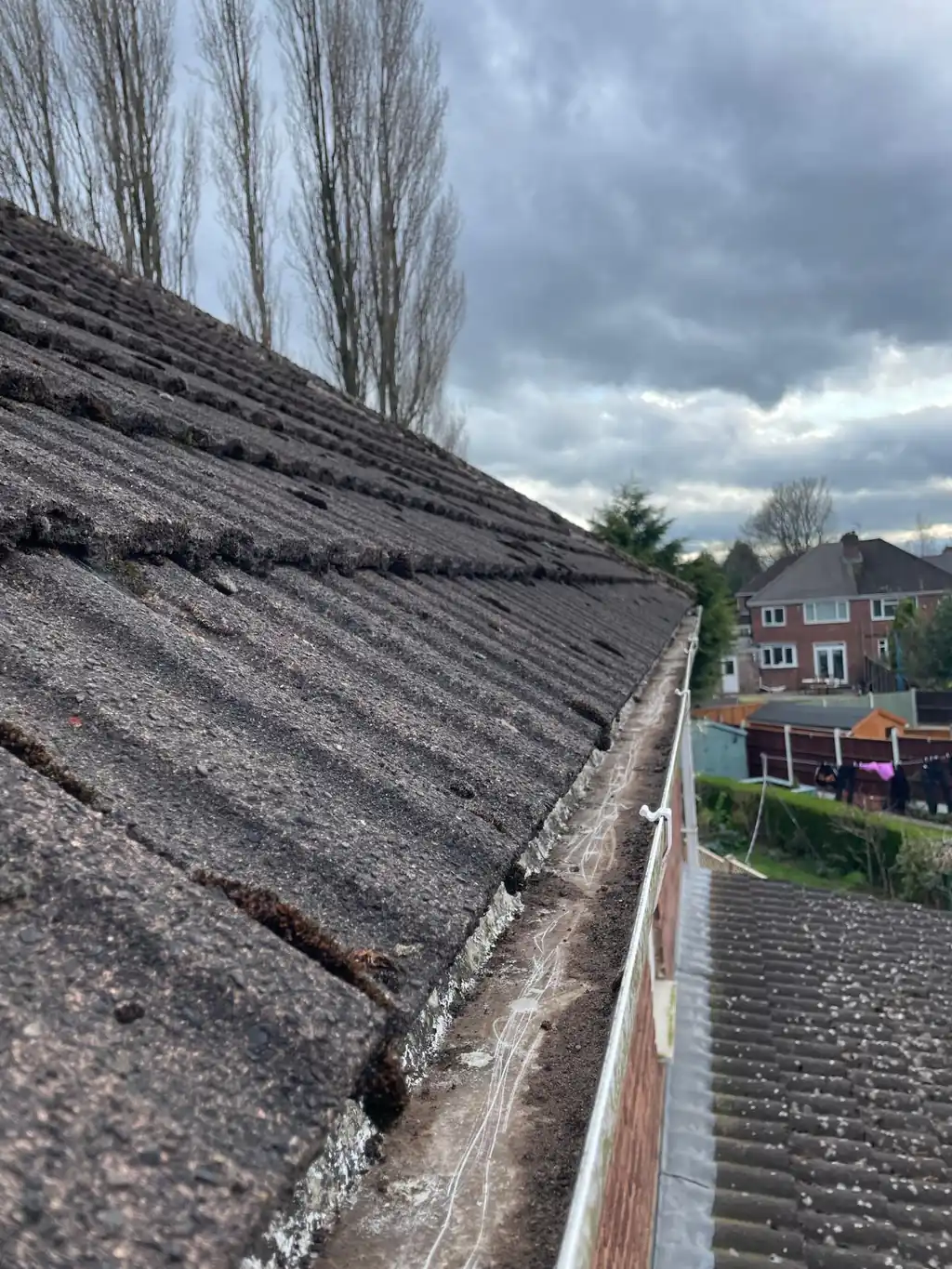
In dry summer conditions, the silt layer is clearly visible as a distinct horizontal band of compacted mineral material at the channel floor. Its depth can be assessed. The areas of worst accumulation can be identified. And its removal by industrial vacuum can be visually confirmed as complete — the clean channel floor is unmistakable against the residue of silt.
In a waterlogged autumn gutter, the silt layer is submerged beneath wet debris. It is indistinguishable from the general mass of wet material filling the channel. Whether it has been removed or simply covered by the wet extraction is difficult to confirm with certainty until the channel dries — which does not happen during autumn maintenance.
5. Hairline Cracks and Channel Splits — Obvious Against a Dry Background
UPVC gutter channels develop hairline cracks through UV exposure, temperature cycling, and physical stress over years of service. These cracks are inconsequential in light summer rain but become active leak points under the sustained volume of heavy autumn and winter downpours — running water into the void behind the gutter and down the fascia board every time rainfall exceeds a moderate rate.
In dry conditions, a hairline crack in a UPVC channel is a clear, visible feature against the uniform pale surface of the gutter interior. Camera inspection reveals it immediately. In wet conditions, the same crack has water running through it and across the surface around it — making it visually very similar to normal wet gutter surface that has no crack at all.
Catching cracks in summer means addressing them before they become active leak points in October. Missing them in autumn means they are already leaking before anyone notices them.
6. Downpipe Inlet Condition — Clearly Visible
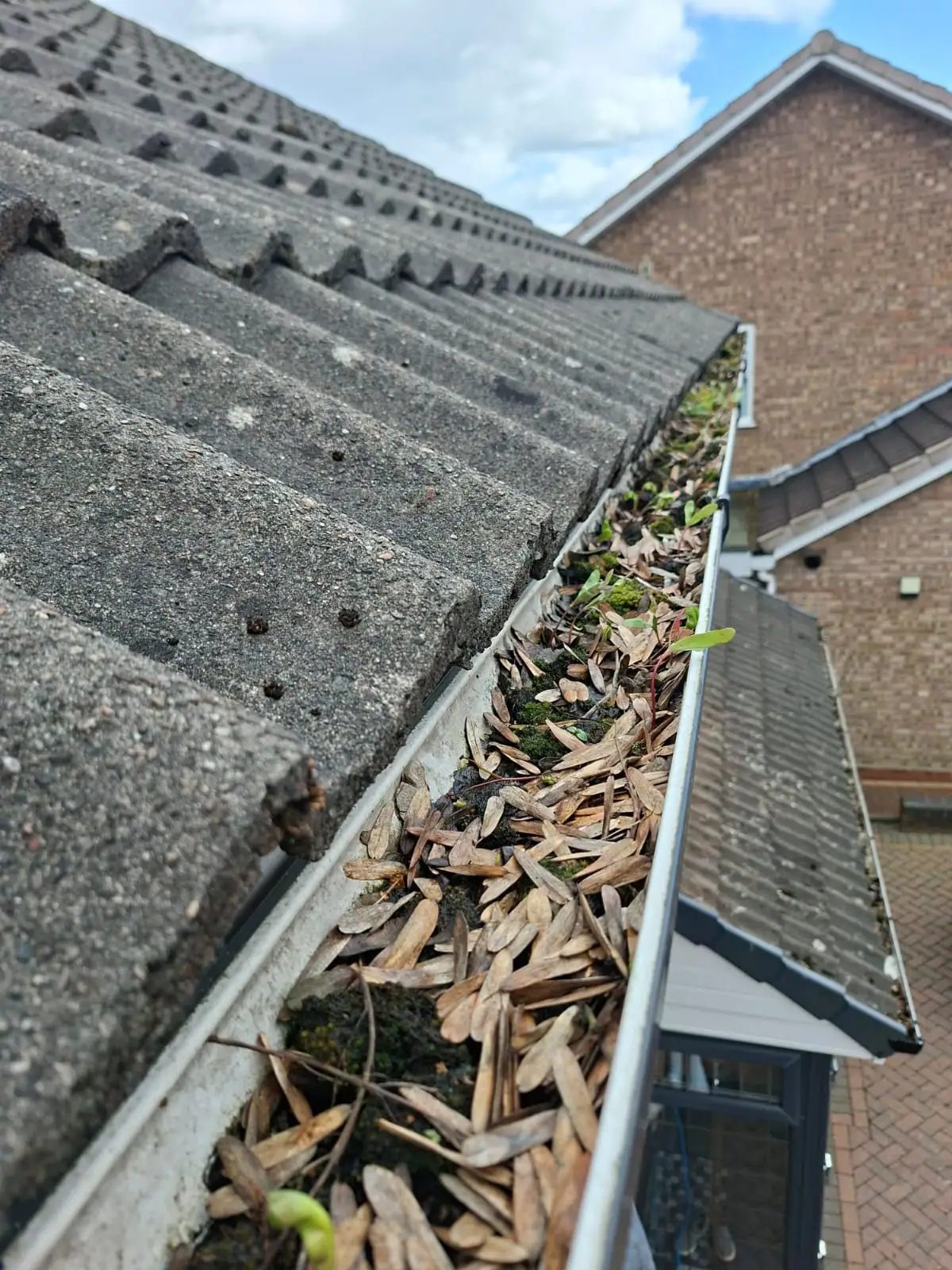
The inlet where the gutter outlet meets the downpipe is one of the most common blockage points in any gutter system. Debris — leaves, seed cases, nesting material — accumulates at this inlet, eventually forming a plug that restricts or stops downpipe flow entirely while allowing the gutter channel above it to appear clear.
In dry summer conditions, the downpipe inlet can be viewed directly through the camera inspection head with clear visibility. The condition of the inlet — clear, partially obstructed, or fully blocked — is immediately apparent. Any debris present is loose and dry, making it straightforward to extract completely.
In wet autumn conditions, the inlet has water running through it or standing water above it. Assessing the degree of obstruction requires flow testing rather than visual inspection, and any debris present is waterlogged and more resistant to extraction than dry material.
7. Moss and Algae Coverage on the Roof Surface — Assessable in Full
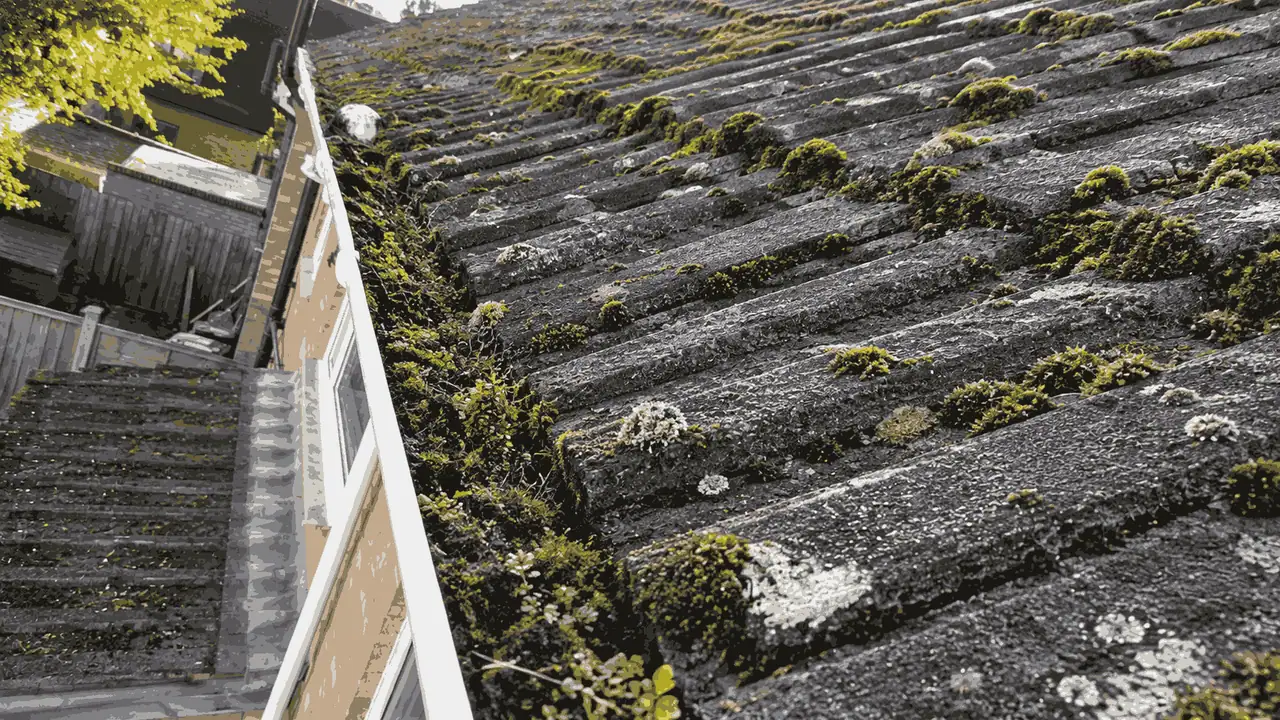
From the elevated vantage point of a camera inspection head, the roof surface above the gutter line is visible during a professional clean. In dry summer conditions, moss coverage — its extent, thickness, and distribution across each roof section — is clearly assessable. Algae streaking, which shows the paths water regularly follows across the tile surface, is visible against dry slate or tile.
This assessment informs two decisions. First, whether roof moss treatment is warranted — and if so, applied in summer, the biocide is more effective because dry moss tissue absorbs it more thoroughly than wet. Second, which parts of the roof are shedding the most debris into which gutter sections — allowing the maintenance schedule to be calibrated to actual accumulation patterns rather than assumed ones.
In wet autumn conditions, the roof surface is uniformly dark and wet. Moss coverage is much harder to assess accurately because the contrast between mossy and clear sections is reduced significantly when everything is damp.
8. Before and After Photographs — Genuinely Informative
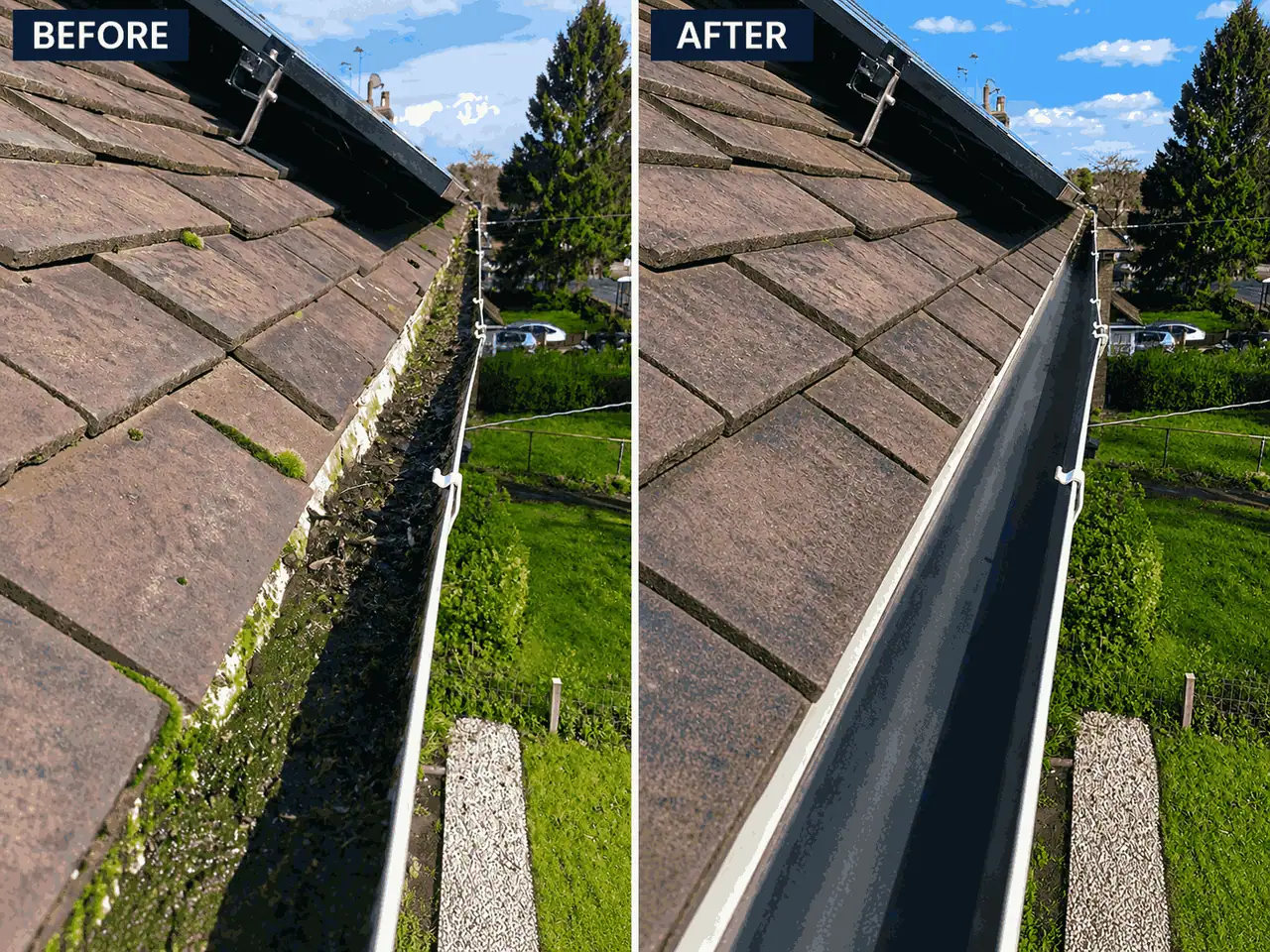
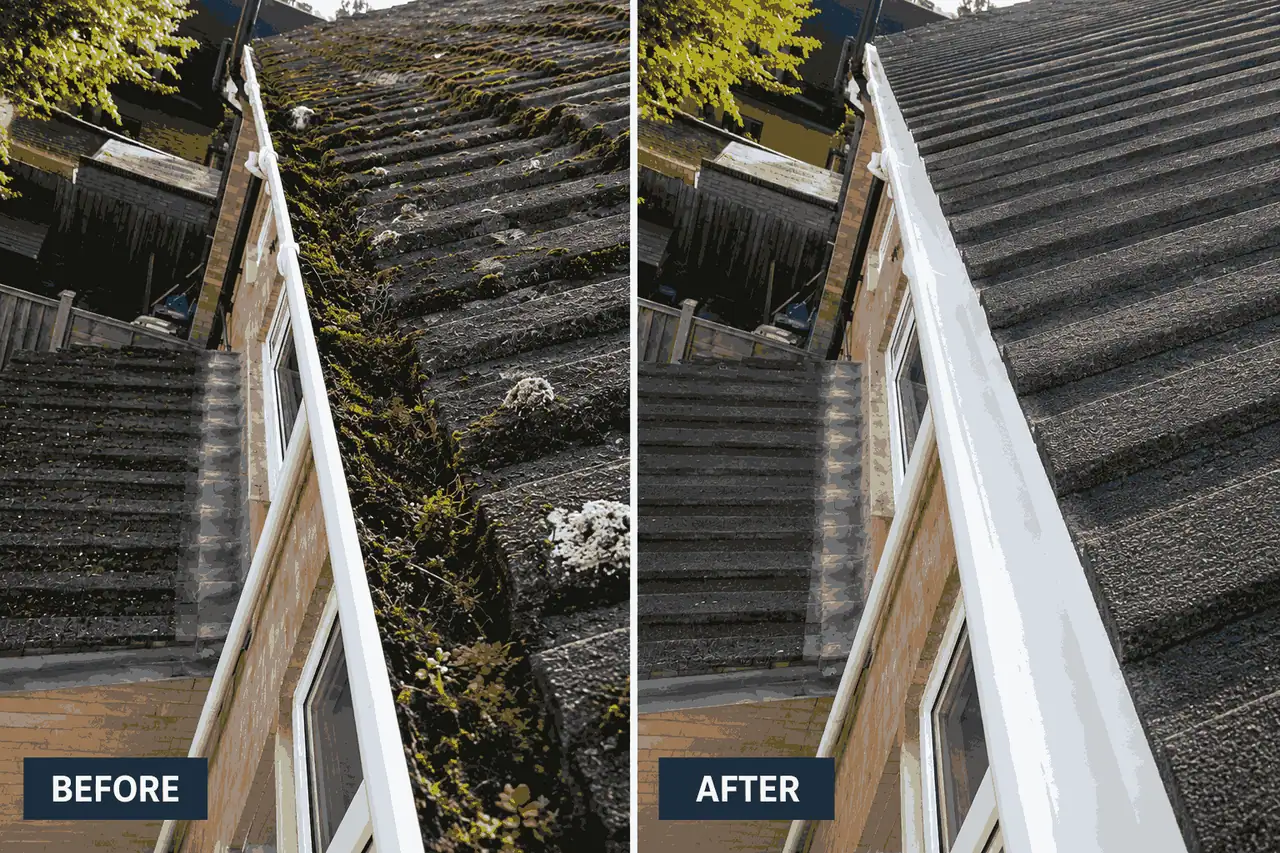
WOW Gutters Ltd provides before and after photographs on every job without exception. The value of those photographs as a condition record and maintenance document is directly affected by the conditions in which they are taken.
A before photograph taken in dry summer conditions shows the gutter interior clearly — the silt layer, the debris type and distribution, the channel floor condition, and the inlet condition all visible in good light against a dry background. The after photograph shows an unmistakably clear channel that confirms complete extraction.
The same photographs taken in wet November conditions show a wet gutter, wet debris, and a wet cleared channel. The contrast between before and after is less clear. The confirmation of complete extraction is less certain. And the condition details visible in dry photographs simply do not appear in wet ones.
For homeowners using these photographs as a maintenance record, and for landlords using them as documented evidence of completed work, the summer photographs are materially more informative and more useful than wet-season equivalents.
Why Repairs Done in Summer Last Longer Than Those Done in Autumn
Finding a problem is only half the value of an inspection. The other half is fixing it — and the quality of repairs is as affected by seasonal conditions as the quality of inspection.
Joint resealing. Gutter sealant is specified to bond to clean, dry surfaces at temperatures above approximately 5°C. A joint resealed in July on a dry fascia board in ambient temperatures of 15–20°C bonds according to its specification and achieves its designed service life. The same sealant applied in November on a damp board in 7°C weather bonds partially, achieves a service life shorter than specification, and may need revisiting within a season.
Bracket resetting. A bracket refixed to dry timber in summer seats with the full mechanical engagement the fixing is designed for. A bracket refixed to damp timber in autumn is being fixed to wood that will move dimensionally as it dries — potentially loosening the fixing before the autumn load has even tested it.
Downpipe clearance. A downpipe cleared of dry material in summer is cleared completely in a single operation. A downpipe cleared of waterlogged compacted material in autumn may need multiple passes to achieve equivalent extraction — and confirming complete clearance through a flow test is easier in dry conditions where the test result is the only water present, not indistinguishable from rainfall.
Summer repairs start from a better position, bond and seat in better conditions, and face their first serious test — Birmingham's autumn and winter rainfall — after a period of cure in good conditions rather than immediately.
Summer vs Autumn Inspection: A Direct Comparison
| Inspection Factor | Summer (Dry Conditions) | Autumn (Wet Conditions) |
|---|---|---|
| Joint failure identification | Precise — localised dry staining on fascia is unambiguous | Imprecise — general surface moisture obscures specific weeps |
| Fascia board condition | Clear — soft vs sound immediately distinguishable | Ambiguous — all surfaces damp regardless of condition |
| Gutter fall angle defects | Visible — biological growth marks low points precisely | Obscured — pooled water looks identical across all sections |
| Hairline cracks in UPVC | Clear — visible against dry background | Obscured — running water across surface hides them |
| Silt layer assessment | Visible — measurable and removal confirmable | Submerged — indistinguishable from wet debris |
| Downpipe inlet condition | Clear — direct visual assessment possible | Requires flow testing rather than direct observation |
| Roof moss coverage | Fully assessable in dry conditions | Reduced visibility — wet conditions mask extent |
| Debris extraction completeness | High — dry material vacuums cleanly and completely | Lower — waterlogged matter compacts and resists extraction |
| Repair quality | Optimal — dry surfaces, ambient temperatures | Suboptimal — damp surfaces, cold temperatures |
| Before and after photography | Clear, detailed, informative condition record | Reduced clarity — wet surfaces obscure detail |
| Lead time for findings | Months before autumn pressure | Days to weeks before peak rainfall |
BOOK YOUR SUMMER INSPECTION
Free quote — no hidden charges. Before and after photos on every job across Birmingham and the West Midlands.
Why Birmingham Properties Benefit Most From Dry-Season Inspections
Birmingham's specific combination of housing stock, tree density, rainfall pattern, and local geology makes accurate summer inspections more valuable here than in many other parts of the UK.
Victorian and Edwardian housing stock across Bournville, Selly Oak, Handsworth, Sparkhill, Kings Heath, and Perry Barr carries original or early-replacement cast iron gutter systems with joint seals that are frequently at or beyond the end of their service life. Identifying a failing cast iron joint in dry conditions — from the precise dry rust stain it leaves on the fascia board behind it — is straightforward and certain. In wet conditions, cast iron running with water makes the same identification genuinely difficult. For properties where cast iron joint failure is a common and recurring maintenance item, summer inspection is the only reliable way to find all the joints that need attention before each winter.
The mature urban tree canopy across Edgbaston, Harborne, Moseley, Sutton Coldfield, and Four Oaks means gutters on these streets accumulate debris faster than properties in more open environments. Understanding the accumulation pattern — which sections fill fastest, which species are depositing what type of debris — helps calibrate the maintenance schedule accurately. This pattern is visible in summer when the debris is distributed as deposited. In autumn it is compressed under leaf fall into a uniform mass that obscures the original accumulation pattern.
Birmingham's consistent year-round rainfall means gutter defects are under load for more months per year than in drier UK regions. A joint that is marginal in a dry climate causes significant damage in Birmingham's wetter one. Finding and addressing marginal defects in summer — when they are clearly visible and repairable — is substantially more effective than finding them in Birmingham's wet months when they are harder to locate and harder to repair correctly.
Clay-heavy soils in parts of the West Midlands mean that sustained water discharge against foundations — from overflowing gutters or downpipes that are depositing water at the base of the wall rather than into the drain — creates subsidence risk over time. A summer inspection that identifies a downpipe not discharging correctly addresses this risk months before it causes progressive ground saturation through winter and spring.
What WOW Gutters Ltd Assesses on a Summer Inspection Visit
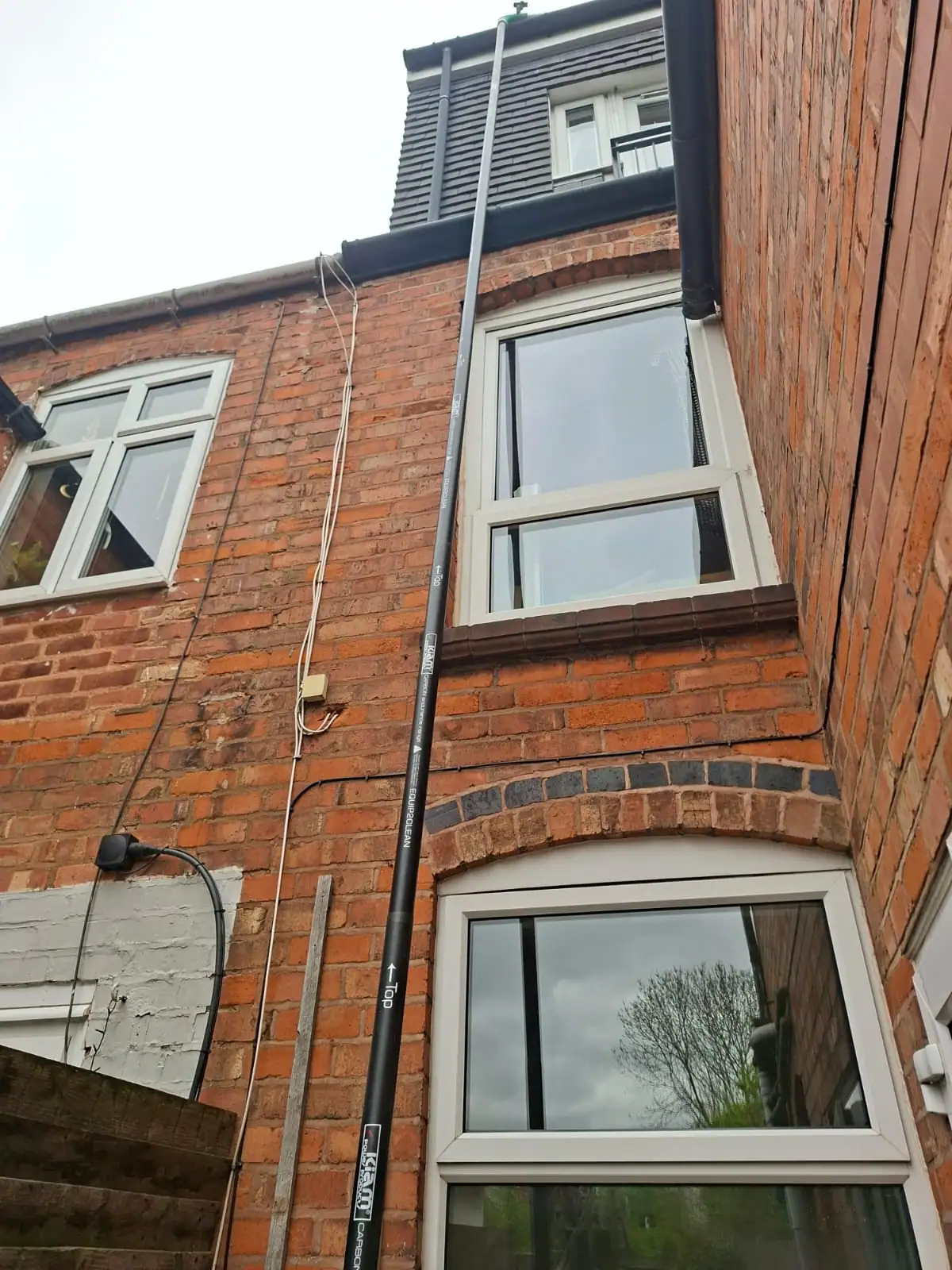
Every WOW Gutters Ltd summer inspection is carried out using our industrial-grade SkyVac gutter vacuum system, operating entirely from the ground. No ladders are placed against your property at any point. Carbon-fibre reach poles extend to four storeys. The camera inspection head provides real-time internal views of the gutter channel in the clear visibility that dry summer conditions allow — views that directly support all eight of the diagnostic advantages described in this article.
- Joint sealant condition — every joint on every run assessed from above in dry conditions, failing joints identified precisely from localised residue patterns
- Gutter fall angle verification — low points identified from biological growth evidence visible only in dry conditions, brackets assessed for correction
- Fascia board condition — assessed in dry conditions where sound and deteriorating timber are immediately and reliably distinguishable
- Debris extraction to channel floor level — dry summer debris vacuumed completely including the silt layer at the base, extraction confirmed visually in clear dry conditions
- Hairline crack identification — channel interior examined in clear light against a dry background through the camera inspection head
- Downpipe inlet condition and flow test — direct visual assessment of inlet condition plus flow testing on every outlet
- Roof surface observation — moss coverage extent, algae streaking, and visible tile condition all assessed from camera head position in summer light
- Before and after photography — produced in the clear conditions that make them most informative, delivered to you on completion of every job
- Written condition summary — specific findings, any repairs recommended, and overall gutter system condition heading into autumn
We cover all Birmingham postcodes and the wider West Midlands. You do not need to be home. Results — including the before and after photographs — are sent to you on completion.
WOW Gutters Ltd — Birmingham's gutter specialists
07421 433910How a Summer Inspection Connects to the Rest of the Maintenance Cycle
A summer inspection is most effective when understood as part of the complete year-round maintenance cycle for a Birmingham property.
Spring (March–April): Clear winter accumulation, inspect for frost-cycle joint damage. Full guide: Birmingham Gutter Maintenance Calendar.
Early summer (June–July): Summer health check and inspection — the dry-condition diagnostic window this article describes. Ideal timing for the most accurate condition assessment of the year. Full guide: Why Every Birmingham Home Needs a Gutter Health Check This Summer.
Late summer (August–September): Clear full summer accumulation including sycamore seeds and nesting debris before autumn leaf fall begins. Full guide: Late Summer Gutter Maintenance: Prepare Your Home for Autumn.
Autumn (October–November): Clear main leaf fall, timed correctly for your specific tree coverage. Full guide: Get Your Gutters Ready Before Birmingham's Autumn Leaves Arrive.
Winter (December–February): Monitor for frost-cycle joint changes. Note conditions for spring attention.
The summer inspection specifically — the dry-condition diagnostic visit — is the most accurate single assessment of your gutter system's structural condition available in the annual cycle. It is the visit that finds what other seasons hide. And it is the one that gives you the longest lead time to act on what it finds.
For the complete guide to what clean gutters protect across all seasons: How Clean Gutters Help Protect Your Home Throughout the Year.