
Most commercial gutter jobs take a few hours. This one took a full day's risk planning before we even loaded the van.
A multi-unit industrial warehouse in Birmingham — canalside on one elevation, hemmed in by mature trees on another, completely inaccessible from the rear — and gutters so badly blocked that established plants were actively growing out of them. Not surface debris. Rooted vegetation. The kind of accumulation that builds up across multiple years of skipped maintenance until the gutter channel functions less as drainage and more as a raised garden bed.
This is the full account of how we approached it, what we found, and what it means for any commercial property manager responsible for a building in similar condition anywhere across the West Midlands.
📞 Need a commercial gutter quote?
Call WOW Gutters Ltd now: 07421 433910
Table of Contents
- The Site and Its Three Access Problems
- What We Found When We Got Up There
- Why We Used Six Safety Harnesses
- How the Clear Was Carried Out Step by Step
- The Real Cost of Blocked Commercial Gutters
- Commercial Gutter Maintenance: What Building Owners Need to Know
- FAQ: Commercial Warehouse Gutter Clearing
The Site and Its Three Access Problems
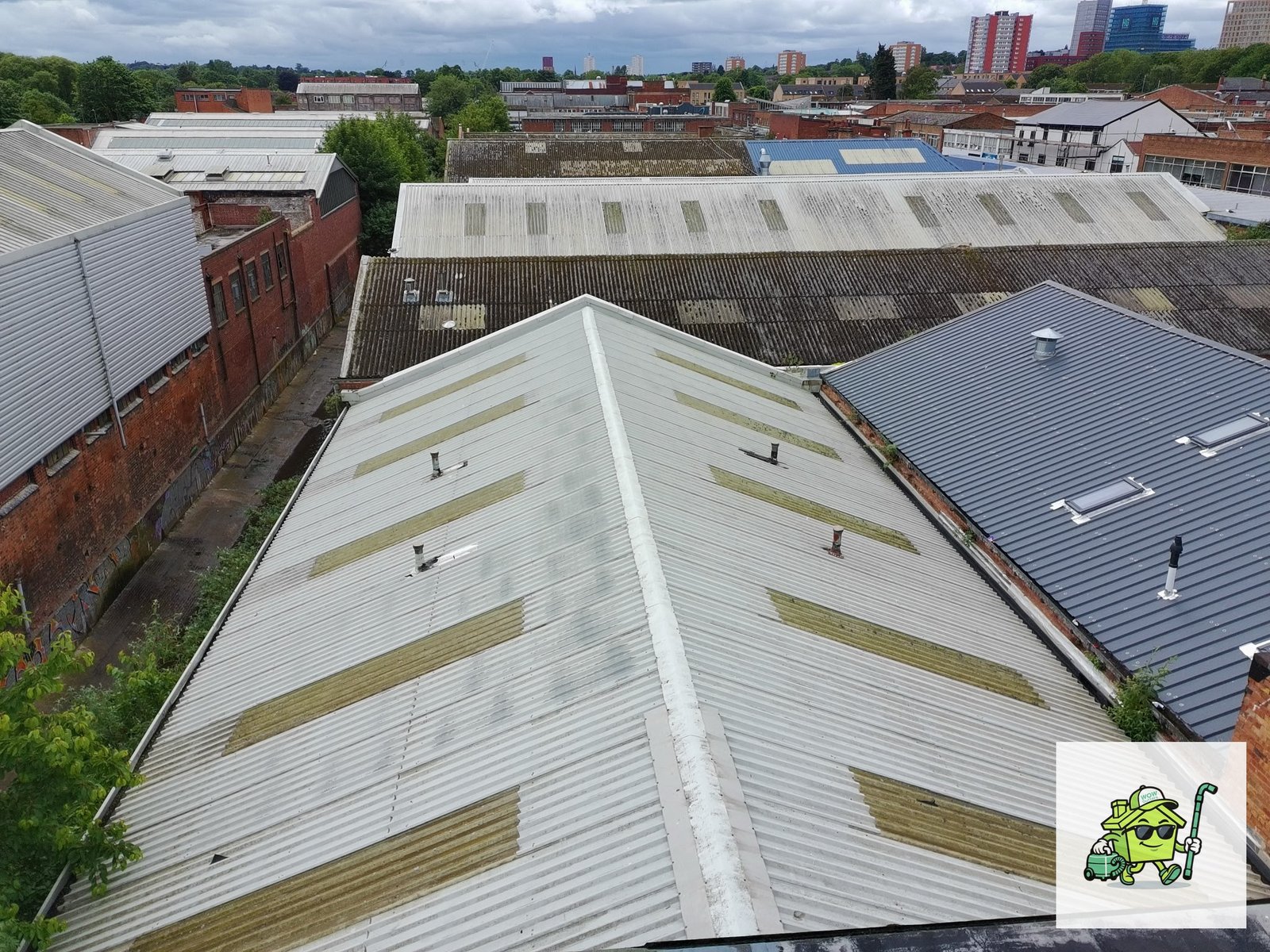
The warehouse sits within one of Birmingham's dense Victorian-era industrial corridors — the kind of tightly packed commercial terrace common to inner-city neighbourhoods across the West Midlands. These buildings were built to maximise every square metre of ground footprint. External maintenance access was never a design consideration. Decades later, that creates genuine problems when the gutters need attention.
When our team arrived for the initial survey, three separate access constraints were immediately apparent.
Challenge 1: Canal on One Full Elevation
One side of the building runs directly alongside a Birmingham canal. There is no working footprint on that side whatsoever — the building edge meets the waterway with no intervening path, bank, or safe standing area. Any fall from height on that elevation would be directly into open water with no rescue access below.
This ruled out ladder access completely on the canalside and required all work to be planned from the roof itself using anchor-based fall-arrest systems.

Challenge 2: Dense Mature Trees on a Second Elevation
The adjacent boundary on the opposite side is completely overgrown with mature trees — the very trees responsible for years of accumulated leaf debris filling the gutter channels. Branches extended onto the roof surface itself in places, obscuring footing and creating additional slip risk. No meaningful approach from ground level was possible on that elevation either.

Challenge 3: No Rear Access at All
The rear of the building is fully enclosed — no service lane, no accessible boundary opening, no approach of any kind. Every operative, every piece of equipment, and every kilo of extracted debris had to move through the single accessible front elevation.

What We Found When We Got Up There
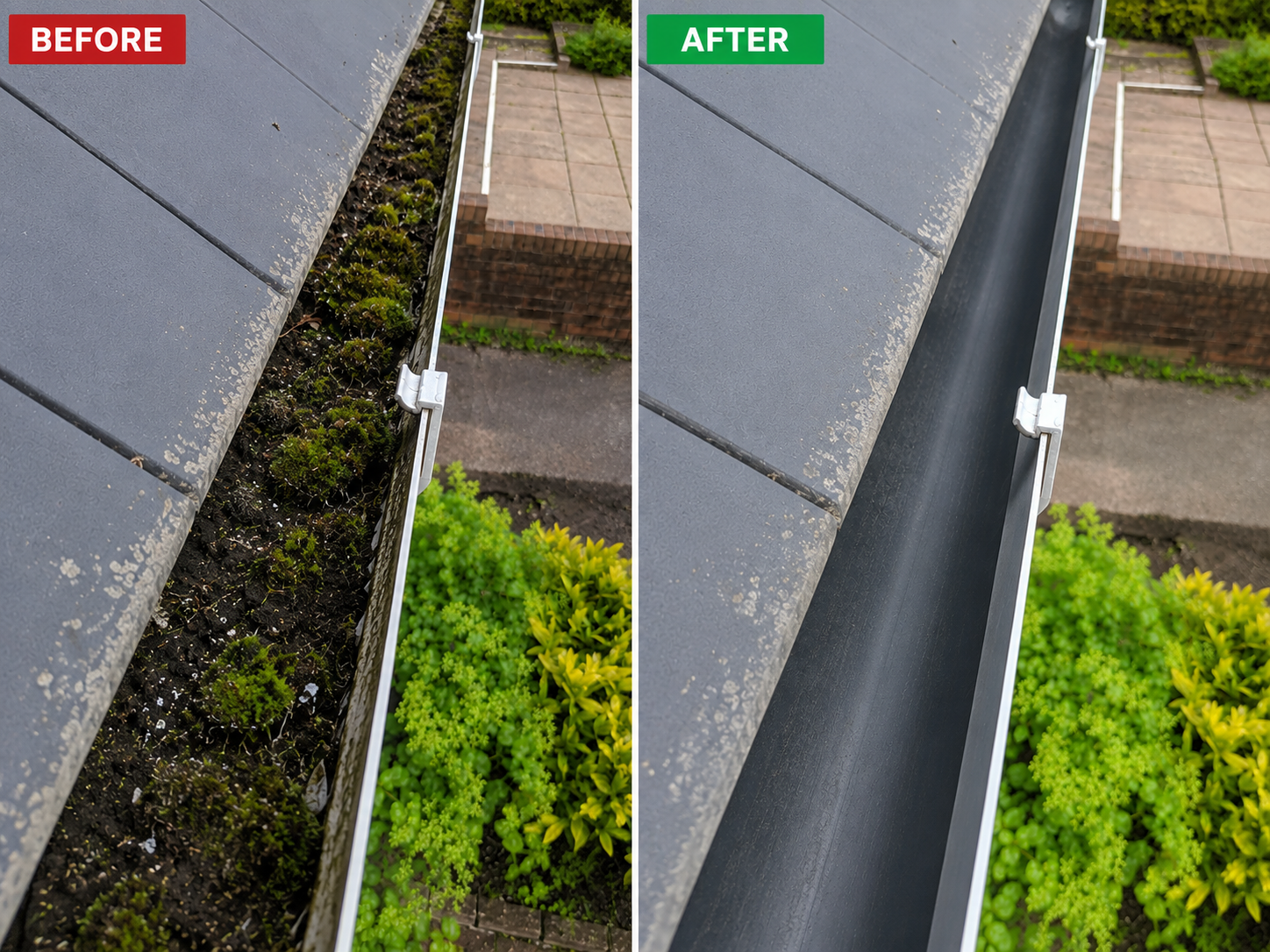
The condition of the gutters matched what you'd expect from years of deferred maintenance in a high-debris environment. These weren't simply blocked. They had become, in the truest sense, garden beds at height.


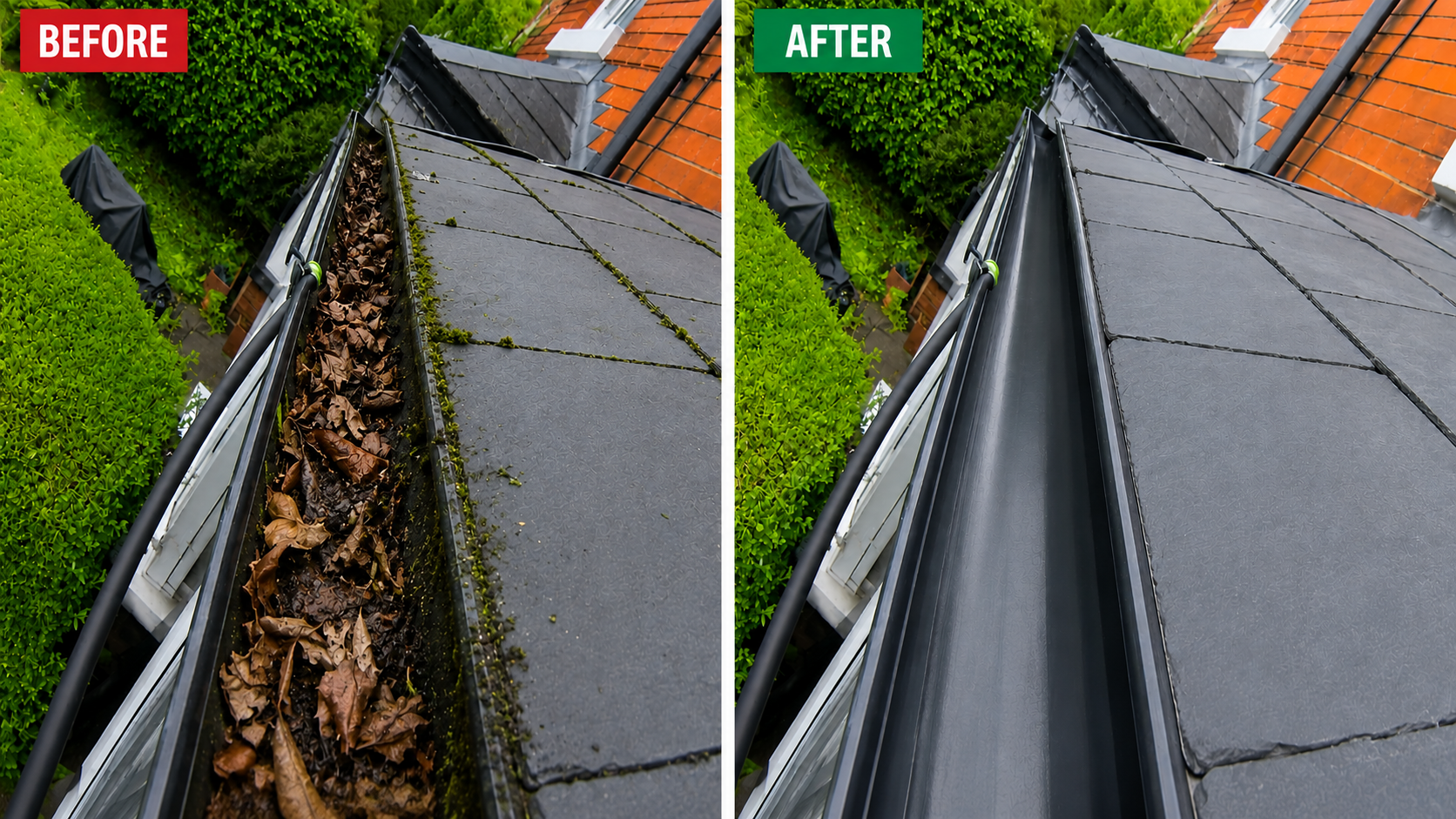
The gutter channels on the tree-adjacent elevation were carrying an estimated two to three inches of compacted leaf matter, bird droppings, seed debris, and standing water. Several downpipe outlets were completely choked.

On the canalside run, a section of gutter had partially separated from its fixing — a direct consequence of the added weight from saturated debris. Standing water had been pooling and sitting in place, accelerating both the organic growth and the physical stress on the gutter fixings themselves.


The moss coverage across the corrugated roof surface was also significant, with algae streaking visible across multiple spans in the aerial photographs.


Why We Used Six Safety Harnesses
Working at height on a commercial building is regulated under the Work at Height Regulations 2005. Every job we carry out includes a written method statement and risk assessment. This site required something considerably more involved than a standard residential clear.
The roof structure comprised multiple spans of corrugated sheeting at varying pitches, with no permanent edge protection installed. The canalside drop was the highest-risk zone — a fall from that elevation would be into water with no rescue point below. The tree-overhang side presented a different but equally serious risk: branches obscuring footing, reduced visibility of gutter condition, and uneven loading at the eave line.

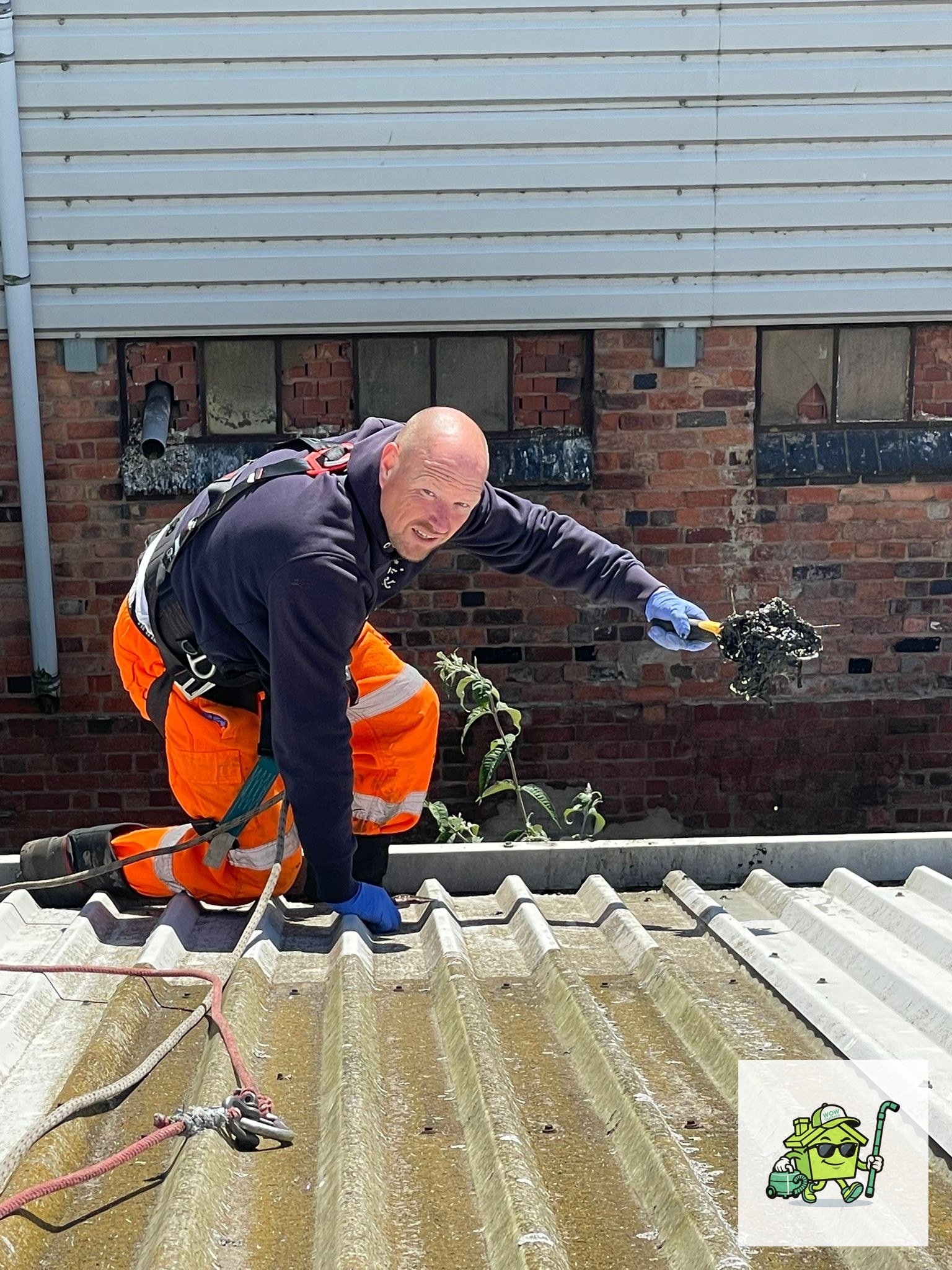

Here's how the six harnesses were deployed across the site:
| Harness | Zone | Risk Controlled |
|---|---|---|
| 1 | Canalside eave — west | Fall into canal, no rescue below |
| 2 | Canalside eave — east | Fall into canal, no rescue below |
| 3 | Tree-side eave | Fall into vegetation, obscured footing |
| 4 | Ridge traverse — span A | Slip on pitched corrugated surface |
| 5 | Ridge traverse — span B | Slip on pitched surface with debris underfoot |
| 6 | Downpipe outlet access | Lean-out risk at outlet clearance points |
Important for commercial property owners: Any contractor working on a building like this without a documented risk assessment and appropriate fall-arrest equipment is putting your building, their operatives, and your own liability at serious risk. Under the Work at Height Regulations 2005, responsibility for ensuring safe access arrangements extends to the person commissioning the work. Ask to see method statements before any contractor goes on your roof.
How the Clear Was Carried Out Step by Step
Once the harness systems were rigged and every operative was confirmed attached, the gutter clear proceeded section by section — working from the front elevation access point outward along each run toward the canalside and tree-side elevations.
- Initial roof-level inspection. Before clearing began, each gutter run was inspected for condition, documenting cracked sections, failed joints, loose fixings, and areas of particular concern. Photographs were taken at each stage to record pre-existing defects clearly separate from any blockage-related damage.
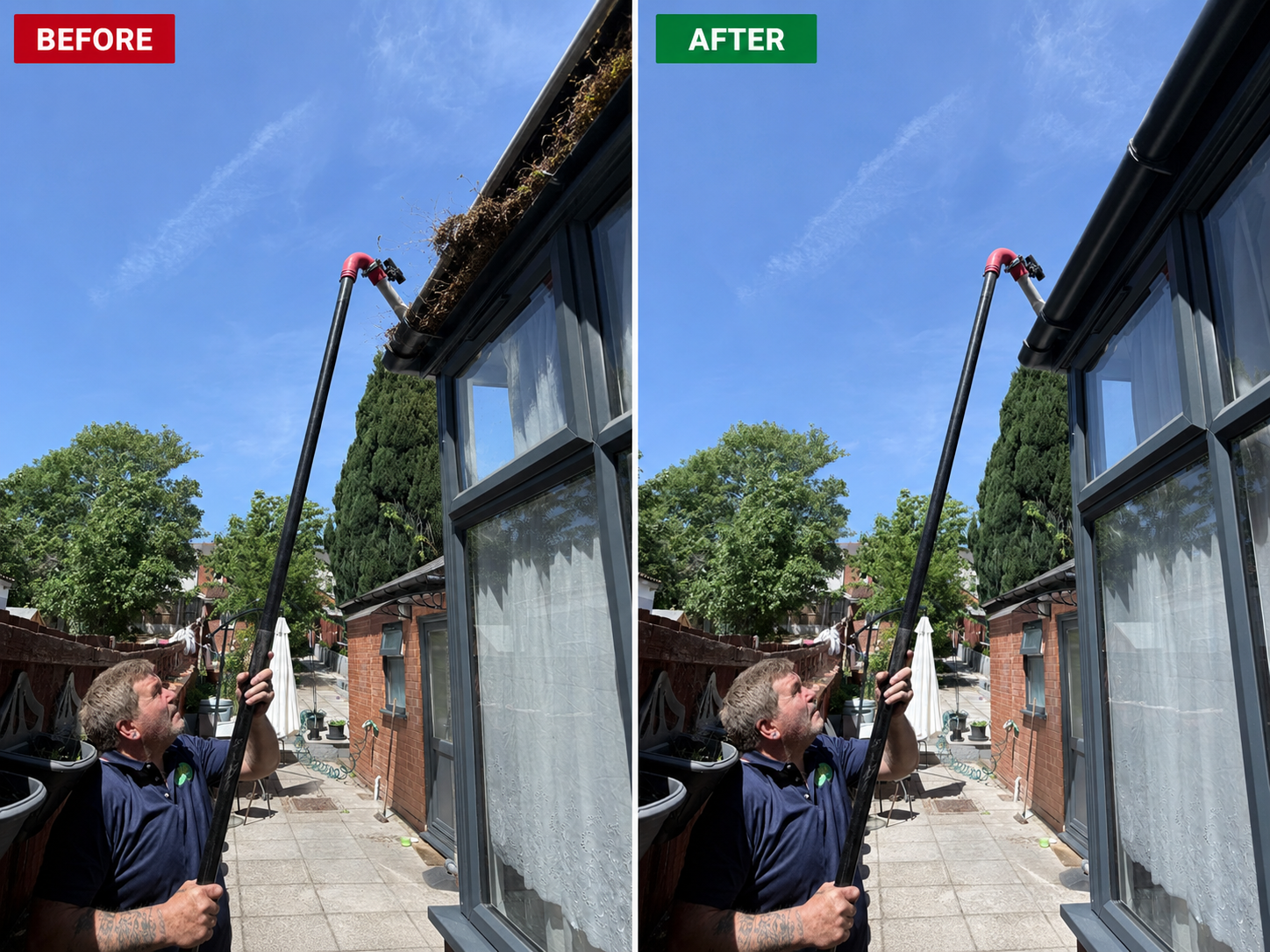
- Vegetation and bulk debris removal by hand. The rooted plant growth and large deposits were removed manually first. This material couldn't be vacuumed without risking damage to already-stressed gutter sections. The extracted volume was considerable.
- Full gutter channel clearance. The channels were cleared along their entire length, working all debris toward downpipe outlets and removing compaction at the base of each channel.
- Downpipe outlet clearance. Each outlet was checked and individually cleared. Several were completely blocked — in one case, the outlet had been sealed so completely that the gutter above had been functioning as a closed retention tank.
- Flow test and documentation. Water was run through each downpipe to confirm clear passage from gutter to ground. Before and after photographs were captured at every section and compiled into a written summary for the property manager.


The Real Cost of Blocked Commercial Gutters
Property managers often treat gutter maintenance as a deferred item — something to deal with when there's a visible problem. The trouble is that the visible problem, a wet ceiling or saturated internal wall, is rarely the beginning of the issue. It's usually the end of a much longer, unseen process.
Water that cannot drain through gutters has to go somewhere. On a pitched corrugated roof like this warehouse, it backs up against the roof edge and finds its way under flashing, through fixing points, and along any horizontal surface until it either evaporates or enters the building. By the time a leak is visible internally, significant damage to insulation, structural timbers, or stored goods may already have occurred.
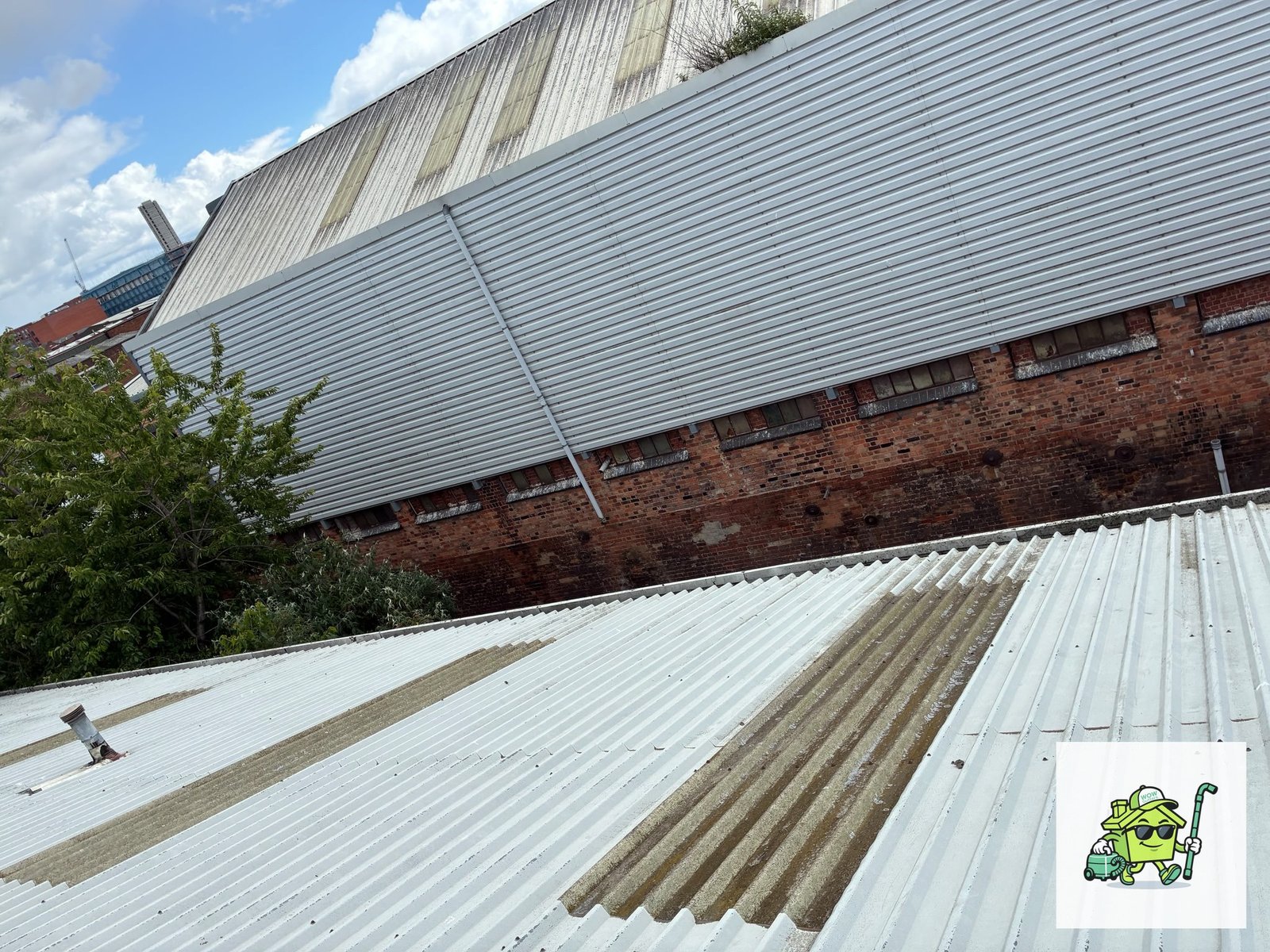

In a warehouse context, the consequences extend beyond the building fabric. Stock damage from an undetected roof leak can run into thousands of pounds before it's noticed. And in buildings with older corrugated asbestos cement roofing — common in Birmingham's Victorian-era industrial stock — water damage to sheeting creates additional compliance risk that goes well beyond the cost of simple gutter maintenance.
The irony is that routine gutter clearing is, by comparison, a modest cost. This job — complex, multi-hazard, requiring specialist rigging — still cost a fraction of what a single episode of stock damage or roof fixing repair would have run to.
Commercial Gutter Maintenance: What Building Owners Need to Know
For commercial and industrial properties across Birmingham, Wolverhampton, Coventry, Redditch, Dudley, Walsall, and the wider West Midlands, twice-yearly cleaning is a minimum baseline — not a ceiling. Buildings with specific risk factors need more frequent attention.
Factors that accelerate commercial gutter blockage:
- Adjacent mature deciduous trees (especially ash, sycamore, and cherry)
- Flat or very low-pitch roof sections where debris accumulates rather than sliding
- High bird activity — nesting material, droppings, and feathers compact quickly
- Moss-covered roof surfaces — fragments wash in continuously
- Long gutter runs with few outlets — debris builds furthest from the downpipe
- Proximity to canals, rivers, or bodies of water — increased airborne organic matter
For a building with several of these factors, as this warehouse had, quarterly inspection and clearing is a sensible baseline programme. During autumn and winter, six-weekly checks are not unreasonable for high-debris sites.
What a proper commercial gutter clear should include:
Every commercial job from WOW Gutters Ltd includes before and after photography of each gutter run, a note of any structural defects observed during the work, and confirmed downpipe flow tests. That documentation matters for building records, insurance requirements, and planned maintenance audit trails.
BOOK COMMERCIAL GUTTER CLEARING
Restricted access, hazardous locations, high buildings — full before and after documentation on every job.
FAQ: Commercial Warehouse Gutter Clearing
Ready to Book Commercial Gutter Clearing?
Restricted access. Hazardous locations. High buildings. Whatever the complexity of your commercial property, WOW Gutters Ltd has the equipment, training, and experience to clear it safely — with full before and after photo documentation on every job.
📞 Call: 07421 433910
💬 WhatsApp: wa.me/447421433910
📧 Email: support@wowgutters.co.uk
🌐 wowgutters.co.uk
Covering Birmingham, Solihull, Sutton Coldfield, Wolverhampton, Dudley, Walsall, Coventry, Redditch, Bromsgrove, Worcester and all West Midlands areas.